Literature & Thought · TALE24 REVIEW
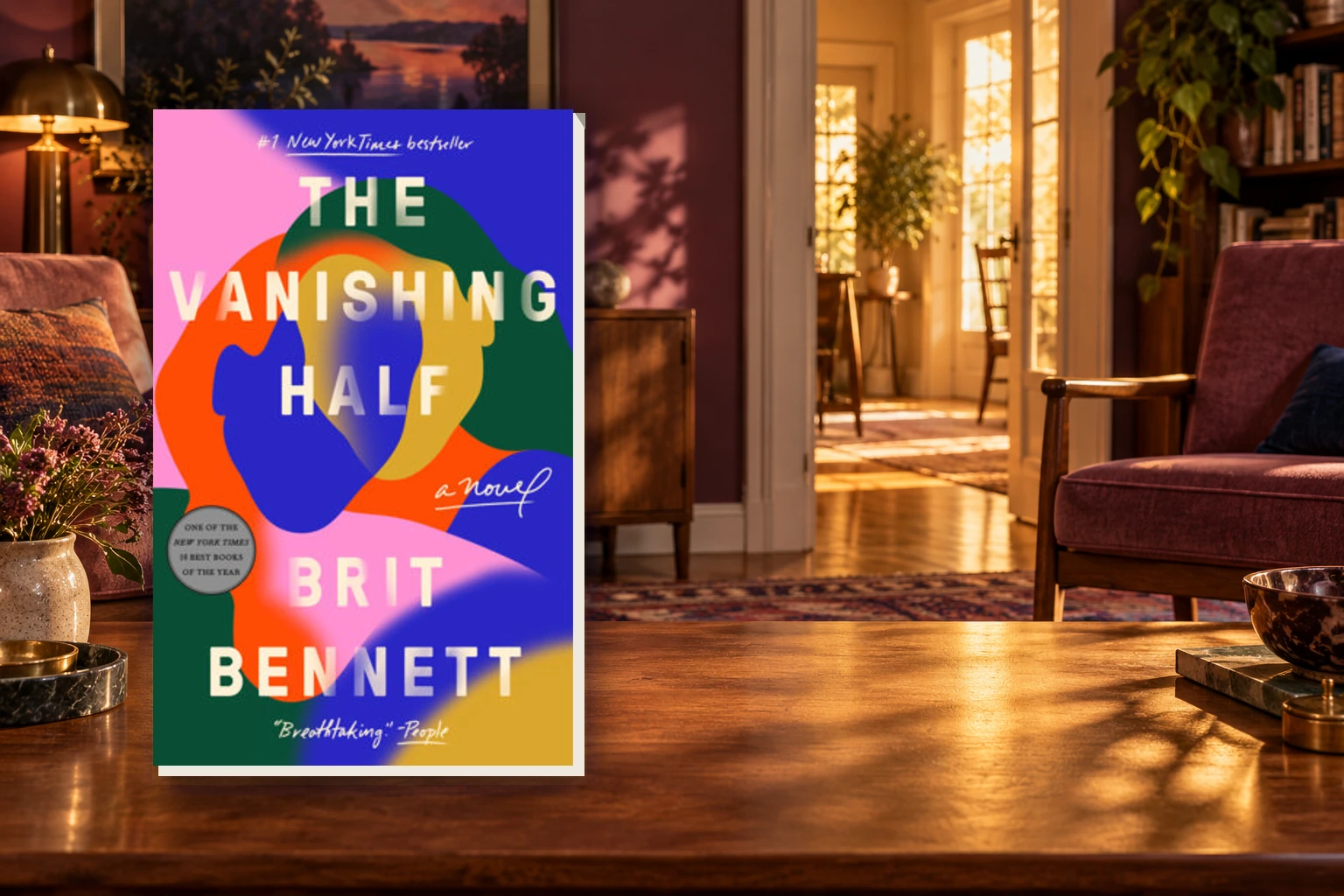
The Vanishing Half: What Reinvention Cannot Erase
Brit Bennett’s intergenerational novel turns the diverging lives of twin sisters into a precise inquiry about racial passing, family memory, and the costs of becoming someone new.
A strong intergenerational design that gives racial passing and family secrecy both personal and historical depth.
In The Vanishing Half, Brit Bennett begins with a structure that seems almost mathematical: two identical sisters leave home and take different paths. One eventually returns to the Southern community they fled; the other lives as a white woman, concealing her history even from her husband. The symmetry gives the novel immediate force, but its deeper achievement lies in resisting a simple comparison of right and wrong choices. Bennett is interested in what each life makes possible, what it demands in payment, and what the next generation inherits without consent.
The publisher describes the Vignes twins as inseparable in childhood and radically divided as adults. Their separation creates suspense, yet Bennett’s premise is more than a family secret waiting to be exposed. Passing is a practice shaped by American racial hierarchy, not merely a private act of disguise. To live within an identity others will accept can offer material safety and access while requiring constant vigilance. The novel’s moral question is therefore inseparable from its social one: what does a country ask people to surrender in order to move through it with less danger?
The sister who remains visibly connected to her Black family carries a different burden. A return home can look like acceptance of origins, but it can also be shaped by narrowed options and persistent memory. Bennett does not need to present staying and leaving as clean opposites. Both involve adjustments to a world that assigns value to appearance, lineage, and place. The twins’ identical faces make the difference in their public lives especially stark. The effect is to expose race as a system of recognition and power rather than a truth a person can settle by looking in a mirror.
The novel moves across generations, and that choice prevents the sisters’ decisions from remaining self-contained. Their daughters encounter identities formed before they were born. Children do not simply repeat their parents, but they grow among stories that have been told, suppressed, or edited for survival. A secret can create distance even when its content is unknown. Bennett’s intergenerational design makes inheritance a matter of atmosphere as well as information: what a family refuses to name may still determine where people feel at home and whom they believe they can trust.
The publisher places the narrative from the 1950s through the 1990s and from the Deep South to California. That geographic and historical movement matters. Reinvention is often imagined as a matter of changing location, as though distance itself could become freedom. Bennett’s wider map tests that hope. New communities may offer other possibilities, but they do not dissolve the categories through which others judge a person. The past travels through documents, kinship, memory, and the habits of self-protection learned early in life.
The book is compelling because its central premise supports several kinds of reading at once. It is a family story with the pull of withheld knowledge. It is a study of colorism and the particular privileges attached to being read as white. It is also an inquiry into performance: the small, repeated acts by which a person maintains a public self. Those layers give a familiar narrative device, the divided twins, historical weight. Their resemblance does not flatten their differences; it makes the pressures that produce those differences harder to ignore.
Bennett’s approach to agency deserves care. To say that a character chooses a life is true only up to a point when the available lives are arranged by discrimination. The novel can recognize the injury caused by secrecy while also acknowledging why a person might cling to it. This is not an excuse for every consequence. It is a refusal to make an individual bear the entire moral meaning of an unjust system. That balance helps keep the sisters recognizable as people rather than examples deployed to prove a thesis.
The structure has an inevitable limitation. A premise built on two divergent lives invites readers to wait for convergence and explanation, and that expectation can occasionally narrow attention to plot mechanics. The broad sweep across years and characters also means that some transitions carry more weight than they can fully dwell upon. Readers who want every relationship examined at the same depth may feel the pressure of the novel’s design. Yet its movement is also what allows Bennett to ask how an early decision alters a family over time, beyond the moment in which it was made.
The book also unsettles the easy praise of authenticity. Demanding that someone reveal a hidden past can sound like a defense of truth, but the demand looks different when disclosure could take away safety or belonging. Bennett’s premise does not make concealment painless. It asks who gets to treat openness as a simple virtue and who must calculate its consequences. That question continues beyond the twins and gives the daughters’ stories a sharper edge.
What stays with the reader is the difference between reinvention and erasure. A new name, place, or social position can change the conditions of a life. It cannot make other people and earlier selves disappear without remainder. Bennett treats that remainder as neither a sentimental call to return home nor a simple punishment for leaving. It can be a longing, a fear, a relationship interrupted, or an opportunity a daughter must find on her own terms.
The Vanishing Half earns its reach by allowing these meanings to coexist. It offers the momentum of a family narrative while asking exacting questions about how race shapes the possibilities of self-creation. Its strongest insight is that identity is lived among other people. The attempt to become new may open a door, but it changes the lives on both sides of it.
EDITOR’S VERDICT
Tale24’s assessment
A strong intergenerational design that gives racial passing and family secrecy both personal and historical depth.
Points to considerThe wide time span can leave some relationships less fully explored than the central premise invites.
Best for: Readers interested in family sagas, American racial history, identity, and the consequences of secrecy.
Editorial method: This is an independent assessment informed by the work and its official supporting information. AI tools may assist the drafting process; Tale24 reviews and takes responsibility for everything it publishes.