Literature & Thought · TALE24 REVIEW
The Last House on Needless Street: Fear Inside an Uncertain Mind
Catriona Ward makes a house, a missing child, and fractured accounts of ordinary life feel unstable from the first pages. Its deeper horror lies in how quickly fear becomes certainty about another person.
Bold shifts in perspective turn a familiar ominous house into a sustained inquiry about memory and judgment.
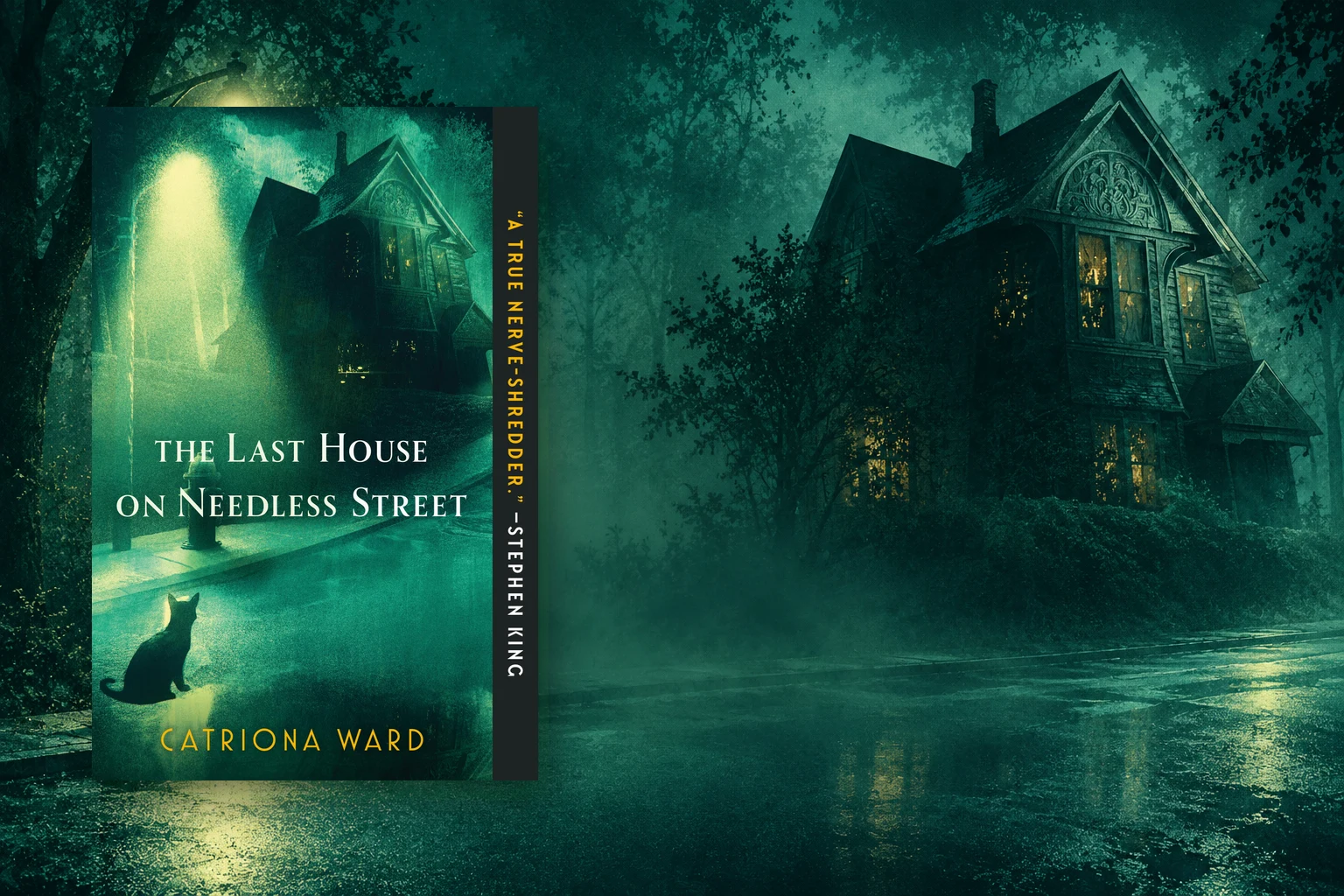
A boarded-up house at the edge of the woods appears to promise a familiar kind of horror: something terrible is hidden inside, and the reader must discover it. Catriona Ward’s The Last House on Needless Street uses that promise, then makes the act of looking much less secure. According to the publisher’s description, the house contains a man troubled by gaps in his memory, a teenage girl who cannot go outside, and a cat with an unexpectedly vivid inner life. A new neighbor brings the pressure of an older mystery closer. These are enticing pieces of a puzzle, but the book’s distinctive force comes from asking how a person decides that a puzzle has only one possible shape.
Ward understands the visual shorthand of the genre. A dead-end street, dark woods, closed windows, and a person who seems unable to give a straight account can all become evidence before anything has been established. Horror often works by making the ordinary environment look newly hostile. Here the environment also reflects a social habit: when a story about danger is incomplete, people fill its gaps with whatever they most expect to find. The house is frightening partly because it seems to invite a verdict. Its boarded exterior suggests concealment, and concealment suggests guilt. Ward lets that chain of inference drive the reading experience while keeping its reliability in doubt.
The shifting points of view are crucial to that doubt. Different voices do more than withhold a single final fact. They give texture to daily routines, fears, and attachments that cannot be reduced to the outside observer’s theory. The cat’s perspective, unusual even in a genre willing to experiment, changes the emotional scale of the narrative. Small domestic concerns sit beside the possibility of extreme violence. That mixture can be disorienting, and it is meant to be. A home can contain tenderness and terror in the same corridor; a reassuring detail does not automatically erase danger, and a disturbing one does not complete the case against its owner.
The novel’s momentum depends on a disciplined refusal to explain itself too early. Each account seems to offer orientation, then shifts the reader’s footing. This is a technical achievement as much as a mood. A twist works best when the earlier material was not empty camouflage; it needs to acquire a different meaning after the reader learns more. Ward builds a narrative in which familiar gothic signs—secrecy, confinement, a strange house—remain powerful while their significance keeps changing. The reader is asked to attend to voice and perception, not simply to collect clues in the hope of winning a race against the author.
That demand can be exhilarating, but it can also feel engineered. The book is carefully arranged to control what its audience knows and when. Some readers will enjoy the sense that every detail might matter. Others may feel that the characters have been bent toward the needs of a large reveal. The line between productive uncertainty and manipulation is especially delicate when a story draws on traumatic experience. Pain should not exist solely to make a final explanation surprising. Ward’s novel is most persuasive when it keeps the emotional lives inside the puzzle visible, allowing fear to coexist with vulnerability instead of turning vulnerability into a mere mechanism.
This is also why a spoiler-free assessment matters. Much of the book’s pleasure lies in the reorganization of its premises, and naming the hidden arrangement would flatten the encounter for a new reader. One can still describe its ethical question without exposing the answer. The novel asks how suspicion forms around incomplete testimony, how memory can be understood or misunderstood, and what happens when outsiders want a clean story more than they want to see a complicated person. These concerns are not decorations attached to a clever structure. They are the reason that the structure leaves an ache after the immediate shock passes.
Ward’s prose and framing make the story more than a sequence of traps. The book can be darkly funny, unsettling, and unexpectedly tender, sometimes in quick succession. This tonal range prevents the house from becoming a simple container for menace. Domestic life has its own habits and comforts, and those habits matter precisely because the surrounding facts feel uncertain. The reader’s dread grows not only from anticipating violence but from realizing that a judgment about the people inside may be badly wrong. The title points to a location, yet the most threatening room may be the mental space where a plausible guess hardens into certainty.
The book is not a clinical account of trauma, memory, or mental health, and it should not be used as one. Its psychological material is shaped by fiction’s needs for metaphor, suspense, and reversal. Some readers will reasonably object to the way a thriller can make suffering into a source of surprise. The novel’s best defense is its insistence that a person is more than the frightening story told about them. Whether that insistence fully offsets the machinery of suspense is a question each reader may answer differently. It is part of the book’s seriousness that the question remains worth asking.
The Last House on Needless Street offers a rare combination of a fast, unnerving reading experience and a reason to distrust the speed of one’s own conclusions. Its elaborate design is visible, and its themes require care from the reader as well as the writer. For those willing to enter a story whose apparent facts may shift, the reward is more than a clever surprise. Ward turns an ominous house into a test of perception: what do we think we know about someone who cannot tell the story in the form we expect, and who benefits when we stop asking?
EDITOR’S VERDICT
Tale24’s assessment
Bold shifts in perspective turn a familiar ominous house into a sustained inquiry about memory and judgment.
Points to considerThe elaborate withholding can feel manipulative, and its trauma-centered design will not suit every horror reader.
Best for: Readers who want literary psychological horror, unreliable perspectives, and a twist without advance spoilers.
Editorial method: This is an independent assessment informed by the work and its official supporting information. AI tools may assist the drafting process; Tale24 reviews and takes responsibility for everything it publishes.