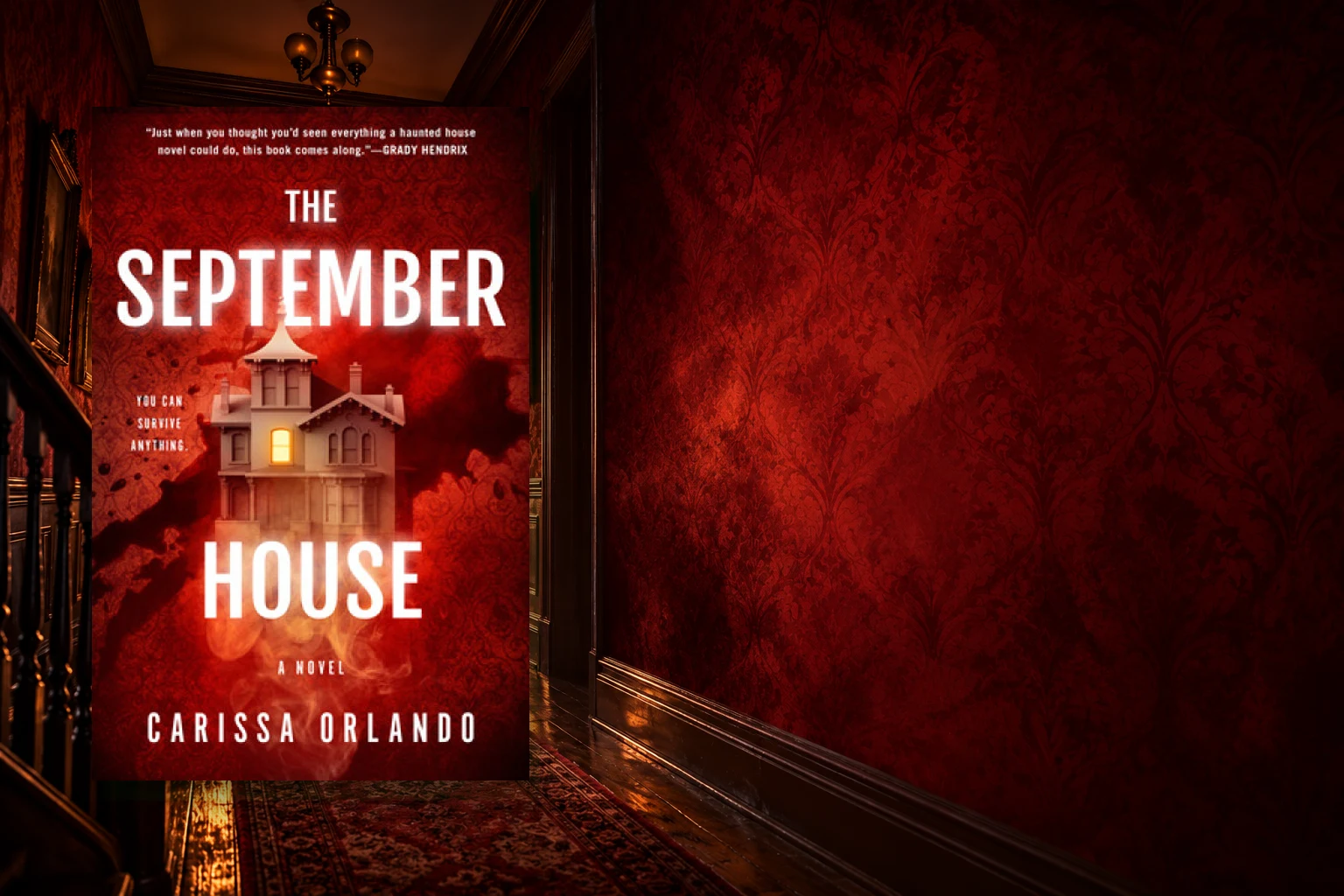
Literature & Thought · TALE24 REVIEW
The September House: When Staying Becomes the Scariest Choice
Carissa Orlando gives a haunted-house story a stubbornly practical heroine who refuses to leave. Her dry routines make the ghosts funny, frightening, and inseparable from the family’s buried tensions.
A vivid, darkly funny narrator refreshes haunted-house conventions and gives the family conflict emotional weight.
Most haunted-house stories begin with a sensible instruction: leave. The September House becomes interesting because its heroine declines it. Margaret and her husband Hal bought a Victorian home on Hawthorn Street, only to discover that every September brings alarming disturbances. The official publisher’s description notes blood on the walls, ghosts of former inhabitants, and a threatening presence in the basement. Hal eventually disappears, and their daughter Katherine arrives to look for him. Margaret, however, continues to insist on staying. Carissa Orlando makes that decision seem at once absurd, admirable, troubling, and deeply revealing.
The premise allows the novel to turn the familiar grammar of horror inside out. A scream, a stain, or a spectral visitor would normally interrupt a household routine and send everyone running. Margaret works the disturbance into the routine instead. Her practicality produces some of the book’s dark humor: the supernatural is not denied so much as managed. That response is funny because it violates our expectations of fear. It is frightening because it suggests a long history of adaptation to conditions nobody should have to accept. Orlando lets both reactions remain active, so a moment of comic control can leave a faint sense of dread behind it.
Margaret’s relationship to the house is more than ownership. Buying a home carries a promise of stability, autonomy, and a place where one’s choices matter. Leaving would mean surrendering that promise after years of effort and attachment. The novel understands why a person might defend an unsafe space, especially when it is also the space she has worked to make hers. This does not make staying a wise choice in ordinary terms. It gives the choice emotional logic. The building is both a setting and a stubborn claim: Margaret wants to decide what her home means, even as the home keeps offering evidence that control is incomplete.
The annual return of September gives the horror a peculiar rhythm. Unlike a single intruder, the haunting is expected. Anticipation becomes part of domestic life; danger acquires a season, and the family must decide what to call normal during the rest of the year. That pattern allows Orlando to connect supernatural escalation with habits of explanation and concealment. When something awful becomes predictable, people may spend more energy managing its appearance than confronting its cause. The book’s most effective unease arises from that recognition. The ghosts are vivid, but so is the social labor of behaving as though the situation can be kept under control.
Katherine’s arrival changes the pressure. A daughter who does not share Margaret’s practiced tolerance sees the house through a different set of expectations, and Hal’s absence makes every explanation consequential. The resulting family tension prevents the novel from becoming a simple contest between a homeowner and a malevolent property. Two people can occupy the same rooms yet inhabit very different accounts of what has happened there. Orlando uses the contrast to explore the difference between endurance and safety. Surviving a place for years does not prove that the place is harmless, and an outsider’s alarm does not automatically capture the whole history of why someone stayed.
The novel’s tonal balance is its signature strength. Margaret’s dry voice gives readers a reason to remain in the house even when a straightforward plot would drive them out. Humor can make a frightening scene bearable without canceling the threat. It also makes the later seriousness sharper: a reader who has enjoyed Margaret’s resourcefulness must reckon with the cost of needing so much resourcefulness in the first place. The comedy is therefore not just relief between scares. It is one of the ways the book tells us how a person protects an idea of ordinary life under extraordinary strain.
Haunted houses are often read as metaphors, and The September House encourages that reading. Yet its value does not depend on translating each ghost into a single real-world referent. The house functions best when its strange events remain fully present as horror while also making domestic secrecy and control more visible. If a reader treats the supernatural only as a code to be solved, some of the book’s pleasure disappears. Orlando gives the haunting texture and pace: doors, rooms, recurring signs, and the physical stubbornness of a building that will not stop being itself. The metaphor works because the house still feels like a place.
There are limits to the approach. The growing catalogue of disturbances may exhaust readers who prefer suggestion to explicit supernatural incident. The connection between family harm and haunting can also feel forceful once the novel draws its strands together. A restrained, ambiguous ghost story would leave more interpretive air. Orlando chooses emotional clarity and escalation instead. That choice suits a book interested in the ways people normalize what hurts them, but it means the story occasionally explains a feeling that its scenes have already conveyed. Readers will differ on whether the payoff justifies that emphasis.
What remains most compelling is the question beneath Margaret’s refusal: when does perseverance become a way of protecting oneself, and when does it become a way of protecting the thing that causes harm? The novel does not reduce her to a lesson or ask us to dismiss the real attachment represented by a home. It allows competence and vulnerability to coexist in one character. That complexity gives the frightening images emotional traction. The ghosts matter because Margaret has a life among them, and because leaving a place can require admitting how much one has already endured there.
The September House is a strong choice for readers who want horror with a recognizable human argument, a voice capable of dry wit, and a house that is vividly more than a backdrop. Its scares are plentiful, but its lasting disturbance is quieter. Orlando asks what people learn to call ordinary when the alternative feels too costly, and whether the determination to stay can finally become the courage to see a home clearly.
EDITOR’S VERDICT
Tale24’s assessment
A vivid, darkly funny narrator refreshes haunted-house conventions and gives the family conflict emotional weight.
Points to considerThe accumulating supernatural incidents can become intense, while the central metaphor may feel emphatic to some readers.
Best for: Readers who like haunted houses, dark humor, and family-centered horror with a strong narrator.
Editorial method: This is an independent assessment informed by the work and its official supporting information. AI tools may assist the drafting process; Tale24 reviews and takes responsibility for everything it publishes.