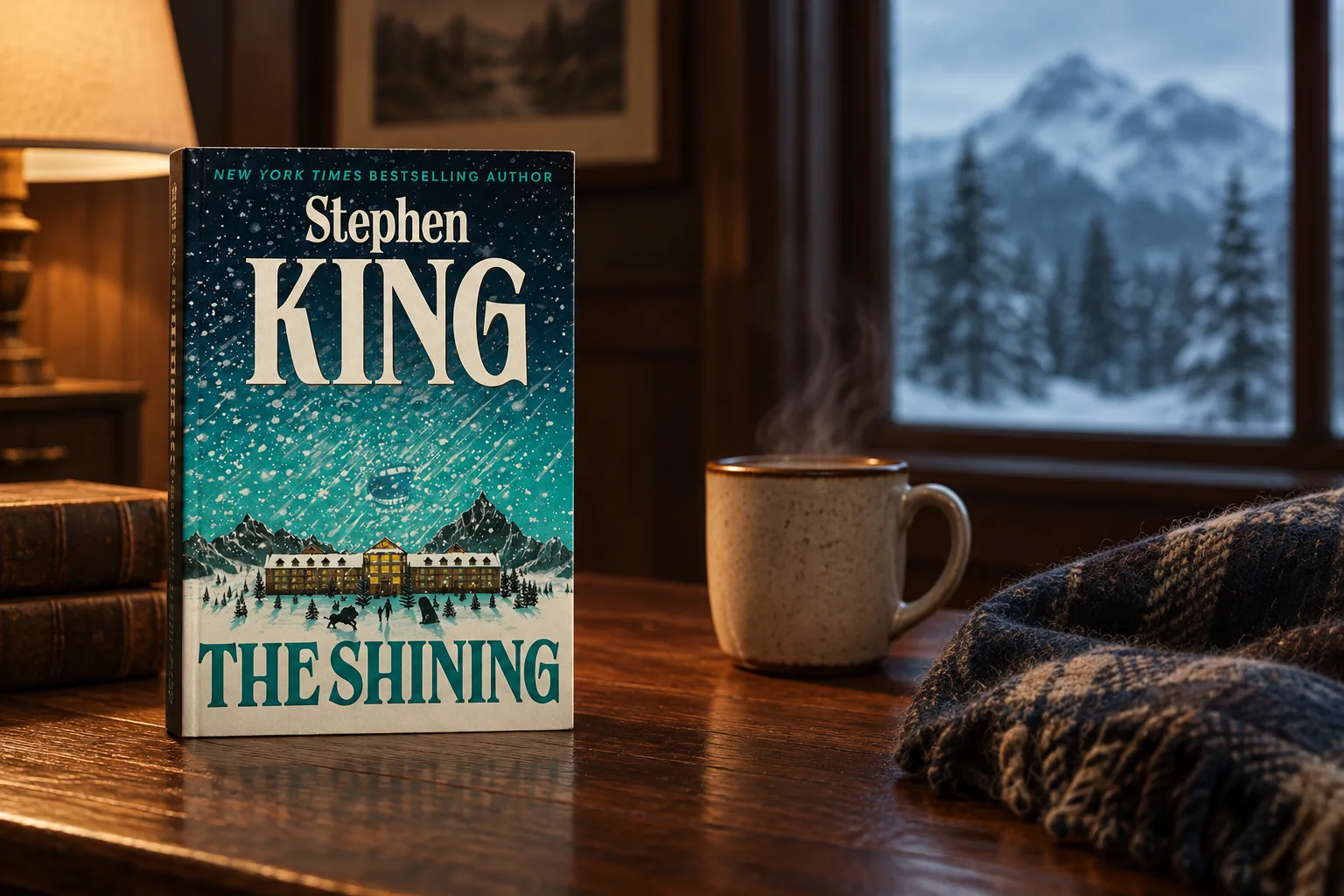
Literature & Thought · TALE24 REVIEW
The Shining: A Haunted Hotel Built from Family Pressure
Stephen King’s The Shining uses an isolated winter hotel to bring family pressure, addiction, and supernatural horror into the same closed space. Its most lasting unease comes from a question of trust: what happens when the place meant to shelter a family also makes escape difficult?
A vivid setting that shapes the action; psychological tension grounded in dependence and family care; a nuanced connection between the supernatural and Jack’s vulnerabilities.
Stephen King’s The Shining begins with a job that sounds almost ordinary: Jack Torrance will care for a closed mountain hotel through the winter. The arrangement offers the Torrance family shelter, income, and a chance to start again. Its danger comes from how completely those needs converge in one isolated building. The Overlook is not merely a haunted backdrop. It is a system that controls movement, separates the family from help, and gives old violence the time and quiet to press against the present. King turns a familiar haunted-house premise into a novel about what isolation can amplify inside a family.
The hotel’s seasonal closure supplies the book with a powerful practical constraint. Snow and distance are not decorative obstacles; they make dependence on the building unavoidable. The family’s ordinary tasks—keeping warm, maintaining the property, staying in contact—become part of the suspense. King understands that an empty hotel can feel crowded when it contains traces of former guests and the routines built to serve them. Rooms, corridors, service spaces, and mechanical systems suggest a social world that has vanished but left its infrastructure behind. The setting keeps offering hospitality and withholding safety at the same time.
Jack is central to that interaction because the book gives him both a desire to change and reasons to fear he cannot. He arrives with a history of drinking, anger, and damaged professional prospects; the caretaker job appears to offer a new beginning and the privacy needed to write. King’s strongest decision is not to treat Jack’s vulnerability as a simple switch that turns him into a different person. The supernatural does not erase the emotional history that precedes it. It presses against Jack’s shame and ambition, making the wish to restore his identity inseparable from the threat that his family may suffer for his failures. That ambiguity makes the haunting more unsettling than a series of external attacks.
The novel also makes the idea of a fresh start morally complicated. Jack can see the job as a chance to prove himself, while Wendy and Danny need the same arrangement to deliver basic security. Their hopes overlap without being identical. The promise of a clean beginning can become a burden when one person’s redemption requires everyone else to accept risk. King invites readers to distinguish sympathy for a person struggling with addiction from the obligation of family members to endure harm. That distinction keeps the book’s emotional stakes from collapsing into a single question of whether Jack is good or bad.
Wendy is essential to the novel’s account of that danger. She is frequently forced to assess what can be trusted, whom she can protect, and whether the family’s situation has crossed a line that hope can no longer repair. Her fear does not make her passive. The narrative’s attention to her practical judgments gives the domestic setting a second point of view: the same hotel that can look like a writing retreat to Jack is an increasingly unsafe home to Wendy. The book’s treatment of her is shaped by familiar gender conventions of wifehood and motherhood, and some of its dramatic emphasis falls heavily on her vulnerability. Still, her decisions and perceptions help measure the reality of the threat, rather than merely decorating it.
Danny’s sensitivity to the hotel creates another problem of belief. A child can perceive things adults do not, but that perception does not automatically give him the power to make adults respond in time. His gift makes him a target, yet it also renders him an interpreter of a place whose adults are struggling to understand what they have entered. The novel’s tension often rests on an uncomfortable gap between knowing and being believed. King uses that gap without asking the child to explain every mystery for the reader; Danny’s experience retains an emotional scale that exceeds its plot function.
The horror works best when it stays close to ordinary perceptions and decisions. A familiar room can feel wrong; a sound can have a source and still carry more meaning than the explanation accounts for. King alternates moments of dread with stretches of routine, allowing the reader to feel how slowly a family’s sense of normality narrows. The result is less a sequence of set-piece scares than a pressure campaign. The Overlook’s size makes the family physically small, while its winter isolation makes every choice feel consequential.
That method has a cost. The Shining is a long novel, and its interior explanations sometimes repeat or enlarge a point that the surrounding action has already made. Readers who want a compact ghost story may find that King’s accumulation of background and psychological context delays the next turn. The book’s melodramatic intensity can also push some characters toward broad, heightened roles. These choices are part of the novel’s expansive style, but they can make its pacing feel less controlled than the central premise promises. The most powerful passages often rely on a small shift in trust or perception; the surrounding narrative occasionally explains the pressure after the reader has already felt it.
Even so, the novel’s scale serves an argument. The hotel’s past is large because the people inside it cannot understand their trouble as a single isolated event. Private history, addiction, family dependence, and the building’s own violence overlap. The result is an American haunted-house story that places responsibility and care alongside the supernatural. Its scariest question is not simply what might be hiding in a room. It is what happens when the place a family depends on also makes escape difficult, and when the person meant to protect the household is not reliably safe.
For Halloween readers, The Shining remains a compelling choice for a long, atmospheric stay in an isolated setting. Its strength lies in the way the Overlook turns family intimacy into a test of trust, and in the way King allows Jack’s human struggles and the hotel’s supernatural threat to intensify each other without making them the same thing. The length and occasional repetition call for patience, while its domestic violence and addiction themes give the scares emotional weight. This is not only a book about a haunted hotel. It is a study of how architecture, dependence, and unaddressed harm can make a place feel impossible to leave.
EDITOR’S VERDICT
Tale24’s assessment
A vivid setting that shapes the action; psychological tension grounded in dependence and family care; a nuanced connection between the supernatural and Jack’s vulnerabilities.
Points to considerIts length and repeated interior explanations can slow momentum; its domestic violence and addiction themes are intense and may not suit every reader.
Best for: Readers of atmospheric haunted-house fiction who want psychological depth, family conflict, and a patient build rather than a short sequence of shocks.
Editorial method: This is an independent assessment informed by the work and its official supporting information. AI tools may assist the drafting process; Tale24 reviews and takes responsibility for everything it publishes.