Technology & Careers · CRITICAL ESSAY
The Soul of a New Machine: Craft, Pride, and the Myth of Signing Up
Tracy Kidder's Pulitzer and National Book Award winner turned a late-1970s minicomputer race into timeless literature about engineering pride—even as later readers question the crunch culture it helped immortalize.
Pulitzer-winning narrative journalism capturing the psychological drama, mentorship, and rivalries behind building a computer from scratch.
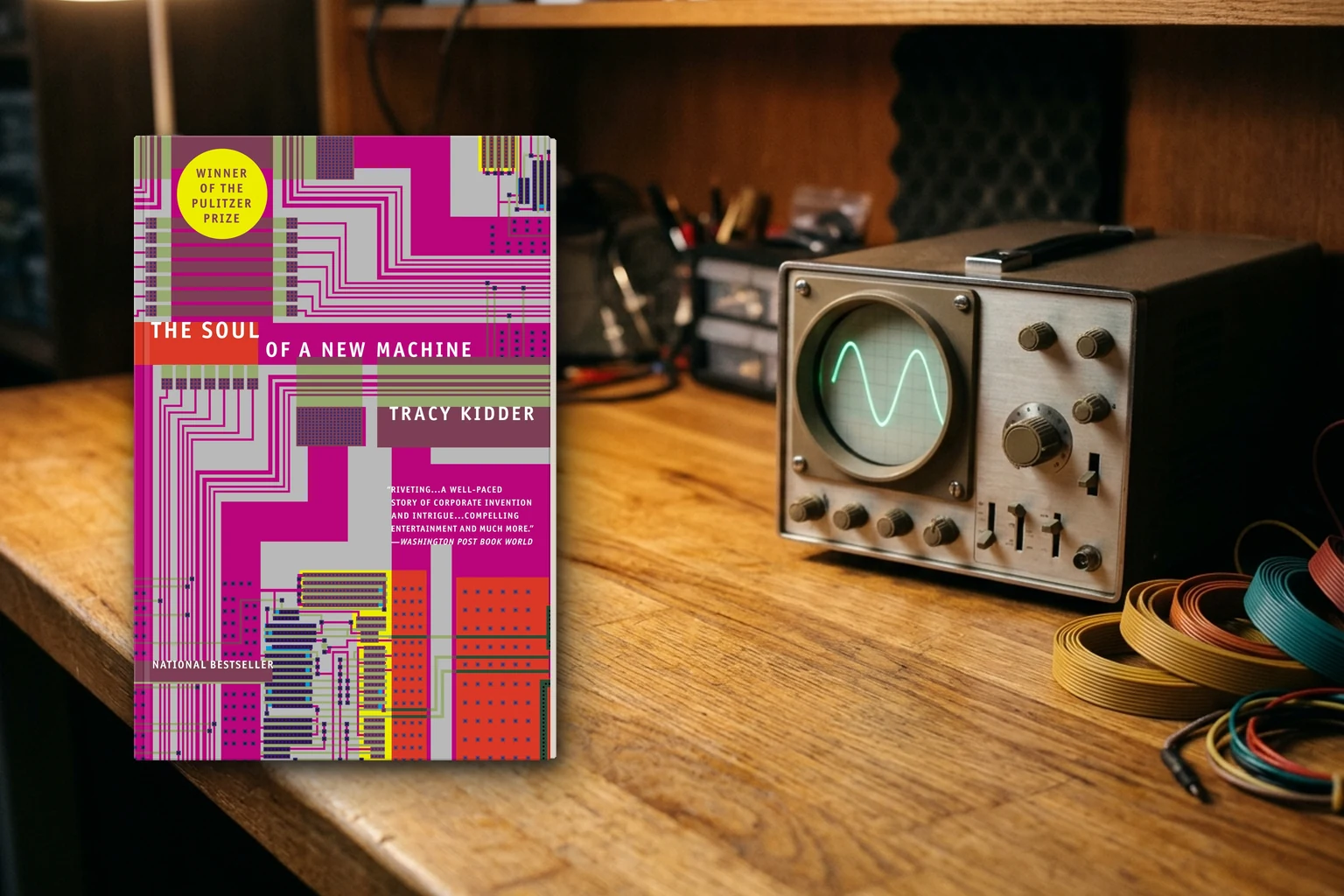
More than four decades before software engineers debated startup sprint velocity and burnout, literary journalist Tracy Kidder descended into a windowless basement lab in Westborough, Massachusetts to chronicle how computers actually get built. First published in July 1981 and preserved in Little, Brown and Company's verified 320-page Back Bay Books paperback, The Soul of a New Machine achieved the rare double honor of winning both the 1982 Pulitzer Prize for General Nonfiction and the 1982 National Book Award for General Nonfiction.
Examined decades after late-1970s minicomputers gave way to microprocessors and cloud data centers, Kidder's book endures less as a hardware chronicle than as the foundational ethnography of modern engineering culture. Even more strikingly, its clear-eyed ending quietly exposes the human toll behind the exhilarating myth of technological heroism that Silicon Valley later turned into routine management practice.
Underground Rivalry Inside Data General
Set between 1978 and 1980, Kidder's narrative follows a desperate corporate survival sprint inside Data General Corporation, founded by CEO Edson de Castro—himself a former Digital Equipment Corporation (DEC) engineer who had led creation of the pioneering PDP-8. Data General faced an existential threat after DEC launched its hugely successful 32-bit VAX-11/780 superminicomputer, leaving Data General dangerously behind in high-end computing. While Data General leadership staked its formal 32-bit response on a sprawling new research facility relocated to North Carolina's Research Triangle Park, veteran Westborough engineer Tom West launched an unsanctioned underground "skunk works" effort code-named Eagle. Because de Castro's own company had originally thrived as an upstart challenger to DEC, the internal tension between corporate orthodoxy in North Carolina and scrappy rebellion in Massachusetts mirrors computing history in miniature.
Kidder embeds inside the Westborough basement across more than a year of frantic architecture design, debugging, and inter-team politics as West's group races to deliver the machine that reaches market as the Eclipse MV/8000. Framing technical troubleshooting and internal rivalry between Massachusetts and North Carolina like a ticking-clock thriller lets readers feel why circuit timing bugs and corporate skepticism carried life-or-death urgency for engineers fighting for institutional survival inside their own company.
Characters, Mushroom Management, and the Ethos of "Signing Up"
What lifted an intricate engineering chronicle into "a high level of narrative art," as The New York Times Book Review observed, was Kidder's sharp eye for personality, hierarchy, and unspoken social contracts. Tom West leads with enigmatic intensity, practicing "Mushroom Management"—shielding staff from upper-management intrigue while keeping them fed on daunting technical puzzles. Around him revolve architect Steve Wallach, empathetic lieutenant Carl Alsing—who mentors rookies and shepherds the microcode group while sustaining morale through late-night pranks and "tube-wars"—and two hungry cohorts of recent university graduates: the "Hardy Boys," wiring physical hardware boards and logic circuits, and the "Microkids," authoring the microcode firmware layer. Watching Alsing absorb emotional pressure while West channels competitive pride shows how small engineering groups build distinct subcultures inside large corporations.
At the emotional heart of Kidder's reporting sits the ethos of "signing up": the voluntary yet fiercely demanding compact by which young engineers surrendered sleep, hobbies, and personal relationships purely for the pride of shipping an audacious machine. In Kidder's unforgettable metaphor, engineering victory paid off like winning a free game on a pinball machine—earning you nothing more than the privilege to keep playing harder, even when formal corporate recognition remained distant.
Technical Density vs. Narrative Drama
Contemporary reviewers admired Kidder's storytelling stamina while flagging genuine accessibility barriers for non-technical readers. In August 1981, Kirkus Reviews compared Kidder's ability to turn an "indescribably complex intellectual task" into compelling drama to John McPhee, applauding his grasp of corporate rivalry and human strain, yet frankly cautioned that "the text does bog down, occasionally, in Boolean algebra, instruction processors, system caches, and microsequencers." Readers without background in computer architecture may still skim a few low-level hardware debugging passages before rejoining the human drama, though that technical fidelity is also what earns trust from working engineers who rarely see their craft portrayed accurately.
Similarly, every technical detail belongs strictly to the late-1970s era of minicomputer cabinets, logic boards, and bespoke microcode teams—long superseded by modern integrated microprocessors and software-defined cloud infrastructure. Yet that historical specificity gives the book documentary permanence rather than reducing it to dated tech journalism: watching young builders wrestle with physical clock signals, prototypes, and scarce memory reveals enduring organizational truths about how ambitious engineering groups negotiate ambiguity, rivalry, and pride under tight deadlines.
The Aftermath and the Crunch-Culture Debate
With hindsight, the sharpest ongoing debate surrounding The Soul of a New Machine concerns how later generations of tech leaders read it. Because Kidder captures the camaraderie, adrenaline, and intellectual intoxication of the Eagle basement lab so vividly, critics and veteran engineers have noted that the book inadvertently helped normalize Silicon Valley "crunch time" and corporate "death marches" across future software startups—treating extreme self-sacrifice as a romantic badge of engineering identity.
That charge makes Kidder's actual closing pages all the more crucial to notice. Kidder never romanticizes corporate gratitude once the Eclipse MV/8000 ships: exhausted team members receive modest financial rewards, watch internal credit scatter, and quietly drift away from Data General. The author's loyalty belongs to the human cost of the craft, not to the executives who harvested it. Reading the ending carefully makes clear that Kidder documented the price of unchecked zeal with bittersweet honesty rather than recommending it as a permanent workplace model.
Verdict for Contemporary Readers
Despite occasional stretches of dense 1970s hardware terminology, The Soul of a New Machine remains an unmatched literary portrait of collaborative invention. Readers seeking contemporary software practices will obviously look elsewhere, and thoughtful technologists should resist reading "signing up" as a healthy baseline for career sustainability. Yet few works of journalism capture so precisely how pride, rivalry, mentorship, and exhaustion intertwine inside ambitious technical teams, or why smart managers must protect engineers from burning out on their own enthusiasm.
For software and hardware engineers, engineering managers, startup founders, technology historians, and admirers of immersive narrative journalism, Little, Brown's trade edition remains indispensable. More than forty years on, it reminds anyone building complex systems that every ambitious machine carries the obsessions, pride, and finite stamina of the people who brought it to life. Even in an era of distributed teams and cloud abstraction, Kidder's basement portrait still asks what organizations owe the builders who pour themselves into difficult work.
CRITICAL PERSPECTIVE
Tale24’s assessment
Pulitzer-winning narrative journalism capturing the psychological drama, mentorship, and rivalries behind building a computer from scratch.
Points to considerDense Boolean logic and microsequencer passages can slow lay readers, and its intense ethos of 'signing up' echoes modern tech crunch and burnout.
Best for: Software and hardware engineers, technical leads, startup founders, computing historians, and readers of literary journalism.
Editorial method: This is Tale24’s original analysis of the published material and attributed criticism. AI tools may assist the drafting process; Tale24 reviews and takes responsibility for everything it publishes.
READING AND RESEARCH
Sources and edition scope
Bibliographic details and textual claims in this review were checked against the edition and reference records below (The Soul of a New Machine by Tracy Kidder). Commercial retailer links are kept separate from editorial verification.
- hachettebookgroup.com — the soul of a new machine / 9780316491976 Publisher's edition record
- kirkusreviews.com — tracy kidder 2 / the soul of a new machine Independent review
- pulitzer.org — prize winners by year / 1982 Editorial reference
- nationalbook.org — books / the soul of a new machine Editorial reference
Sources checked November 23, 2026.
KEEP READING