Literature & Thought · CRITICAL ESSAY
Between the World and Me: Vulnerability, History, and the Dream
Modeled on James Baldwin's letter to his nephew, Ta-Nehisi Coates's National Book Award winner trades civic optimism for an unsparing account of Black bodily vulnerability in America.
Visceral, historically grounded epistolary prose uniting West Baltimore memory, Howard University, and Baldwin's literary lineage.
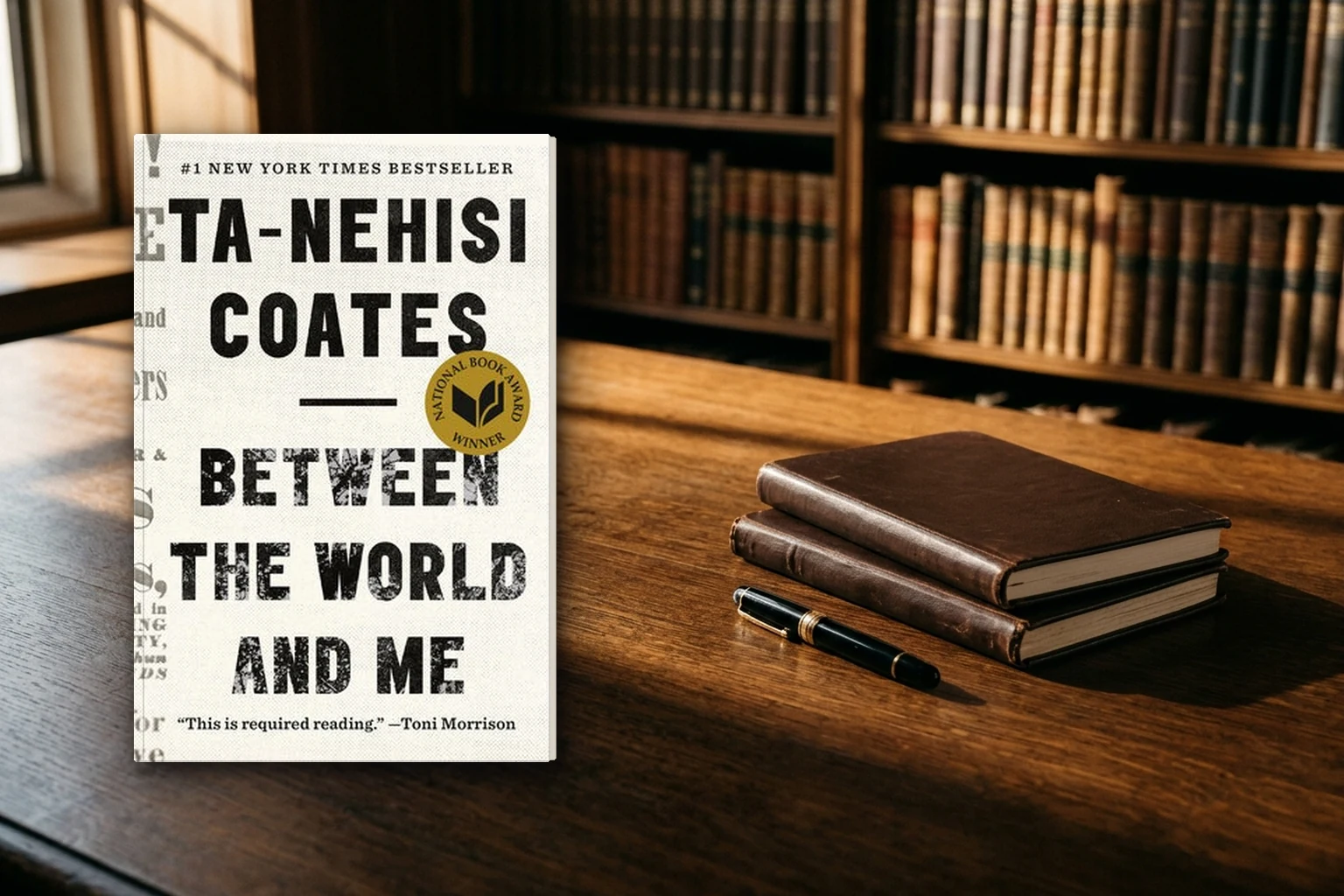
When Ta-Nehisi Coates published Between the World and Me in 2015 under the Spiegel & Grau and One World imprint of Penguin Random House, the slender 176-page volume immediately entered a charged national conversation about policing, race, and historical memory. Drawing its title from Richard Wright's 1935 lynching poem and its epistolary form from James Baldwin's 1963 landmark The Fire Next Time, the book surged to number one on The New York Times bestseller list and earned the 2015 National Book Award for Nonfiction alongside a 2016 Pulitzer Prize finalist citation.
Assessed alongside its documented reception and counterarguments, the book's distinctiveness lies in what it refuses to offer. Unlike conventional public-affairs nonfiction built around ten-point legislative blueprints or reassuring narratives of gradual progress, Coates writes an austere paternal reckoning that strips away American mythology and leaves his teenage son—and his readers—face to face with physical vulnerability as a structural historical inheritance. Rather than soothing civic conscience with easy optimism, the essay asks what truthful inheritance looks like when safety itself cannot be guaranteed.
Epistolary Architecture and Three American Landscapes
Coates frames the entire essay—running 152 pages of core narrative text—as a direct, urgent letter to his teenage son, Samori, prompted by Samori's tears upon hearing that no indictment was returned in the police killing of Michael Brown. That domestic opening matters structurally: rather than sheltering his son with reassuring promises that goodwill or civic reform will inevitably triumph, Coates chooses radical paternal candor. He treats his son not as a child to be pacified with national myths, but as an inheritor who must see historical power clearly in order to survive with dignity.
To substantiate that warning, Coates organizes his reflection around three formative landscapes: the unforgiving street vigilance of his youth in West Baltimore, his awakening into the vastness of Black intellectual history at Howard University, and his confrontation with the fatal police shooting of his middle-class Howard classmate Prince Jones by an undercover officer. Moving from Baltimore's defensive street codes into the cosmopolitan intellectual breadth of Howard University and then outward to suburban tragedy, Coates builds an argument grounded in lived American geography. By anchoring his reflection in specific losses—culminating in observations from Paris and a devastating conversation with Prince Jones's mother, Dr. Mabel Jones—Coates demonstrates that neither socioeconomic ascent nor elite education fully insulates a Black body from state violence. The personal grief around Prince Jones gives emotional weight to claims that might otherwise read purely as structural theory.
"The Dream," "The Mecca," and Bodily Materiality
Two conceptual anchors organize Coates's prose across the narrative. First is "the Dream": Coates's term for the comforting suburban mythology of manicured lawns, cookouts, and moral innocence that American culture tells itself while forgetting the slavery, exclusion, and economic plunder that financed that prosperity. Second is "the Mecca," his name for Howard University, where exposure to diverse Black scholars, poets, and traditions taught him to reject narrow racial folklore without surrendering intellectual rigor or wonder.
Equally decisive is Coates's insistence on the physical body. Drawing implicitly on strands of Afro-pessimism—which treats anti-Blackness as a foundational, recurring condition rather than a temporary aberration—and echoing voices from Baldwin and Wright to Sonia Sanchez, Nas, and Ice Cube, he treats racism not primarily as private malice inside individual hearts, but as an ongoing material threat registered upon skin, bones, schools, and streets. That somatic focus gives his sentences unusual urgency, reminding readers that historical abstractions always land on mortal bodies.
Literary Acclaim and Baldwin's Mantle
Major critical institutions greeted Between the World and Me as a defining American text of its decade. Beyond winning the 2015 National Book Award and appearing among NPR's Best Books of 2015, it earned a Pulitzer board citation praising it as "A powerful book that passionately and bleakly propounds the hazards faced by black men coming of age in America." Shortly before Coates received a MacArthur Fellowship, Toni Morrison offered a landmark endorsement calling the book "required reading" and crediting Coates with filling "the intellectual void that plagued me after James Baldwin died."
In The New York Times, chief critic Michiko Kakutani similarly praised the book as "a searing meditation on what it means to be black in America today," recognizing how sharply Coates condensed years of historical and journalistic reporting into an intimate familial voice. Its brevity made it widely teachable, turning a personal letter into a shared seminar text across universities and civic reading groups nationwide.
Class Blind Spots, Tone, and the Fatalism Critique
Yet the most illuminating criticism came from sympathetic reviewers who tested the book's moral reach against its omissions. Even while admiring its force, Michiko Kakutani noted a "Manichaean tone" and a "hazardous tendency to generalize," pointing specifically to a passage in which Coates struggles to distinguish the officer who shot Prince Jones from September 11 first responders—and asking whether Coates's unremitting bleakness undervalued real historical advances secured through civil rights struggle.
In The Guardian, critic Sukhdev Sandhu offered an incisive structural critique centered on what he termed "the inaudibility of class in this book." Sandhu observed that Coates's tight focus on an American Black-white polarity leaves little room for Asian and Latino histories of alienation, while arguing that his elevated, quasi-theological syntax—"Thus," "I propose"—feels "increasingly ventriloquised" and narrower in range than the vibrant, grounded energy of Coates's 2008 memoir The Beautiful Struggle. Policy-oriented commentators including David Brooks likewise questioned whether dismantling "the Dream" while refusing reformist horizons risks nudging readers toward political fatalism rather than collective mobilization, leaving readers to weigh prophetic diagnosis against practical civic action.
Verdict for Contemporary Readers
Between the World and Me does not attempt to serve as a comprehensive sociology of multiracial America or a pragmatic legislative playbook, and readers expecting balanced policy proposals or hopeful civic reconciliation will understandably notice those boundaries. Its ambition is narrower and sharper: to bear witness, without soothing euphemism, to how racial history shapes fear, parenting, and bodily risk in the United States.
For readers of literary nonfiction, American history, contemporary social criticism, and James Baldwin's essay lineage, Coates's One World volume remains vital precisely when read alongside critics like Kakutani and Sandhu. Pairing its searing epistolary witness with wider debates over class, multiracial solidarity, and political agency yields a far richer engagement with the country Coates sets out to confront.
CRITICAL PERSPECTIVE
Tale24’s assessment
Visceral, historically grounded epistolary prose uniting West Baltimore memory, Howard University, and Baldwin's literary lineage.
Points to considerCritics note a portentous formal register, limited attention to class and non-Black minorities, and bleak refusal of reformist pathways.
Best for: Readers of American social criticism, literary nonfiction, civil rights history, and university seminars on Baldwin's essay tradition.
Editorial method: This is Tale24’s original analysis of the published material and attributed criticism. AI tools may assist the drafting process; Tale24 reviews and takes responsibility for everything it publishes.
READING AND RESEARCH
Sources and edition scope
Bibliographic details and textual claims in this review were checked against the edition and reference records below (Between the World and Me by Ta-Nehisi Coates). Commercial retailer links are kept separate from editorial verification.
- penguinrandomhouse.com — between the world and me by ta nehisi coates / 9780812993547 Publisher's edition record
- nationalbook.org — books / between the world and me Editorial reference
- theguardian.com — 08 / between the world and me sukhdev sandhu review Editorial reference
- apps.npr.org — best books 2015 Editorial reference
Sources checked November 23, 2026.
KEEP READING