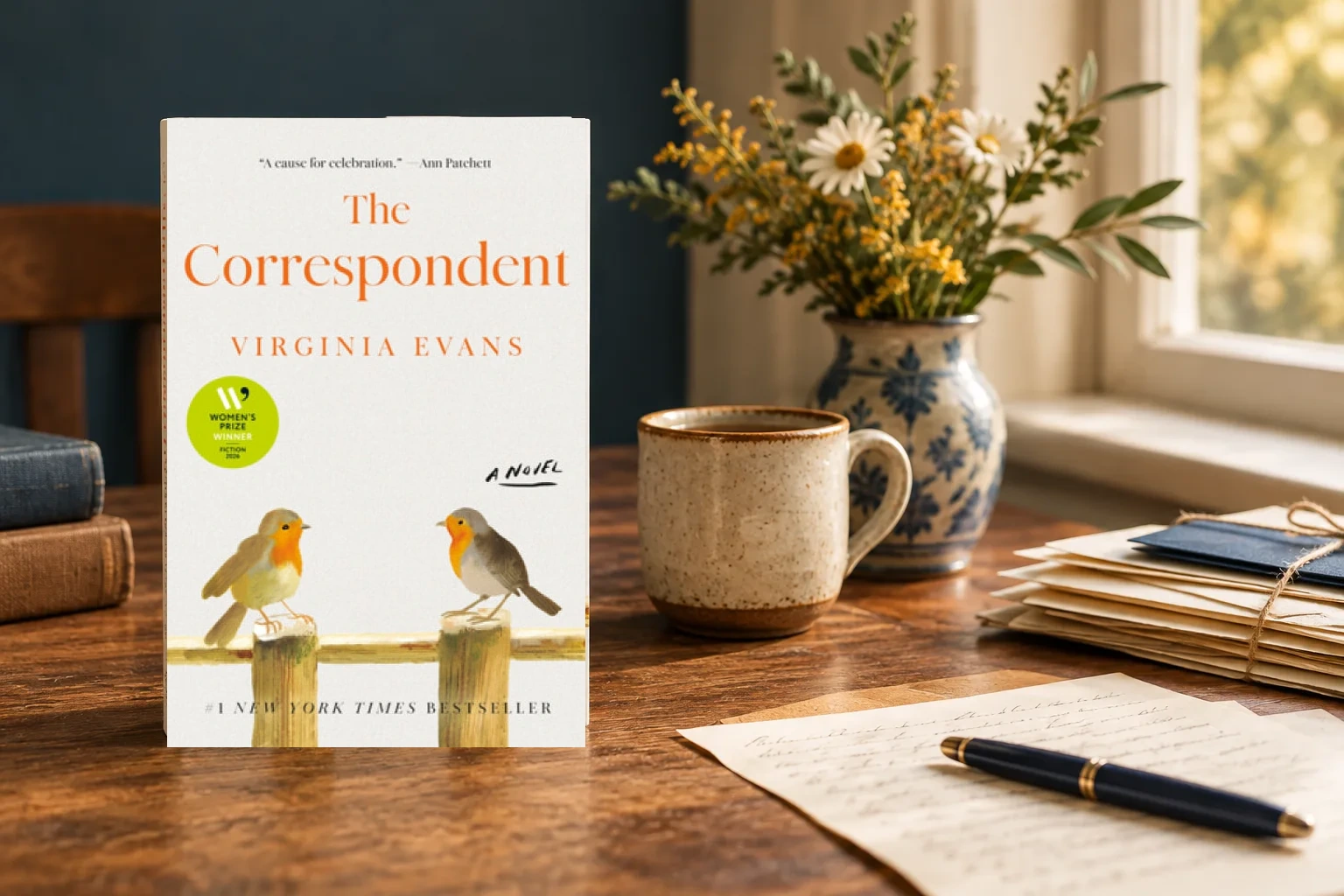
Literature & Thought · TALE24 REVIEW
The Correspondent: A Life Revised One Letter at a Time
Virginia Evans gives an older woman the room to be witty, difficult, generous, and unfinished. Her letters make a life visible while asking what even its careful writer cannot yet say.
A vivid older protagonist and an epistolary form that turns voice, silence, and revision into real drama
A letter gives its writer a rare advantage: time to decide which version of a feeling is fit to send. Sybil Van Antwerp, the center of Virginia Evans’s The Correspondent, has made that advantage into a daily practice. A retired lawyer with a large, complicated network of family and friends, she sits down to write to people close to her and to people she has never met. Yet one recurring letter remains unsent. The gap between those carefully addressed messages and the page she cannot release gives this novel its most searching question. Can a person who is eloquent about everyone else become honest about herself?
Sybil’s correspondence reaches her brother, a friend, a university president who has frustrated her academic plans, and admired authors. The range matters. A family letter carries a history its recipient already knows; a note to a public figure can be bolder precisely because the writer expects little in return. Her legal background suggests another habit: shaping an argument for an audience. Evans uses a form that lets Sybil sound assured while leaving room for readers to notice what confidence may conceal. The letters do not simply report her life. They are among the tools with which she tries to manage it.
An epistolary novel can turn a person into a collection of polished performances. Here that risk is part of the interest. Sybil has been a mother, grandmother, wife, divorcee, and lawyer; no single role is enough to explain her. A letter to a younger acquaintance need not resemble one to a contemporary. The official reading guide invites readers to consider how her tone changes across generations. That question is worth carrying through the book: the voice someone uses with each recipient is real, but none of those voices can contain the whole person. A life in letters is assembled in the space between what is shared and what is held back.
Evans also gives the physical act of writing weight. The reading guide notes Sybil’s fear of losing that ability as her eyesight changes. For someone who has long organized thought through pen and paper, such a possibility is more than an inconvenience. It threatens a way of staying connected and a means of keeping uncertainty at a manageable distance. The novel’s affection for older forms of communication need not be read as a simple complaint about digital life. Its stronger idea is that a medium changes the pace at which a person can respond. A letter creates room for revision; it can also postpone a conversation that would demand an answer now.
That double edge keeps the story from becoming a sentimental advertisement for stationery. Writing can be generous: it tells a recipient that a thought was worth preserving and sending. It can also be evasive. A person may describe regret beautifully without risking the encounter in which regret would have consequences. Sybil’s unsent letter makes the difference visible. The publisher connects it to a painful period of her past and to the possibility of forgiveness, while leaving its recipient and full meaning for the novel to reveal. The restraint is useful. The important tension is not a puzzle to solve in advance, but the distance between finding words and allowing another person to read them.
Sybil’s age gives that tension a particular force. Stories of change often reserve their largest transformations for the young, as though experience eventually hardens into a settled character. Evans instead places reconsideration late in a life already full of work, relationships, and decisions that cannot be undone. The prospect of making amends does not erase those years. It asks what responsibility can look like when the past remains part of every present relationship. Sybil’s wit and stubbornness matter because they keep her from becoming an easy emblem of wisdom. Age has given her perspective, but it has not made self-knowledge automatic.
The correspondence also makes other people more than an audience for Sybil’s development. Replies can interrupt her account of herself; silence can do so as well. A letter belongs to its sender only until it arrives. From then on, another person may read it generously, misread it, save it, or answer from an angle the writer did not expect. That basic uncertainty is what makes the form dramatic. Even when readers know Sybil’s stated intention, they cannot assume that intention determines the effect of her words. Connection is an exchange, not a private achievement that can be perfected at a desk.
There is a limit to the device. When a story reaches us through composed messages, the rough disorder of ordinary speech is partly filtered out. Readers who prefer scenes unfolding in real time may find the rhythm of letter and response unusually deliberate. The novel’s promise of emotional repair may also make some developments feel more neatly arranged than life permits. Those are fair reasons to approach its warmth with a little resistance. The stronger reading is not that writing reliably heals every relationship, but that it exposes the effort involved in trying to speak clearly after years of practiced avoidance.
The Correspondent is best suited to readers who enjoy character revealed through voice and relationships rather than through a fast sequence of events. Its attraction lies in how modest its materials appear. A letter can be an argument, an invitation, a complaint, or an apology; sometimes it is several of these at once. Evans uses that ordinary instrument to give an older woman room for contradiction. Sybil’s life is not waiting to begin, and it is not finished. Each page she sends makes a claim about who she has been. The unsent one asks whether she is ready to revise it.
EDITOR’S VERDICT
Tale24’s assessment
A vivid older protagonist and an epistolary form that turns voice, silence, and revision into real drama
Points to considerIts composed, letter-by-letter pace may feel too deliberate for readers seeking immediate scenes or rapid plot
Best for: Readers drawn to character-rich literary fiction, aging, family ties, and the art of correspondence
Editorial method: This is an independent assessment informed by the work and its official supporting information. AI tools may assist the drafting process; Tale24 reviews and takes responsibility for everything it publishes.