Literature & Thought · TALE24 REVIEW
The Emperor of Gladness: Care Without Easy Rescue
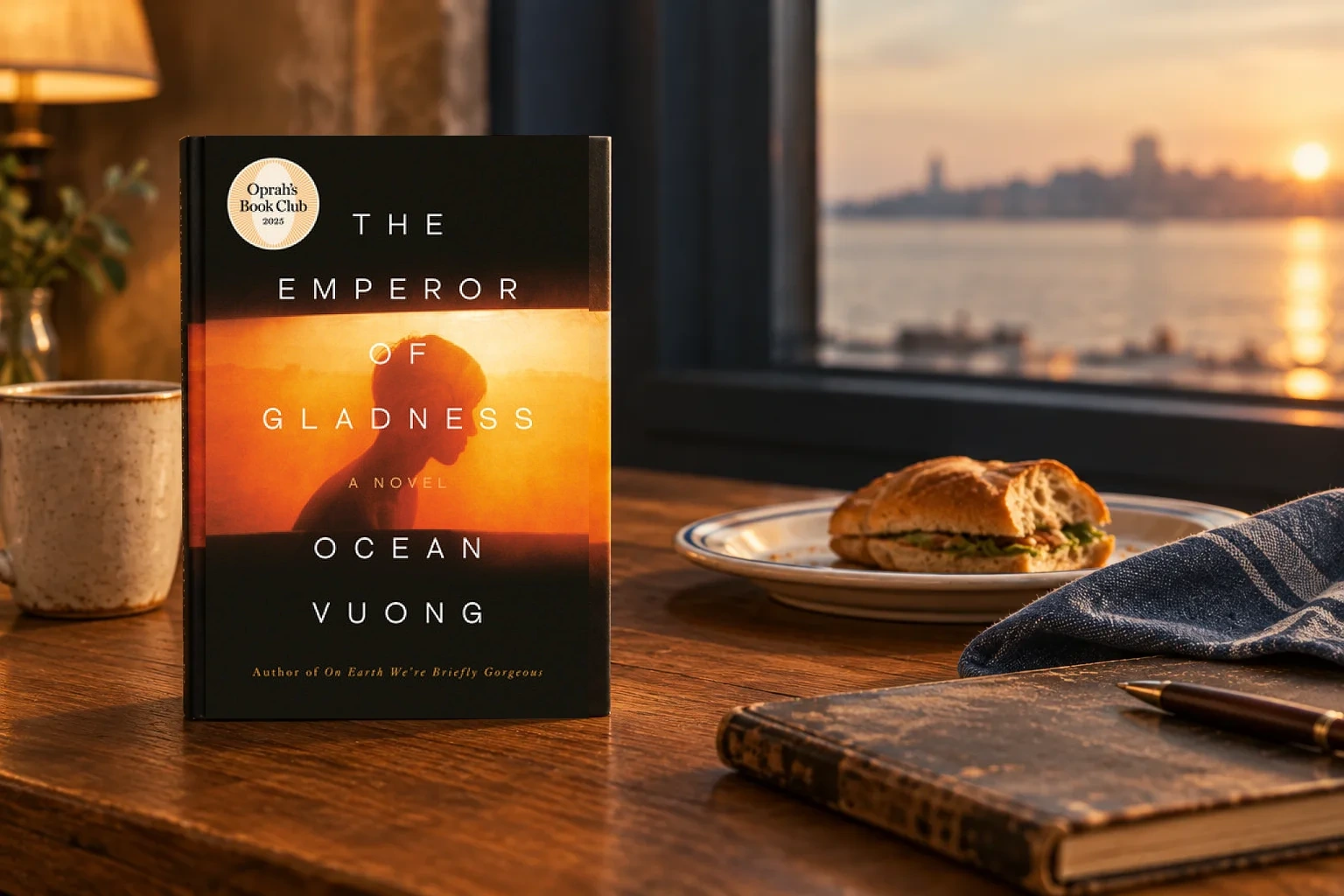
Ocean Vuong brings a young man, an aging neighbor, and restaurant workers into the same fragile circle of care. The novel’s hope comes from ordinary labor rather than a promise that love fixes everything.
A distinctive pairing of domestic care and service work, with a strong sense of community at the margins
A stranger calls across a river, and a young man’s life takes a different turn. Ocean Vuong begins The Emperor of Gladness with nineteen-year-old Hai in acute distress and Grazina, an elderly widow whose memory is failing, reaching him at a moment of danger. Their meeting could have been the whole shape of a reassuring story: one person saves another, affection completes the work, and suffering recedes. Vuong’s premise is more difficult. Hai becomes Grazina’s caretaker, and both must continue living inside bodies, histories, and an economy that do not change simply because they have found each other.
The novel unfolds in East Gladness, a post-industrial Connecticut town whose name sounds more like a hope than a description. Hai’s bond with Grazina develops over the course of a year, while his job at a fast-food restaurant called HomeMarket brings another group of people into view. The two settings make a productive pair. In a house, care may be intimate and largely unseen. At work, bodies perform care in public-facing routines: preparing food, cleaning, covering for one another, absorbing demands from people who may never learn their names. Vuong puts emotional survival alongside the daily labor required to keep a household and a workplace going.
Grazina is living with dementia, a condition that makes care unpredictable rather than merely tender. Hai cannot restore a stable past for her, and she cannot provide him with a simple escape from his own trouble. The publisher describes their relationship as transformative, but its most persuasive possibility lies in reciprocity without equivalence. One person may need help with ordinary tasks; the other may need a reason to remain present. Those needs do not cancel each other out or make the arrangement effortless. Reading the relationship as work as well as affection protects Grazina from becoming a symbol whose only function is to redeem a young man.
HomeMarket widens the same question. The official reading guide names Hai’s coworkers and asks how their relationships become a kind of home. That word can be comforting, but it deserves scrutiny in a workplace. Colleagues may offer jokes, meals, attention, or practical help that a person’s family cannot give. They still meet under schedules and pay structures that limit their choices. The restaurant can be a place of genuine solidarity without becoming an argument that precarious labor is somehow good because it produces friendship. Vuong’s strongest subject may be the care people invent within conditions they did not choose.
Immigration histories complicate the idea of belonging further. The reading guide places Hai’s family story beside Grazina’s experience as a Lithuanian immigrant, inviting attention to different histories of war and displacement. Those histories should not be flattened into a single lesson about resilience. They change what each person remembers, what must be translated, and which sacrifices are treated as a family obligation. A younger person’s stalled future may be especially painful when earlier generations worked to make his options wider. A home can offer protection while also carrying a script for a life that its youngest member cannot follow.
Vuong is known for a highly attentive, lyrical style, and the publisher highlights his formal and syntactic inventiveness. In a story about workers and caregivers, such language has a particular task. It can make routine gestures visible without pretending every action is beautiful. A shift in tone may open the distance between how a person is seen by a customer, a relative, or a stranger and what that person carries privately. Yet there is also a risk: lyrical intensity can make hardship seem arranged for aesthetic effect. The novel asks its prose to stay answerable to its characters’ material lives, not merely to produce memorable sentences around them.
The book’s seasonal structure, noted in the publisher’s guide, gives this pressure time to accumulate. Care is repetitive. A single dramatic act can change a day; it cannot perform the tasks of the next morning. As the year turns, the reader is invited to notice whether connection survives fatigue and whether hope can coexist with uncertainty. That is a more demanding rhythm than a straightforward recovery plot. It leaves space for setbacks without treating them as failures of feeling. What matters is not that the characters discover a perfect family but that they keep negotiating how to be present for one another.
This is also why the title should not be taken as a promise of cheerfulness. Gladness in the novel’s name sits beside loneliness, memory loss, and work that rarely receives public honor. The phrase suggests a small and perhaps temporary sovereignty: moments in which people who possess little control can still offer one another attention. Such moments deserve celebration, but not exaggeration. Readers looking for brisk plot mechanics or a clean emotional payoff may find the novel’s breadth and poetic register demanding. Its opening crisis and themes of addiction and loss also call for a reader willing to spend time with difficult material.
The Emperor of Gladness is compelling for readers interested in what literature can do with overlooked labor and chosen relationships. Vuong’s central question is less whether a single kindness can save a life than what follows after kindness has opened a door. Someone must make dinner, show up for a shift, remember an appointment, or sit with another person when memory itself becomes unreliable. Those acts can be fragile and insufficient. They can still be the substance of a life shared. The novel’s most humane promise is to take that ordinary work seriously without calling it a cure.
EDITOR’S VERDICT
Tale24’s assessment
A distinctive pairing of domestic care and service work, with a strong sense of community at the margins
Points to considerThe lyrical style and diffuse, emotionally heavy structure may challenge readers seeking a brisk plot
Best for: Readers of literary fiction about class, migration, memory, chosen family, and the work of care
Editorial method: This is an independent assessment informed by the work and its official supporting information. AI tools may assist the drafting process; Tale24 reviews and takes responsibility for everything it publishes.