Literature & Thought · TALE24 REVIEW
The Great Believers: The Long Life of a Crisis
Across 1985 Chicago and later Paris, Rebecca Makkai follows the friendships and family bonds shaped by the AIDS crisis. Memory remains an active responsibility.
A carefully researched Chicago setting and a dual timeline that gives loss a long social afterlife.
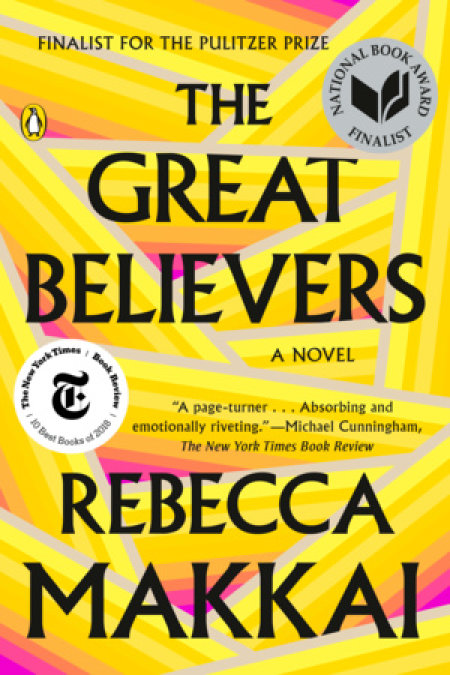
The Great Believers asks what a crisis leaves with the people who survive it. Rebecca Makkai moves between Chicago in 1985, as AIDS takes the lives of men in a close circle of friends, and Paris three decades later, where Fiona confronts the distance between herself and her daughter. The alternating timelines make a demanding claim: an epidemic is not over for a family or a community simply because the calendar has moved forward. Its consequences persist in habits of care, distrust, memory, and love.
The publisher introduces Yale Tishman as the development director of a Chicago art gallery, preparing to secure a collection of paintings from the 1920s. At the same time, the disease draws closer to his friends after the funeral of Nico. Fiona, Nico's younger sister, becomes an increasingly important connection. Years later she travels to Paris in search of her estranged daughter, who has disappeared into a cult. These premises are substantial enough to produce separate novels. Makkai places them together so that the past is never reduced to background for the present, and the present is never offered as a clean resolution of the past.
The art gallery plot gives the book a second language for its interest in loss. A painting survives when somebody recognizes its value, arranges its transfer, and persuades an institution to keep it. Human memory has fewer guarantees. Friends who die young may be remembered intensely by those who loved them and scarcely at all by the public record. Makkai's juxtaposition invites a difficult question without turning art into a simple villain: why do institutions often find it easier to preserve objects than to sustain the lives and relationships around them?
The Chicago timeline also insists on a social scale of illness. To describe AIDS only as a series of private tragedies would miss the practical work done by friends, lovers, relatives, medical workers, and advocates. The novel's central circle makes chosen family visible as a daily arrangement rather than a sentimental slogan. People show up, worry, argue, and try to keep one another from being abandoned. Their care matters precisely because it cannot make them invulnerable. Makkai gives a collective crisis faces and relationships without pretending that personal kindness can replace an adequate public response.
Fiona's later story tests any easy admiration of that care. The younger sister who stayed close to a devastated community does not become immune to grief's more complicated effects. Her search for her daughter suggests that dedication to one set of losses can coexist with distance in another relationship. That is a bracing choice. Survivorhood can confer knowledge and moral seriousness, but it does not confer automatic wisdom in every intimate situation. The Paris chapters allow the novel to ask how loyalty to the dead might affect one's ability to hear the living.
The distance between the timelines gives readers a way to see historical memory in motion. Thirty years can turn an emergency into an era, a photograph, or a familiar phrase. For someone who lived through it, the time may still feel close enough to interrupt an ordinary conversation. Makkai's structure holds those perspectives together. It offers neither the illusion that the 1980s can be fully recovered nor the convenience of treating them as sealed history. The people in 2015 have inherited a world shaped by earlier actions and failures, even when they cannot experience those years directly.
According to the publisher's interview, Makkai researched Chicago's AIDS history through local newspapers and conversations with doctors, nurses, activists, lawyers, survivors, and people who were young and gay in the city during the 1980s. That context matters to the novel's ethical ambition. Chicago is not used as a generic stage for a universal tragedy. Its community, institutions, and art world give the fiction particular social textures. Research alone cannot certify a novel's truth, but it can discipline the imagination by resisting the flattening that occurs when an epidemic is remembered only through its most familiar cities or images.
The book's emotional force also creates a risk for the reader. A narrative with so much illness and loss can be approached as a test of how much sorrow one can endure. That would undersell its attention to friendship, wit, professional purpose, artistic curiosity, and the awkward ways people continue to make plans. The novel is not asking readers to find beauty in suffering itself. It asks them to notice lives that contained more than suffering, and to see how a preventable or neglected crisis cut across that fullness.
Its two-strand design may still frustrate some readers. The urgency of Yale's Chicago story can make a return to Fiona's later search feel like an interruption; for others, the present-day narrative is what prevents the earlier one from becoming a memorial sealed under glass. This is a productive tension rather than a defect that can be edited away. The formal alternation asks the reader to experience the impatience of leaving one person behind and the necessity of attending to another. Neither timeline can claim all the book's moral space.
The Great Believers offers no consoling idea that time alone repairs damage. It presents memory as an obligation that changes as the living change. The paintings, the photographs, the friendships, and Fiona's search each ask who is present in an archive and who is still missing. Makkai's novel is at its strongest when it treats remembrance as more than reverence. To remember well is to make room for the complexity of people who lived through a crisis, and to remain answerable to the relationships that continue after it.
EDITOR’S VERDICT
Tale24’s assessment
A carefully researched Chicago setting and a dual timeline that gives loss a long social afterlife.
Points to considerThe alternating timelines may interrupt readers invested in either story's immediate momentum.
Best for: Readers of literary fiction interested in chosen family, public memory, and the AIDS crisis.
Editorial method: This is an independent assessment informed by the work and its official supporting information. AI tools may assist the drafting process; Tale24 reviews and takes responsibility for everything it publishes.