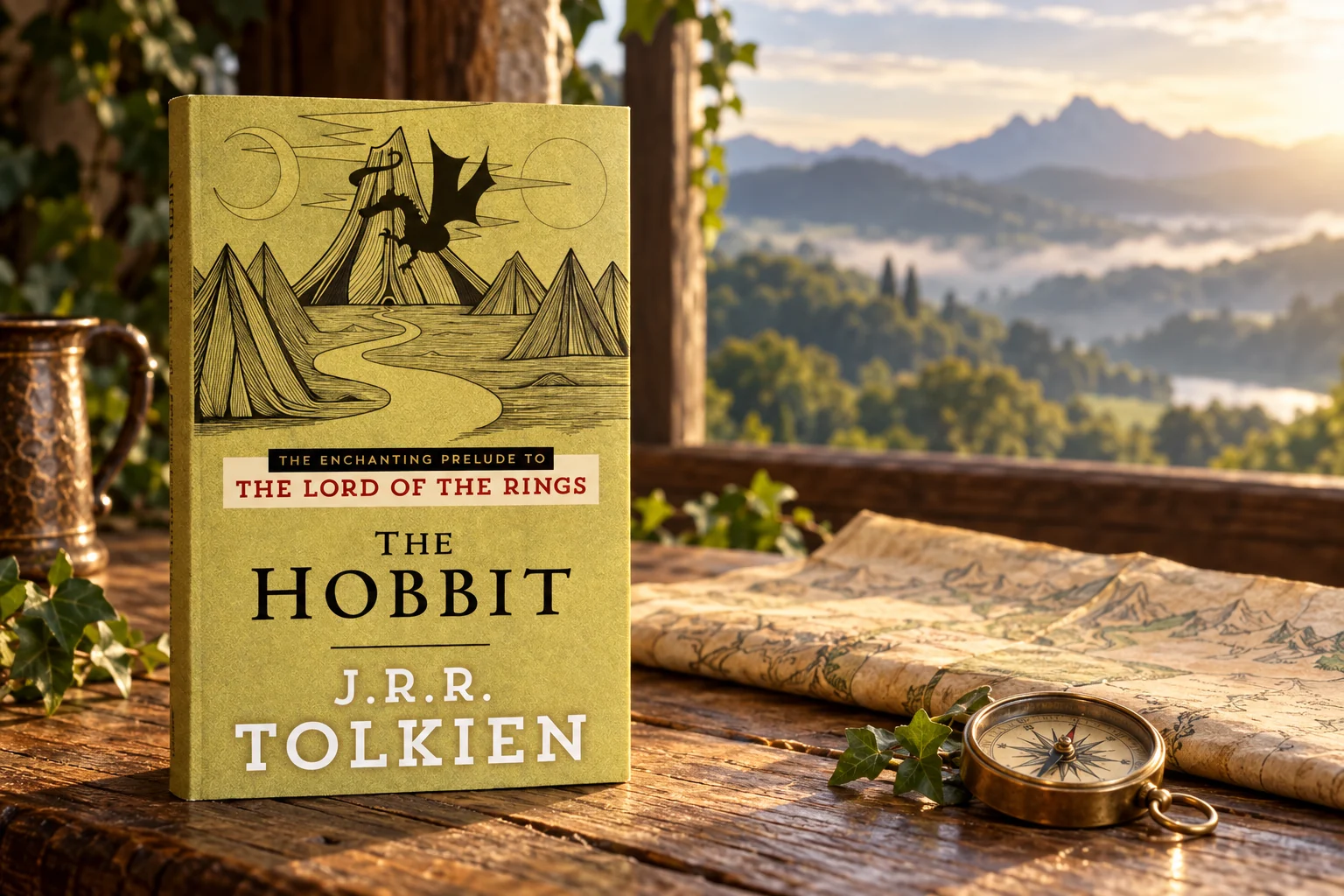
Literature & Thought · TALE24 REVIEW
The Hobbit: Courage Beyond the Comfort of Home
Tolkien’s adventure works because Bilbo never simply stops being a home-loving hobbit. His ordinary values become a way to judge danger, loyalty, and the lure of treasure.
An inviting storytelling voice, a vivid sense of journey, and a hero whose judgment matters more than force.
The Hobbit is often introduced as a doorway into Middle-earth, but its more interesting achievement is smaller in scale. J.R.R. Tolkien places an ordinary, comfort-loving person inside an adventure built around other people's inheritance, ambition, and danger. Bilbo Baggins is neither the strongest member of Thorin's company nor the one with the clearest claim to its destination. That mismatch gives the story its peculiar energy. What can someone who values a settled home contribute to a quest defined by lost treasure and heroic reputation? Tolkien's answer is less about discovering a hidden warrior than about learning how courage, wit, and restraint can travel together.
The premise has the simplicity of a tale told aloud. Thorin Oakenshield and his dwarves want to reclaim gold taken by the dragon Smaug. Gandalf proposes Bilbo as an unlikely companion, pulling him away from the routines of Hobbiton. The company moves through a succession of dangerous places, including encounters with trolls, goblins, spiders, and Gollum. Yet the route is not merely a sequence of obstacles designed to prove that Bilbo can survive. Each unfamiliar place changes the terms of the question posed at the beginning: whether his domestic habits make him unfit for adventure, or give him a different kind of judgment from the people already committed to it.
Tolkien understands the appeal of Bilbo's ordinary life. Food, shelter, and predictable social customs are not shallow pleasures to be discarded before a character becomes interesting. They give Bilbo a standard by which to measure the hardships and promises of the wider world. Because his reluctance is credible, his participation matters. A hero who longs only for a quest has little to lose by accepting one. Bilbo's hesitation keeps the adventure connected to ordinary human concerns: safety, obligation, hospitality, and the possibility of returning home changed. The narrative can be playful about his discomfort without treating it as a moral failure.
The book's episodic shape helps that transformation feel gradual. Rather than move relentlessly toward one climactic confrontation, the journey repeatedly forces the company to renegotiate who is useful and why. Physical power has an obvious role, but it cannot resolve every problem. A small figure who can listen, notice, and improvise becomes important in a group whose expectations initially leave little room for those abilities. Tolkien builds a fantasy world through this movement from one place and challenge to the next. The sense of breadth comes not from a catalog of invented history, but from the feeling that every refuge and threat belongs to a world extending beyond Bilbo's immediate knowledge.
That breadth is one reason the book works for readers who know The Lord of the Rings only by reputation. The Hobbit has its own tone and its own center of gravity. Its humor and directness are part of its design, not signs that it is merely an incomplete version of the later epic. The narrator's storytelling voice creates an intimacy with the reader even as the landscape grows stranger. There is room for fear, but also for the amused recognition that an adventure looks rather different from inside a hungry and tired traveler's experience. Tolkien lets wonder coexist with inconvenience, which makes the wonder easier to believe.
The treatment of treasure gives the novel another dimension. The dwarves' aim is understandable: they seek to recover something stolen from them. But a claim can become a fixation, especially when wealth begins to stand for memory, status, and justice all at once. Bilbo is valuable partly because he does not begin with the same relationship to the hoard. He has not spent his life imagining its return. The story can therefore examine the attraction of possession from a slight distance. It asks how a shared purpose changes when the object of desire comes within reach, and whether loyalty requires agreeing with every demand made in its name.
This is not a novel without rough edges for a contemporary reader. Its pattern of peril and rescue can feel repetitive if one expects the tight continuity of a modern fantasy thriller. Some members of the company remain more vivid as a collective than as distinct people. The story also shifts between light conversational passages and darker stakes, a tonal range that can surprise readers who approach it through the later films or through the solemn reputation of Middle-earth. Those features are worth knowing before starting. They are also inseparable from the book's character as an adventure that can be frightening without surrendering its delight in storytelling.
The fantasy is especially strong when it refuses to confuse scale with importance. A dragon and a mountain may dominate the map, but Bilbo's perspective keeps bringing the reader back to choices made at a personal level. Courage appears in acts of attention and in the willingness to move forward without certainty of success. The book does not make him interesting by erasing the traits that first seem unsuited to the quest. It shows how those traits can acquire new uses. The domestic and the heroic cease to be simple opposites; the knowledge of what a peaceful life is worth can guide a person in a dangerous one.
Readers seeking a severe, uninterrupted epic may find The Hobbit too genial or too fond of narrative detours. Readers open to a story that treats adventure as both an enlargement and a test of ordinary values will find a great deal here. Tolkien's lasting invitation is not simply to leave home. It is to ask what one carries from home into an unfamiliar world, and what kind of person comes back. Bilbo's journey remains compelling because its grand fantasy never loses sight of that modest, difficult question.
EDITOR’S VERDICT
Tale24’s assessment
An inviting storytelling voice, a vivid sense of journey, and a hero whose judgment matters more than force.
Points to considerIts episodic dangers and tonal shifts may frustrate readers who prefer a tightly continuous, solemn epic.
Best for: Readers of classic fantasy and character-centered adventures who enjoy wonder with humor and moral texture.
Editorial method: This is an independent assessment informed by the work and its official supporting information. AI tools may assist the drafting process; Tale24 reviews and takes responsibility for everything it publishes.