Literature & Thought · TALE24 REVIEW
The Wager: Survival and the Stories Empire Tells
David Grann turns a shipwreck and its competing survivor accounts into a study of who gets to define truth when an empire is at stake.
Compelling narrative architecture; a serious inquiry into conflicting testimony and imperial power; accessible historical detail.
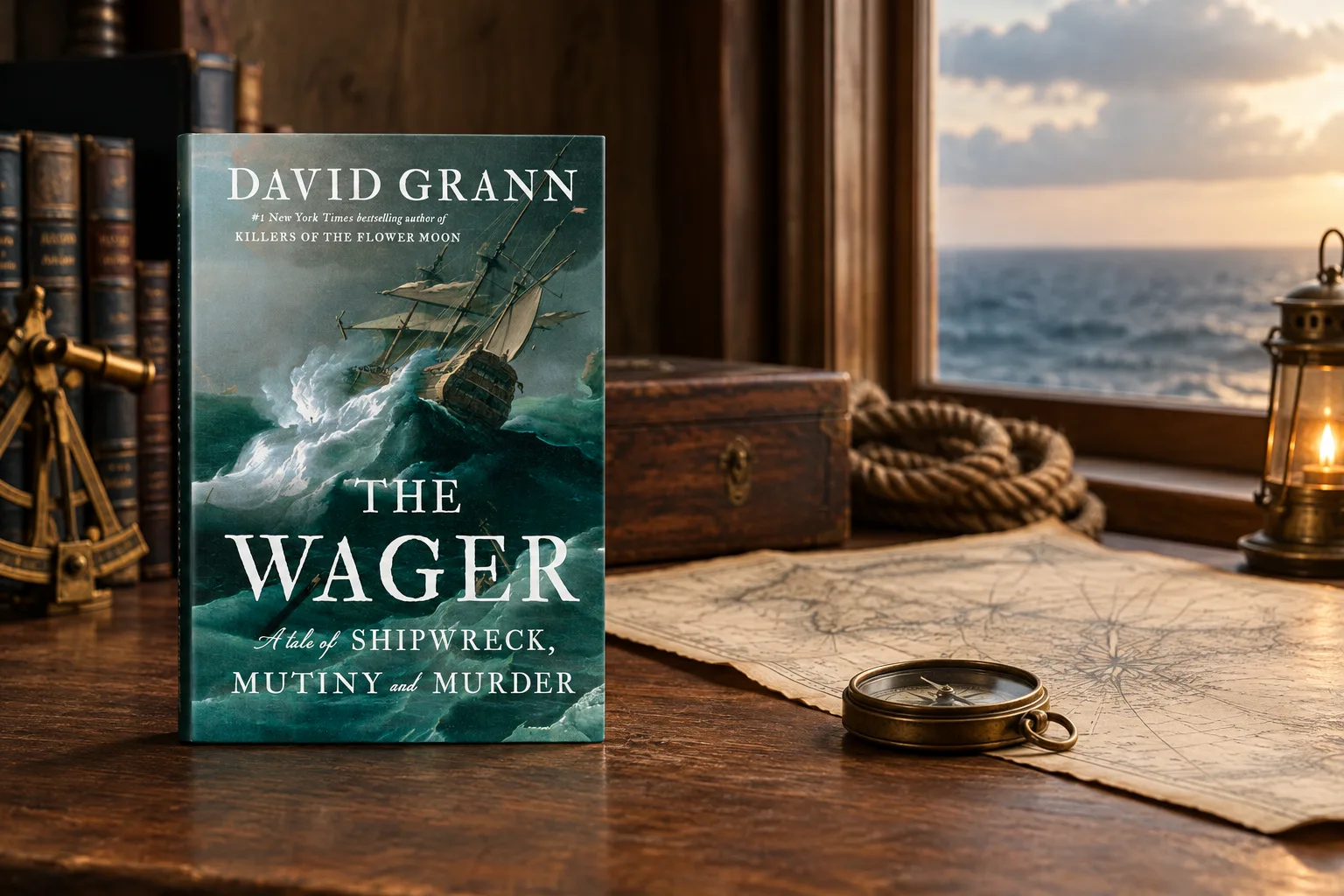
The question at the center of David Grann's The Wager is larger than whether a desperate crew can survive a wreck. It is whether anyone who survives can control what the wreck means. In 1740, HMS Wager left England on a British mission during war with Spain. The ship broke apart near Patagonia, and the men who lived through the catastrophe eventually brought incompatible accounts home. Grann shapes that historical material into an unusually tense work of narrative nonfiction. His strongest move is to make the production of a story, rather than the discovery of a single heroic version, the real subject of the adventure.
The publisher's account begins with a startling return: in January 1742, a patched vessel carrying thirty emaciated men reached Brazil. Such an opening promises a conventional survival tale. How did they get there, and what happened to those left behind? Grann can supply the peril, the isolation, and the astonishing labor of staying alive. But the book's later conflict changes the meaning of that first arrival. The men are not simply witnesses to a shared disaster. They are parties to a dispute over command, obedience, mutiny, and murder. Their future depends in part on whether their version of events becomes the accepted one.
That shift gives the book its distinctive structure. An ocean crossing and an island ordeal lead toward a contest over evidence. A reader who begins by asking whether the sailors will escape comes to ask who has the authority to name an act a rebellion. The movement from ship to shore to public account is more than a succession of dramatic settings. Each stage changes the rules by which conduct will be judged. A decision that looked necessary amid hunger and fear can look criminal when described in the language of naval law. Grann's narrative makes those changes in perspective part of the suspense.
The Wager's mission is essential to that perspective. This was a British warship pursuing imperial aims, not a group of travelers accidentally united by bad weather. The War of Jenkins' Ear and the hunt for a Spanish prize supply the political frame. A state's distant ambitions put men in a vessel whose hierarchy had to survive conditions that made hierarchy increasingly difficult to defend. The captain's formal authority did not vanish when the ship wrecked; neither did the crew's need to judge whether following him would keep them alive. The resulting clash is compelling because both law and survival acquire force, while neither settles every moral question.
Grann's research, as described in the publisher's reading guide, also makes the surviving documents into characters of a kind. The carpenter John Bulkeley published an account; other voices reached the record through different forms and at different levels of influence. The guide asks readers to compare Bulkeley's confident plain style with John Byron's recollections. A direct manner may encourage belief, but it cannot by itself establish that every claim is true. Conversely, a hesitant or self-conscious witness may have seen something important. The book asks readers to notice how tone, position, and access to publication affect the credibility people are granted.
This attention to testimony keeps The Wager from becoming a simple morality play about a good side and a bad one. Captain David Cheap and the men who opposed him have reasons to interpret the same acts differently. Legal categories can clarify events, but they can also protect the institution that defines those categories. The prospect of a court martial raises the stakes for every witness: an account is no longer only a memory but a defense. Readers need not suspend judgment altogether. They do need to see why a tidy verdict may tell us as much about the British Navy's priorities as it does about life on the island.
The book's imperial frame becomes sharpest when one asks whose testimony is missing. The publisher's guide explicitly raises the crew's relationship with the Kawésqar and the absence of a narrative from Black seaman John Duck. Those are not decorative additions to a familiar tale of European endurance. They reveal the limits of a record assembled within unequal systems of power. Grann can recover traces and ask better questions, but no contemporary author can make an undocumented voice speak in full. The responsible historical achievement lies partly in marking that silence, rather than smoothing it into a complete and comforting reconstruction.
Grann's method has an obvious attraction. He writes history with the pressure of a thriller, allowing reversals in what the reader knows to carry the narrative forward. That approach helps make a complex eighteenth-century episode legible without requiring specialist knowledge of naval procedure. It also creates a risk. When evidence is contradictory or fragmentary, a particularly propulsive arrangement can make a provisional inference feel settled. The reader should enjoy the pace while remembering that the archival record does not offer the frictionless access to motives that a novel can invent. The book is most persuasive when its momentum leaves room for uncertainty.
The physical ordeal remains important, even when the larger argument concerns narrative power. Hunger, illness, fear, and difficult decisions are not merely atmospheric devices that set up a courtroom ending. They affect what the men could perceive and later remember. Extreme conditions can make a witness both more urgent and less reliable. Grann's subject therefore joins two kinds of vulnerability: the vulnerability of bodies in an inhospitable place and the vulnerability of facts once those bodies return to an institution eager for an orderly account. The first kind makes the book gripping. The second makes it last beyond its twists.
The Wager is best approached as a history that asks its reader to watch the making of history. Its adventure is substantial, and its competing survivors provide the sort of dramatic conflict nonfiction rarely needs to embellish. Yet its deeper achievement is to resist the assumption that the first surviving account, the most polished account, or the institution's preferred account must become the truth. The book does not make uncertainty an excuse for indifference. It treats uncertainty as a reason to inspect who was allowed to speak, what each speaker stood to gain, and what empire needed its audience to forget.
EDITOR’S VERDICT
Tale24’s assessment
Compelling narrative architecture; a serious inquiry into conflicting testimony and imperial power; accessible historical detail.
Points to considerThe thriller pace may tempt readers to treat disputed evidence as settled; some voices remain inaccessible in the archive.
Best for: Readers of narrative history, maritime survival stories, and nonfiction about how institutions shape public memory.
Editorial method: This is an independent assessment informed by the work and its official supporting information. AI tools may assist the drafting process; Tale24 reviews and takes responsibility for everything it publishes.