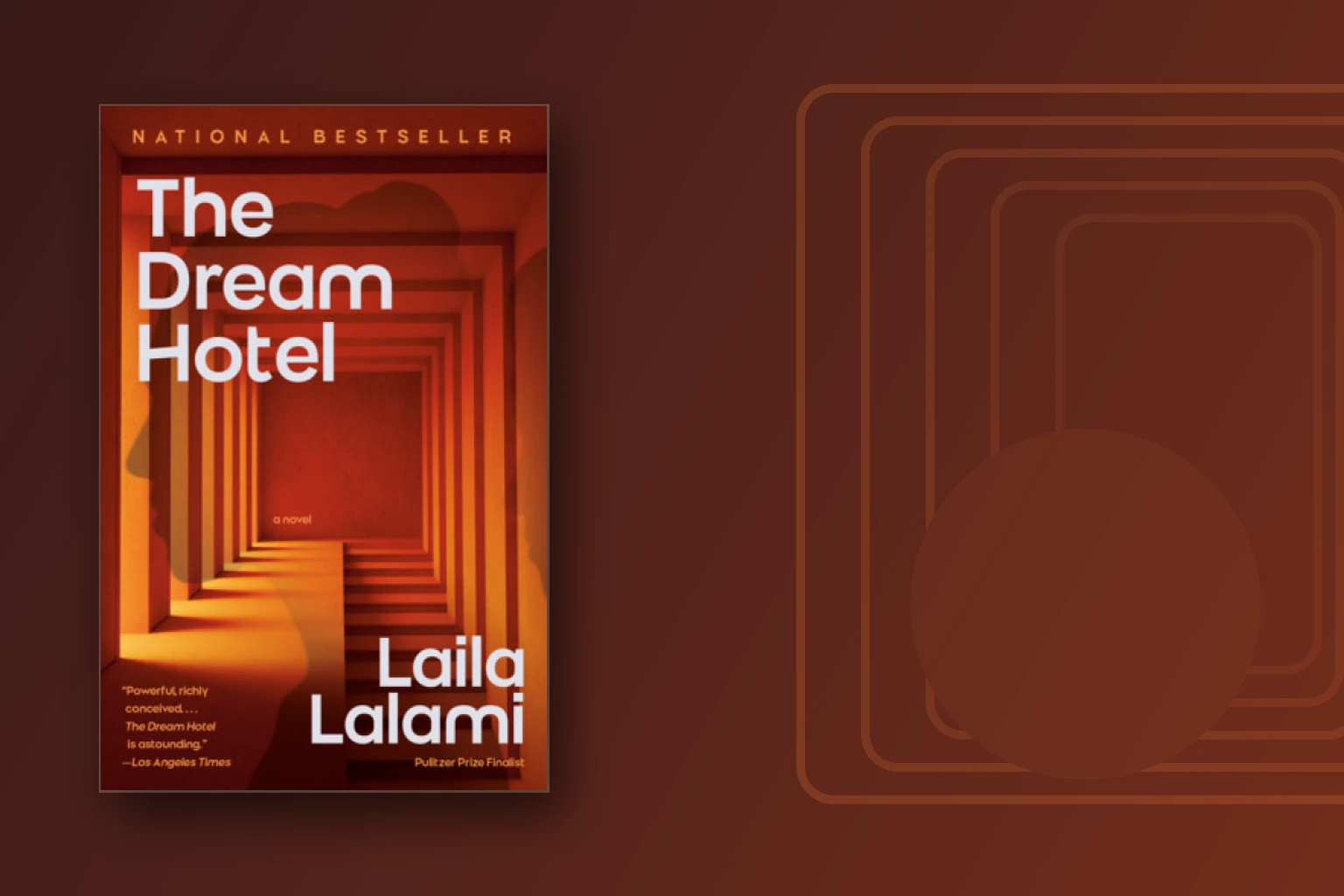
Literature & Thought · TALE24 REVIEW
The Dream Hotel: When a Prediction Becomes a Sentence
Laila Lalami turns a forecast drawn from dreams into a chilling test of justice. The novel's sharpest question is who gets to contest a prediction once an institution treats it as proof.
A gripping premise that turns privacy and due process into immediate human stakes
A prediction should be a claim about what might happen. In Laila Lalami’s The Dream Hotel, it becomes a reason to confine someone now. Sara returns to Los Angeles from a conference and is stopped by agents who say information drawn from her dreams shows she may harm her husband. She has committed no crime. That distinction ought to end the matter, yet it is precisely what the system has learned to ignore. Lalami’s near-future premise is unsettling because its first act of violence is grammatical: a possibility is spoken about as if it were a fact.
The authorities call Sara’s confinement observation and give it a twenty-one-day limit. At the retention center, however, rules shift, deviations lengthen a stay, and time begins to lose its promise of an endpoint. The gap between the institution’s reassuring vocabulary and its practical power is central to the book’s force. A hotel implies temporary shelter and the freedom to leave; the title makes that ordinary expectation feel bitterly ironic. The people administering detention need not announce themselves as villains for the structure to be frightening. Its forms, schedules, and supposedly neutral assessments do much of the work.
Dreams are a clever choice of evidence because they can be vivid without being voluntary. A sleeping mind may produce an image a waking person would reject, fear, or barely remember. Treating such material as a reliable confession makes interior life available for punishment while stripping its owner of the usual means of explanation. Sara cannot simply offer a competing account of what she intended to do; intention has already been replaced by a score. Lalami’s question is therefore larger than whether the technology works. Even an accurate statistical forecast would not settle who deserves to be deprived of liberty, for how long, or on whose authority.
The novel also makes privacy a matter of power rather than personal preference. People often speak of sharing data as a bargain: disclose something intimate and receive convenience in return. Sara’s predicament shows how little control may remain once that information can move between a company and the state. A person who did not expect her sleeping thoughts to become a government file cannot meaningfully consent after the fact. The publisher describes Sara’s path toward confronting the companies behind her confinement, a reminder that a predictive system has designers, owners, and incentives. Calling the outcome an algorithmic decision can make those human choices seem to disappear.
Inside the center, Sara is held alongside other women trying to establish their innocence of crimes they have not committed. Their shared position matters. A thriller built only around one exceptional victim might let readers imagine that a smarter defense or a more sympathetic official could repair the mistake. A room full of detainees points instead to a repeatable procedure. It suggests that the burden of proof has been turned around for everyone caught in the system. Each woman must argue against a future the institution has already written for her, and the institution can always treat uncertainty as a reason to keep watching.
That design gives Lalami a way to join suspense to social criticism. Every extension of Sara’s stay raises a practical question about what she can do next, while also making the rules themselves harder to defend. The arriving resident mentioned in the publisher’s description promises a disruption, but the novel’s appeal does not depend on disclosing its later turns in advance. The more interesting tension is between a system that claims perfect legibility and people who remain unpredictable to one another. Solidarity in such a place has value precisely because no data model can reduce it to a risk category.
There is a temptation to read the story as a simple warning about future gadgets. Its more durable concern is the old habit of treating administrative language as moral authority. Observation sounds gentler than detention; risk sounds more objective than suspicion. Neither word answers whether the person affected can challenge the evidence or leave. Lalami’s speculative setting gives those habits a concentrated form. Readers need not believe that dream analysis will soon become standard practice to recognize how easily a claim of safety can move scrutiny away from the people wielding power and onto the person asked to surrender freedom.
The high-concept premise has a cost. Its mechanism can draw so much attention that a reader may want a more technical account of how the system interprets a dream or calculates danger. Yet that demand can also reproduce the novel’s trap: assume the right answer lies in perfecting the machine rather than examining the decision it is allowed to make. The book is strongest when Sara remains more than an example in a debate. Her fear, resistance, and relationships keep the moral issue attached to a person with a life beyond the file that purports to describe her.
For readers who like speculative fiction grounded in institutional detail, The Dream Hotel offers a particularly sharp form of unease. It asks how a society should handle uncertain futures and refuses the comforting thought that better measurement will automatically produce better judgment. Prediction may help people prepare. It becomes dangerous when it erases the difference between preparation and punishment. Lalami leaves us with a question that outlasts the novel’s machinery: if a person is always treated as the worst thing a model imagines she might do, where can she make a case for the life she is actually living?
EDITOR’S VERDICT
Tale24’s assessment
A gripping premise that turns privacy and due process into immediate human stakes
Points to considerReaders seeking a detailed technical explanation of the predictive system may find the social and moral questions more developed
Best for: Readers of literary dystopias, surveillance fiction, and character-led political thrillers
Editorial method: This is an independent assessment informed by the work and its official supporting information. AI tools may assist the drafting process; Tale24 reviews and takes responsibility for everything it publishes.