Psychology & Skills · CRITICAL ESSAY
Make It Stick: Why Productive Struggle Outperforms Easy Fluency
Combining a ten-year cognitive research program with vivid field reporting, Make It Stick dismantles passive rereading and learning-style myths while clarifying where memory drills stop short.
Translates a decade of replicated memory science into memorable stories and concrete study routines for students and instructors.
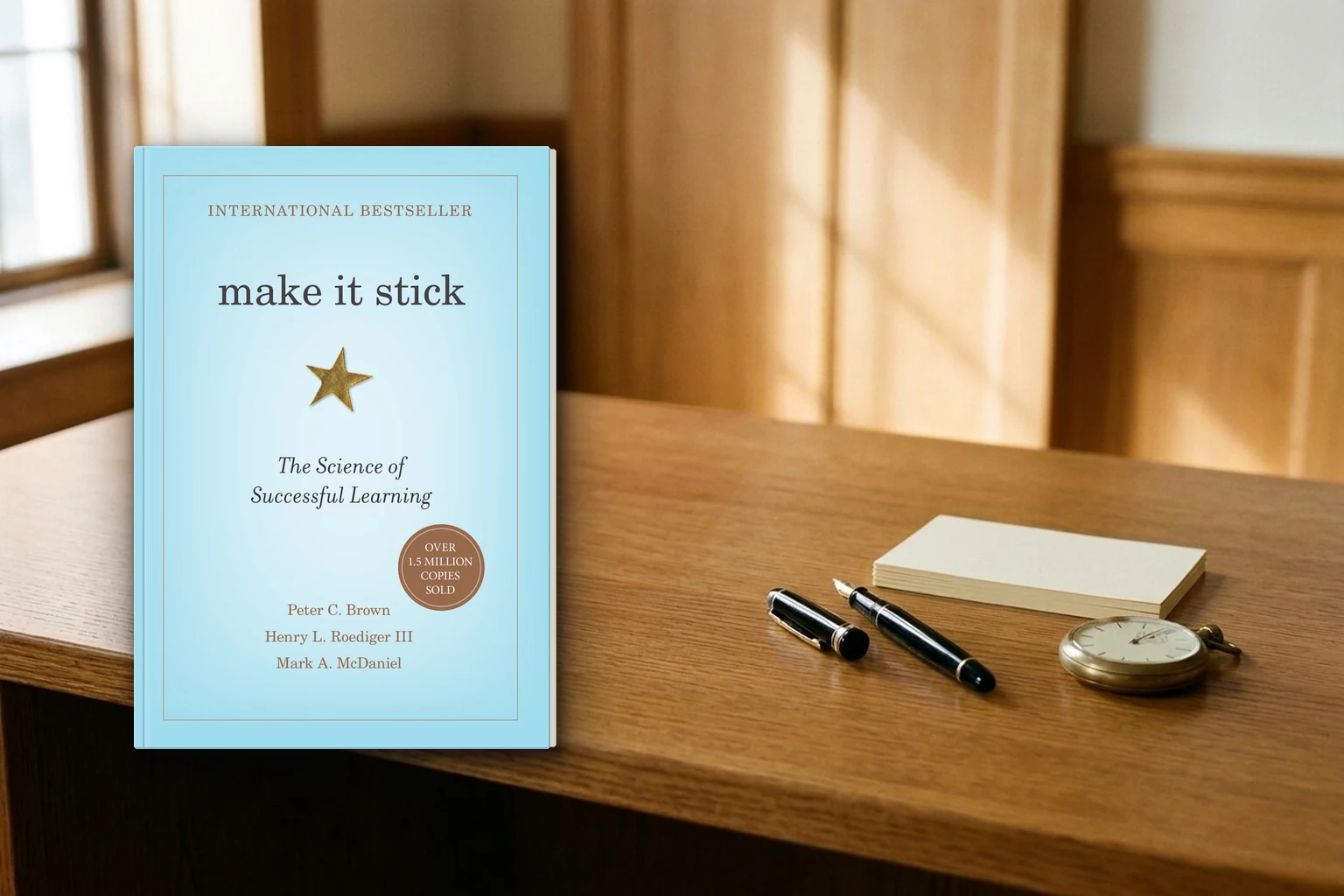
Most popular books on study habits begin by offering clever shortcuts; Make It Stick: The Science of Successful Learning begins by telling students and trainers that comfort is usually a sign they are wasting their time. Published in 2014 by Belknap Press of Harvard University Press in a verified 336-page volume, the book pairs novelist and storyteller Peter C. Brown with Washington University in St. Louis cognitive psychologists Henry L. Roediger III and Mark A. McDaniel. Distilling a ten-year multi-institution research collaboration funded by the James S. McDonnell Foundation, the authors set out to overturn conventional classroom instincts.
Assessed on its empirical grounding and pedagogical utility, Make It Stick earns its reputation as a gold-standard manual for durable retention. Its strength lies in explaining why fluent rereading deceives learners into overconfidence—yet an honest appraisal must also acknowledge its boundaries, particularly where controlled laboratory recall meets messy, open-ended creative or diagnostic judgment.
Exposing the Illusion of Knowing
The opening chapters establish a deliberately contrarian premise: the study routines students trust most—rereading highlighted textbook passages, reviewing clean lecture outlines, and drilling one skill relentlessly in concentrated blocks—feel productive precisely because they keep material in short-term working memory. That effortless recognition creates what cognitive researchers call an "illusion of knowing," convincing learners they have mastered concepts that evaporate days after a quiz. Massed practice and repeated review reward short-term familiarity without building the retrieval cues needed weeks later.
Across eight structured chapters—moving from "Learning Is Misunderstood" and "To Learn, Retrieve" through "Mix Up Your Practice," "Embrace Difficulties," "Avoid Illusions of Knowing," "Get Beyond Learning Styles," "Increase Your Abilities," and "Make It Stick"—the authors argue that genuine consolidation requires cognitive friction. Memory traces strengthen not when information glides smoothly back into view, but when the learner struggles to reconstruct knowledge from scratch, interrupts forgetting just as recall begins to slip, and ties new concepts to existing mental models. That shift reframes struggle itself from an embarrassing sign of incompetence into the active biological signal that durable neural pathways are being forged.
Desirable Difficulties and Five Core Mechanisms
What separates Make It Stick from generic productivity advice is the precision of the five cognitive mechanisms anchoring its chapters. First is retrieval practice, often termed the testing effect: low-stakes self-quizzing and active recall build stronger neural retrieval routes than passive re-exposure because pulling a memory out reconstructs and stabilizes it. Second is spaced practice, distributing study sessions across intervals so slight forgetting occurs and effortful re-retrieval triggers deeper reconsolidation rather than letting massed cramming fade overnight.
Third is interleaving and varied practice, mixing related problem types or categories within a single session rather than mastering one isolated template before touching the next; although blocked drilling feels smoother in the moment, interleaved switching trains learners to diagnose which method a real problem calls for. Fourth is generation, elaboration, and metacognitive calibration—attempting to solve an unfamiliar problem before seeing the worked answer and checking one's subjective confidence against objective recall rather than intuition. Fifth, Chapter 6 delivers an empirical dismantling of the persistent educational myth that tailoring instruction to fixed visual, auditory, or kinesthetic "learning styles" raises student performance, urging learners instead to match strategies to the underlying demands of the material.
Narrative Craft in Service of Cognitive Science
Academic psychology books frequently falter when co-authors bolt dry experimental summaries onto breezy anecdotes. Reviewing Make It Stick for Times Higher Education, Hazel Christie judged the collaboration "a lively and engaging book on the science of learning" and "a must," specifically praising the "seamless and polished" integration between Roediger and McDaniel's experimental authority and Brown's storytelling craft.
That balance shows throughout the text. Rather than burying readers inside isolated laboratory tables, the authors animate retrieval, spacing, and varied practice through fighter pilots drilling cockpit emergencies, neurosurgeons honing split-second clinical calibration, athletic coaches, gardeners, and college undergraduates transforming failed exam routines. By placing professional mastery alongside everyday classroom studying, the book makes metacognitive calibration concrete: learners see how treacherous subjective fluency feels when stakes are real. The closing chapter ("Make It Stick") converts theory into four clear, distinct routines tailored separately for students, lifelong self-learners, classroom teachers, and workplace trainers.
Boundary Conditions, Rote Risks, and Student Resistance
Even robust cognitive science carries clear scope limits that attentive educators highlight alongside the book's recommendations. First is the challenge of far transfer in complex, ill-structured work: much foundational testing-effect research relies on closed-loop declarative tasks such as vocabulary pairs, factual trivia, or straightforward reading comprehension, leaving open how directly basic retrieval drills transfer to open-ended historical synthesis, nuanced clinical diagnosis, or original design work.
Second, memory researchers including Cindy Nebel and colleagues distinguish between "narrow" and "broad" retrieval effects, warning that poorly written low-stakes multiple-choice quizzes stripped of explanatory feedback or conceptual elaboration can encourage isolated fact memorization rather than flexible schema building. Third, readers occasionally notice deliberate pacing repetition: the authors reintroduce core themes across chapters to model spaced review, which can feel slightly redundant in a continuous read. In real classrooms, instructors also encounter steady student pushback because "desirable difficulties" feel harder and yield lower immediate confidence than comfortable rereading, even when objective long-term retention improves. Bridging that motivational gap requires coaching learners to recognize difficulty as progress rather than failure.
Verdict for Contemporary Readers
Make It Stick does not claim to solve curriculum design, classroom equity, or deep domain mentorship on memory mechanics alone, and readers looking for nuanced theory on open-ended creative synthesis should supplement it with subject-specific pedagogy. Yet within its intended territory—explaining how human memory actually acquires, retains, and retrieves reliable knowledge—few general-interest books match its clarity and empirical discipline. By treating memory as an active craft of reconstruction rather than a passive mental tape recorder, the authors permanently raised the standard for evidence-based study advice.
For college and high school students, faculty members, instructional designers, medical and technical trainers, and self-directed adult learners, the Belknap Press edition remains essential. Taken seriously not as a defense of mindless quiz drills but as an invitation to active reconstruction, spaced calibration, and honest self-testing, it offers one of the most dependable bridges between laboratory psychology and everyday intellectual work. Even readers who already suspect cramming fails will find clear experimental explanations from that ten-year cognitive science partnership that make demanding study habits far easier to justify and sustain over time.
CRITICAL PERSPECTIVE
Tale24’s assessment
Translates a decade of replicated memory science into memorable stories and concrete study routines for students and instructors.
Points to considerCore testing-effect studies lean toward closed-loop factual recall, leaving open questions around far transfer in creative or open-ended work.
Best for: College and high school students, educators, instructional designers, medical and technical trainers, and self-directed learners.
Editorial method: This is Tale24’s original analysis of the published material and attributed criticism. AI tools may assist the drafting process; Tale24 reviews and takes responsibility for everything it publishes.
READING AND RESEARCH
Sources and edition scope
Bibliographic details and textual claims in this review were checked against the edition and reference records below (Make It Stick: The Science of Successful Learning by Peter C. Brown, Henry L. Roediger III, and Mark A. McDaniel). Commercial retailer links are kept separate from editorial verification.
- hup.harvard.edu — books / 9780674729018 Library & bibliographic record
- hup.harvard.edu — PDF / 9780674729018 sample.pdf Library & bibliographic record
- timeshighereducation.com — make it stick the science of successful learning by peter c brown henry l roediger iii and mark a mcdaniel / 2012346.article Editorial reference
Sources checked November 23, 2026.
KEEP READING