Technology & Careers · CRITICAL ESSAY
Chip War: How Microscopic Silicon Became Modern Geopolitics
Economic historian Chris Miller turns seventy years of lithography optics, Pentagon procurement, and Taiwanese foundries into a gripping account of global chokepoint power—just as US export controls reshaped the race.
Crystal-clear storytelling that makes intricate EUV lithography and TSMC's global foundry chokepoint gripping for non-engineers.
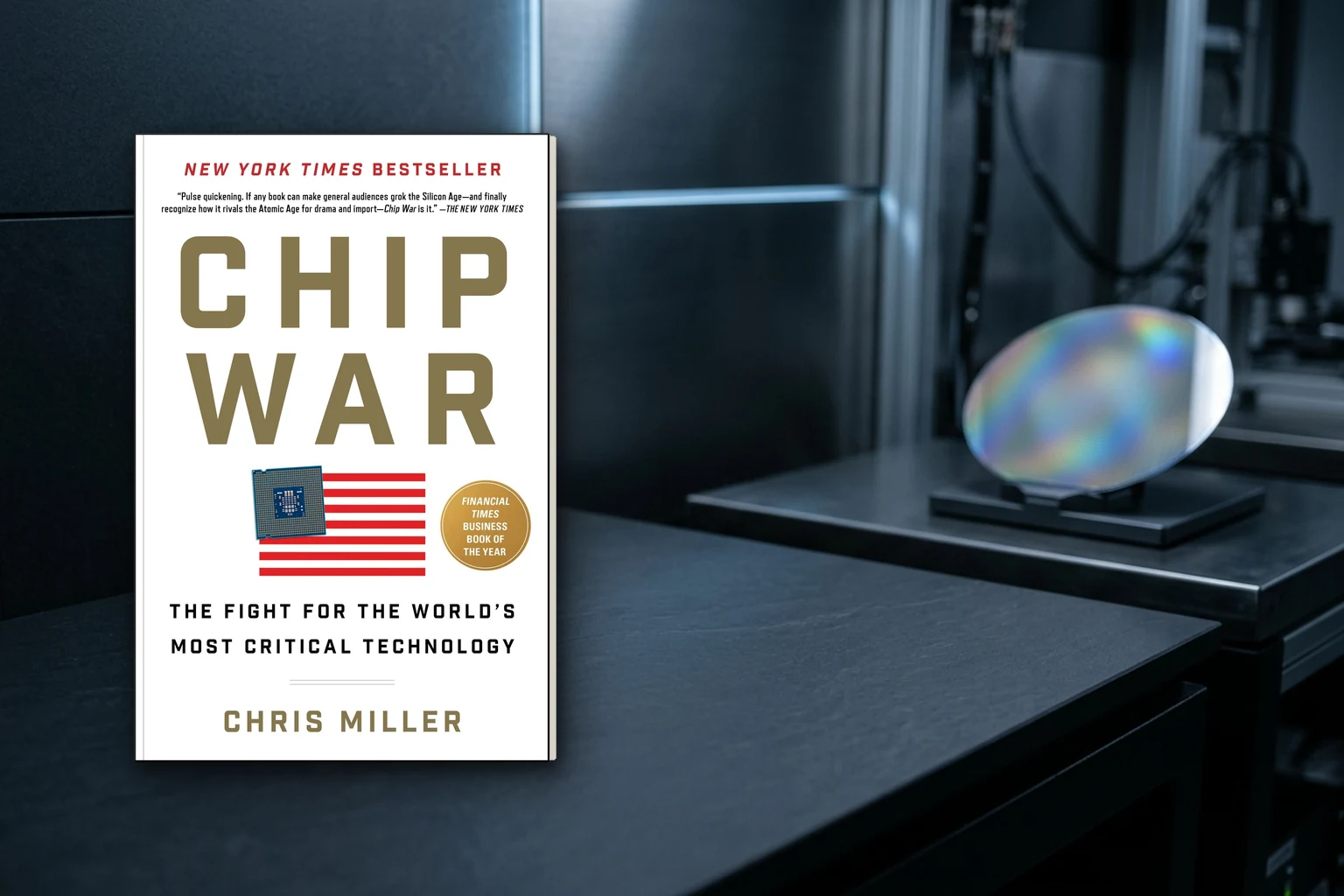
For much of the twentieth century, geopolitical power was measured in barrels of crude oil, tons of rolled steel, and armored divisions. In Chip War: The Fight for the World's Most Critical Technology, published by Scribner in a verified 464-page volume, Tufts University economic historian Chris Miller argues that the decisive strategic resource of the twenty-first century now sits inside microscopic slivers of etched silicon. Winning both the 2022 Financial Times Business Book of the Year Award and the Gold Medal for the 2023 Council on Foreign Relations Arthur Ross Book Award, Miller's bestseller quickly became required reading across policy circles and executive boardrooms.
Assessed critically, Chip War succeeds brilliantly at demystifying the world's most complex supply chain for general readers, while revealing intriguing blind spots around state capitalism and fast-moving export-control politics that unfolded right as the book went to press.
From Cold War Defense Labs to Silicon Valley
Miller's overarching premise is stark: advanced microchips govern everything from smartphones, automobiles, and financial clearing networks to precision missile guidance and artificial intelligence clusters, yet no single country on Earth can manufacture cutting-edge semiconductors independently. Instead, fabrication relies on the most geographically specialized supply chain ever built, spanning US electronic design software, Japanese specialty chemicals, Dutch lithography optics, and Taiwanese wafer plants. Whoever controls those narrow chokepoints wields extraordinary economic and military leverage across global industry and defense.
To trace how that vulnerability emerged, Miller organizes the narrative into eight chronological and thematic parts containing more than fifty brisk, focused chapters. Part 1 ("Cold War Chips") begins not with carefree garage entrepreneurs, but with the Bell Labs transistor breakthrough and Pentagon and NASA procurement contracts—notably Minuteman missile guidance computers—that sustained early chipmakers when civilian demand barely existed. Parts 2 through 4 ("The Circuitry of the American World," "Leadership Lost?," and "America Resurgent") follow pioneers including Jack Kilby at Texas Instruments, Robert Noyce and Fairchild Semiconductor, and Intel, before chronicling the fierce 1970s and 1980s Japanese DRAM surge that nearly bankrupted US memory producers, bitter trade friction, and Intel's pivotal turn toward microprocessors.
Taiwan, the Netherlands, and Global Chokepoints
Chip War reaches peak strategic clarity in Parts 5 and 6 ("Integrated Circuits, Integrated World?" and "Offshoring Innovation?"), spotlighting the two monumental bottlenecks defining twenty-first-century hardware risk. First is Morris Chang's founding of Taiwan Semiconductor Manufacturing Company (TSMC), whose "pure-play" foundry model—fabricating chips designed by external customers rather than competing against them—concentrated more than a fifth of global semiconductor output and the overwhelming share of leading-edge logic chips on a geopolitically contested island. By separating chip design from capital-intensive manufacturing, Chang enabled fabless companies worldwide to innovate rapidly while anchoring the entire global electronics ecosystem in Taiwanese fabrication capacity.
Second is Dutch manufacturer ASML's multi-decade mastery of Extreme Ultraviolet (EUV) lithography machines, using ultra-precise lasers and mirrors to print atomic-scale patterns onto silicon wafers. By showing how decades of cross-border specialization created irreplaceable single points of failure across Taiwan and the Netherlands, Miller converts abstract globalization theory into tangible hardware vulnerability that cannot be replicated overnight by decree or tariff alone. Readers come away understanding why a single machine or island factory can weigh as heavily in strategic diplomacy as oil reserves or naval fleets.
Making Industrial Physics Read Like a Thriller
Turning such intricate industrial engineering and capital-expenditure economics into brisk, accessible history is Miller's foremost literary triumph. The New York Times hailed the book as a "nonfiction thriller" rivaling Atomic Age drama, while Kirkus Reviews recommended it as an urgent warning for policymakers. Both the Financial Times and the Council on Foreign Relations rewarded Miller specifically for making physical hardware legible to non-engineers without diluting strategic stakes.
That structural pacing works cleanly across fifty-plus short chapters: each vignette highlights a decisive technical hurdle, corporate gamble, or strategic miscalculation without bogging readers down in textbook semiconductor physics. For general audiences accustomed to thinking of computing as weightless software and cloud abstractions, Miller restores the cleanrooms, precision optics, specialty materials, and shipping lanes sitting quietly underneath every digital service. Connecting Cold War missile defense directly to contemporary artificial intelligence clusters reveals how uninterrupted that material thread has remained across seven decades.
Export Controls, Subsidies, and Framing Blind Spots
Yet perceptive reviewers in economics and international affairs identified real analytical tensions and timing boundaries. Reviewing Chip War in Foreign Affairs, economist Barry Eichengreen praised it as "At once edifying and entertaining," while pointing out an unavoidable editorial timing limit: Miller finalized his manuscript right before the sweeping October 2022 US export controls barring China from advanced chips and fabrication gear. Consequently, Parts 7 and 8 ("China's Challenge" and "The Chip Choke")—examining Beijing's massive state subsidies, Huawei, and SMIC—leave open the central strategic gamble of whether containment curbs Chinese capacity or triggers an indigenous "Sputnik moment" alongside heightened brinkmanship over Taiwan.
Economic and political commentators also flagged an instructive asymmetry in Miller's framing. Although his own chapters document how decisively Pentagon R&D and guaranteed military contracts launched early Silicon Valley, American growth is framed primarily in the language of free-market entrepreneurship, while Japanese, South Korean, and Chinese state industrial policies draw sharper skepticism. Technical analysts further note that software ecosystems, developer tooling, and routine engineering trade-offs receive far less attention than macro-geopolitical drama, reminding readers that hardware power always operates alongside software dependency. Reading the book with that dual awareness prevents turning a vital history of supply chains into simplified geopolitical determinism, while sharpening attention to how policy choices reshape global innovation networks over the next decade.
Verdict for Contemporary Readers
Chip War is neither a technical semiconductor engineering textbook nor the final word on fast-evolving export sanctions and the CHIPS Act (addressed only in later updated editions). What Miller delivers instead is an indispensable historical roadmap explaining how national security, global trade, and modern computation became fused together inside tiny wafers of silicon. Even where newer policy shifts move faster than print schedules allow, his historical foundation clarifies why export restrictions, fab subsidies, and Taiwanese stability carry global consequences.
For technology professionals, policy analysts, investors, business leaders, and curious nonfiction readers trying to understand the physical hardware foundation beneath modern artificial intelligence and US-China rivalry, Scribner's edition remains the clearest, most engaging starting point available. Few modern business histories illuminate such an invisible layer of daily civilization with comparable pace and clarity.
CRITICAL PERSPECTIVE
Tale24’s assessment
Crystal-clear storytelling that makes intricate EUV lithography and TSMC's global foundry chokepoint gripping for non-engineers.
Points to considerWent to press just prior to sweeping October 2022 US export controls and frames American defense subsidies more favorably than Asian industrial policy.
Best for: Tech industry leaders, policy analysts, investors, business strategists, and general nonfiction readers tracking AI and US-China rivalry.
Editorial method: This is Tale24’s original analysis of the published material and attributed criticism. AI tools may assist the drafting process; Tale24 reviews and takes responsibility for everything it publishes.
READING AND RESEARCH
Sources and edition scope
Bibliographic details and textual claims in this review were checked against the edition and reference records below (Chip War: The Fight for the World's Most Critical Technology by Chris Miller). Commercial retailer links are kept separate from editorial verification.
- simonandschuster.com — Chris Miller / 9781982172008 Publisher's edition record
- cfr.org — articles / chip war analysis geopolitics critical technology wins 2023 arthur ross book award Editorial reference
- ig.ft.com — winner / chip war by chris miller Editorial reference
- foreignaffairs.com — reviews / chip war fight worlds most critical technology Editorial reference
Sources checked November 23, 2026.
KEEP READING