Science & Nature · TALE24 REVIEW
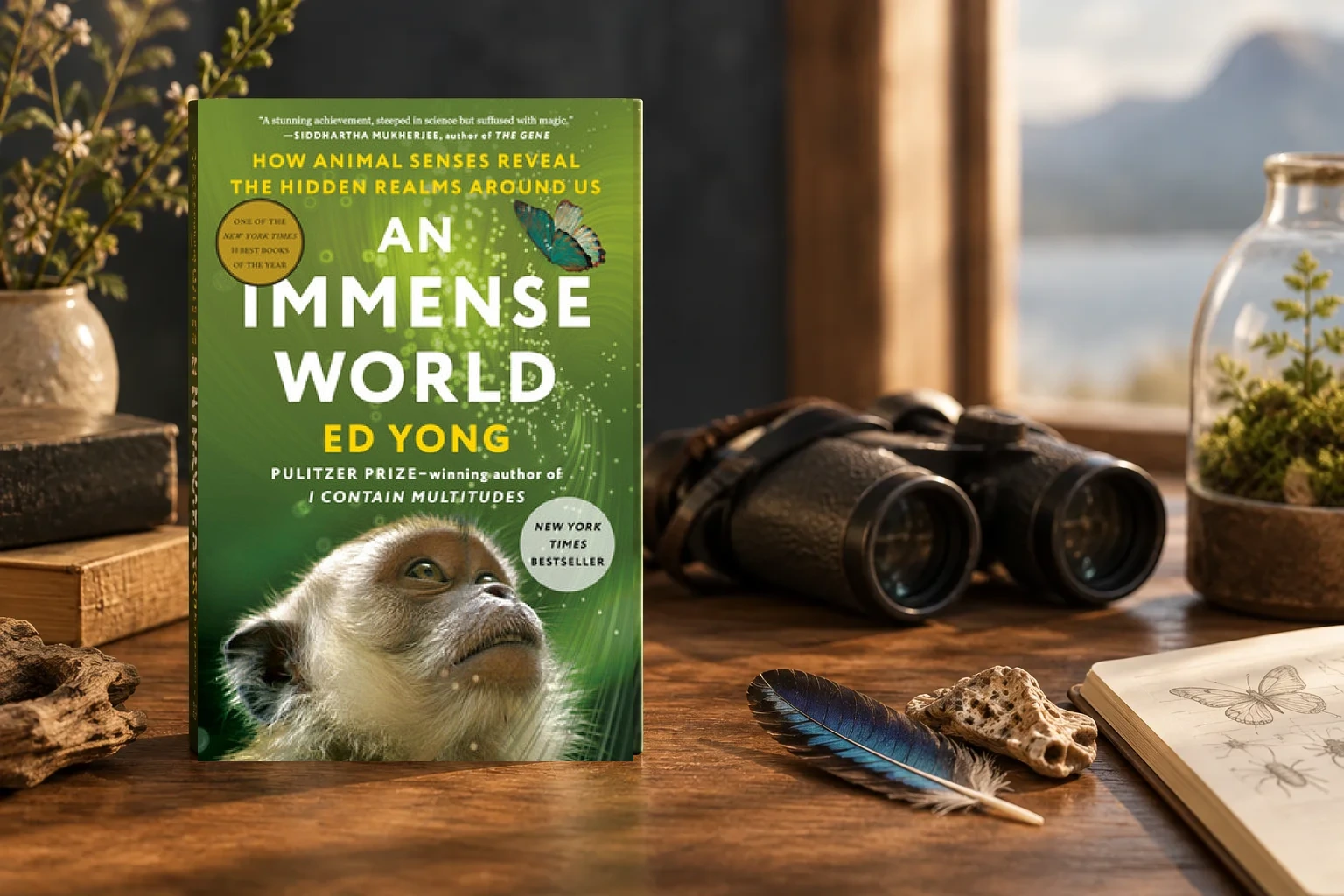
An Immense World: The Senses We Cannot Borrow
Ed Yong makes animal perception vivid without pretending humans can inhabit another creature’s mind. The result is a science book about wonder, uncertainty, and the limits of our own senses.
Rigorous and vivid reporting that links sensory science to a practical ethic of attention
A dog stops at a patch of pavement and reads what a person walks past. Ed Yong’s An Immense World begins from that everyday imbalance: we share a place with other animals, yet we do not share the same version of it. Smell, vibration, electrical signals, sound, and light offer different routes through a landscape that humans often call familiar. The book’s achievement is to make those routes imaginable without claiming that imagination is the same as entry. Its deepest lesson is not that animals possess exotic talents. It is that human perception has never been a complete account of the world.
Yong organizes his inquiry around sensory experience rather than a parade of species. That choice prevents the book from becoming a collection of clever animal facts. A beetle drawn toward a fire, a turtle responding to the Earth’s magnetic field, and a fish exchanging electrical signals each raises a question about what information an environment offers to a particular body. The same river or patch of land can contain channels of meaning unavailable to a human observer. What looks like an empty space to one creature may be crowded with warnings, opportunities, or traces of another life to a second.
The useful term here is umwelt, a creature’s perceptual world. It can be misunderstood as a private fantasy detached from reality. Yong’s account suggests something more concrete: a sensory system selects from real physical signals, and that selection shapes what an animal can notice and do. Humans have an umwelt too. Our difficulty is that ours feels like the default because it is the one we cannot step outside. The book repeatedly unsettles that assumption. It invites curiosity about other animals while refusing the easy claim that a technological image or a vivid analogy lets us know exactly how being one of them feels.
Vision provides some of the most tempting comparisons. Humans tend to ask whether another creature sees better or worse than we do, as though all eyes were entries in one contest. Yong’s examples complicate that scale. The publisher describes scallops with complex vision and giant squid eyes shaped by pressures very different from those that govern our own sight. A visual system has to be understood in relation to its owner’s body and tasks. More detail is not always more useful, and an unfamiliar arrangement is not a failed human eye. The question shifts from ranking abilities to asking what each form of perception makes possible.
Other senses require an even larger adjustment. Electrical communication in fish and magnetic orientation in turtles resist easy translation into human experience. Yong’s reporting gives the reader experiments, observations, and analogies to work with, but it also leaves room for uncertainty. Scientists may establish that an animal responds to a signal while still debating the mechanism or the character of its experience. This distinction is central to good science writing. The book’s wonder is stronger when a mystery remains a mystery than when a metaphor is mistaken for a final answer.
Such caution does not make the writing cold. Yong is alert to the pleasure of discovery, and his range of creatures keeps the reader moving from one sensory problem to another. That abundance has a cost. A reader may reach the end of a chapter remembering a string of striking examples more clearly than the experimental differences between them. The book rewards pauses and returns; it is less suited to being treated as a list of facts to memorize. Its real continuity lies in a habit of asking what a researcher had to notice before an animal’s behavior became intelligible.
The human stakes become clearest when perception meets a changed environment. Artificial light and noise are not neutral background from the perspective of animals that navigate, communicate, hunt, or reproduce through those channels. A streetlamp can alter a route; persistent sound can mask a signal. Yong’s discussion of sensory pollution makes conservation less abstract. Protecting a species may require more than setting aside land. It may require understanding the conditions under which that land can still be heard, seen, smelled, or otherwise used by its inhabitants. A place that looks intact to us can become hard to inhabit for another creature.
This ethical turn is persuasive because it follows from the science instead of being attached as a final moral. If we mistake our own sensory world for the whole environment, we can damage lives without even recognizing the disturbance. Yet humility should not become a claim that humans can never learn enough to act. Experiments and careful observation offer partial knowledge, and partial knowledge can guide better choices. The book’s method joins restraint to responsibility: admit what cannot be known directly, then take seriously what the evidence does show.
An Immense World will delight readers interested in biology, ecology, and the craft of explaining difficult ideas. Its many examples can occasionally feel overwhelming, and anyone looking for a simple ladder from lesser to greater senses will be frustrated. Those are useful frustrations. The book does not ask us to imagine a single harmonious animal kingdom; species also encounter one another as food, danger, or competition. Attention is more honest when it admits those conflicts alongside beauty. Yong makes a backyard, a river, or a city street seem less like scenery arranged for human use and more like a meeting point of different perceptual lives. We cannot borrow those senses at will. We can learn to stop treating their absence from our experience as evidence that they do not matter.
EDITOR’S VERDICT
Tale24’s assessment
Rigorous and vivid reporting that links sensory science to a practical ethic of attention
Points to considerThe sheer number of species and discoveries can overwhelm readers who prefer a narrow, linear argument
Best for: Curious general readers of science, ecology, animal behavior, and environmental writing
Editorial method: This is an independent assessment informed by the work and its official supporting information. AI tools may assist the drafting process; Tale24 reviews and takes responsibility for everything it publishes.