Literature & Thought · TALE24 REVIEW
The Seven Husbands of Evelyn Hugo: The Price of a Public Life
Taylor Jenkins Reid uses a Hollywood legend’s confessions to examine how ambition, love, and image making can leave lasting costs for the people around her.
The interview frame turns Hollywood glamour into a sustained inquiry about image, love, and control over a life story.
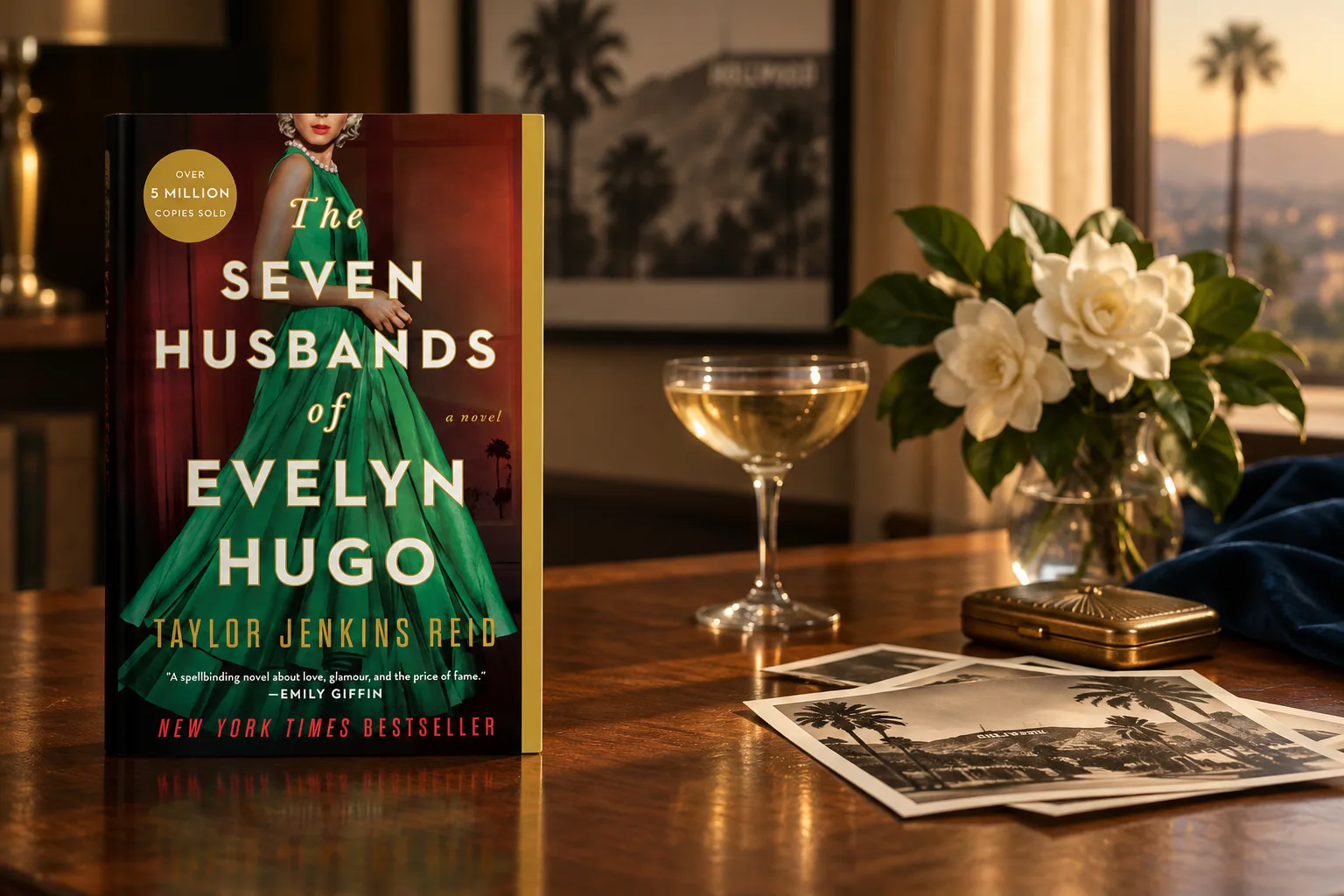
Seven marriages make an irresistible headline, but the question that animates Taylor Jenkins Reid’s The Seven Husbands of Evelyn Hugo is who gets to decide what a life means. The publisher introduces an aging Hollywood icon ready to tell her story to Monique Grant, a comparatively unknown reporter. Evelyn has spent decades being watched, photographed, and discussed; Monique is asked to listen to the account that has been withheld. The arrangement promises scandal and a late revelation, yet its deeper appeal lies in the distance between a marketable public image and the private costs of maintaining it. A glamorous life can be highly visible while its governing choices remain almost impossible for outsiders to see.
Evelyn’s seven husbands appear to offer a neat way of organizing her past. A count is easy to remember, easy to publicize, and easy to mistake for explanation. The publisher’s summary, however, emphasizes ambition, friendship, lost love, and a great forbidden relationship alongside the marriages. This contrast creates the novel’s central tension without needing to expose its secrets. Legal or public relationships need not map neatly onto emotional ones. If a celebrity’s biography is built around what can be printed in a headline, the headline may preserve the wrong story. Reid’s premise asks readers to notice what an apparently complete list leaves out.
The interview frame gives Evelyn unusual power. She selects Monique, sets the terms of access, and offers a narrative that others have wanted for years. The decision raises an immediate question: why this reporter? Monique has her own life in difficulty; the official description says her husband has left and her career has stalled. An exclusive story might help her professionally, but it also places her inside someone else’s carefully chosen account. The book’s two women are therefore linked by more than curiosity. One can give a career-making story, while the other must decide how to receive it. Their unequal positions make the act of telling as important as the events being told.
Hollywood offers a particularly sharp setting for that exchange. The industry manufactures durable images out of unstable human lives. A star can control a pose while losing control of the interpretation attached to it; she can also learn to use that ambiguity as a form of protection. The publisher traces Evelyn’s rise from the 1950s through her later withdrawal from show business, making her account span several decades of public judgment. The broad time frame matters because choices that once seemed necessary may look different from old age. An interview near the end of a career can become a reckoning with the bargains that made the career possible.
The novel’s promise of strong feeling follows from this collision of ambition and attachment. What is a person willing to hide to continue working, to protect someone, or to remain legible to the public? The publisher explicitly describes a forbidden love and the loves Evelyn lost. Those phrases suggest that the emotional stakes extend beyond the husband count, while leaving readers to discover their precise shape. Reid can use the pleasures of a celebrity tale to draw readers into questions about sacrifice. The seduction of the surface matters: a beautiful dress or storied career can make the underlying restriction more painful when it comes into view.
Monique’s role prevents the story from becoming only a retrospective confession. The publisher says Evelyn’s life intersects with hers in tragic and irreversible ways as the account nears its conclusion. That connection gives the interview a moral edge. Monique is not a neutral container for Evelyn’s memories; she has reasons to care about the truth and reasons to question the terms on which it arrives. A review should not reveal the intersection, because the force of the book depends on discovering it. It is enough to say that the frame makes the listener’s future part of the stakes, not merely the star’s past.
There is an ethical problem in any polished confession. To tell a life coherently is to select events, assign causes, and decide who deserves forgiveness. A charismatic speaker may make those choices feel inevitable. Reid’s setup invites readers to enjoy Evelyn’s authority while still asking what remains outside her telling. The seven husbands, the reporter, the hidden love, and the long public career all point to people who may understand the same history differently. That possibility makes the novel suitable for discussion after its revelations: readers can agree on what has been disclosed and still disagree about responsibility. Emotional intensity need not end critical judgment.
The novel also risks the simplifications built into its own appeal. A sequence of dramatic relationships and secrets can feel crowded to readers who prefer a quieter psychological study. Old Hollywood atmosphere may be irresistible, but it can also become a screen that makes hard choices seem more glamorous than they were. The publisher’s description emphasizes both a compelling rise and tragic consequences, so the standard of judgment should include whether the book keeps those consequences in view. Readers drawn only by the marriages may be surprised by how much of the story is about the cost of managing identity in public.
Reception quoted by Simon & Schuster repeatedly notes glamour, emotional force, and a significant late reveal. That is a useful signal of why the book travels through conversations and social feeds, but praise is not evidence that every reader will react in the same way. A reader may be moved by the hidden love, troubled by Evelyn’s compromises, or more interested in Monique’s position as a journalist. The best discussion need not ask who guessed the final connection. It can ask whether telling the truth late is an act of courage, an act of control, or a mixture of both. The publisher’s premise gives room for those different responses without spelling out the answer.
The Seven Husbands of Evelyn Hugo makes its public hook part of its critical question. Seven marriages are easy to count; a life’s motives are not. Evelyn’s account promises to correct the record, yet the power to correct it is itself a form of influence over the people who must hear it. Monique’s presence turns that influence into a relationship with immediate consequences. Reid’s novel is most interesting when the spectacle of fame leads readers toward the limits of a public story: the love it conceals, the bargains it requires, and the lives it touches after the spotlight moves on.
EDITOR’S VERDICT
Tale24’s assessment
The interview frame turns Hollywood glamour into a sustained inquiry about image, love, and control over a life story.
Points to considerIts crowded sequence of secrets and relationships may feel heavily plotted to readers who prefer a quieter study.
Best for: Readers of emotionally rich popular fiction, Hollywood stories, and book club discussions about love and reputation.
Editorial method: This is an independent assessment informed by the work and its official supporting information. AI tools may assist the drafting process; Tale24 reviews and takes responsibility for everything it publishes.