Literature & Thought · TALE24 REVIEW
The Girl on the Train: Seeing Is Not Knowing
Paula Hawkins turns a commuter’s passing glance into an inquiry about memory and credibility. Rachel’s uncertainty matters because other people are so ready to mistake it for proof that she has nothing useful to say.
An arresting train-window premise joins suspense to a thoughtful question about whose observations count.
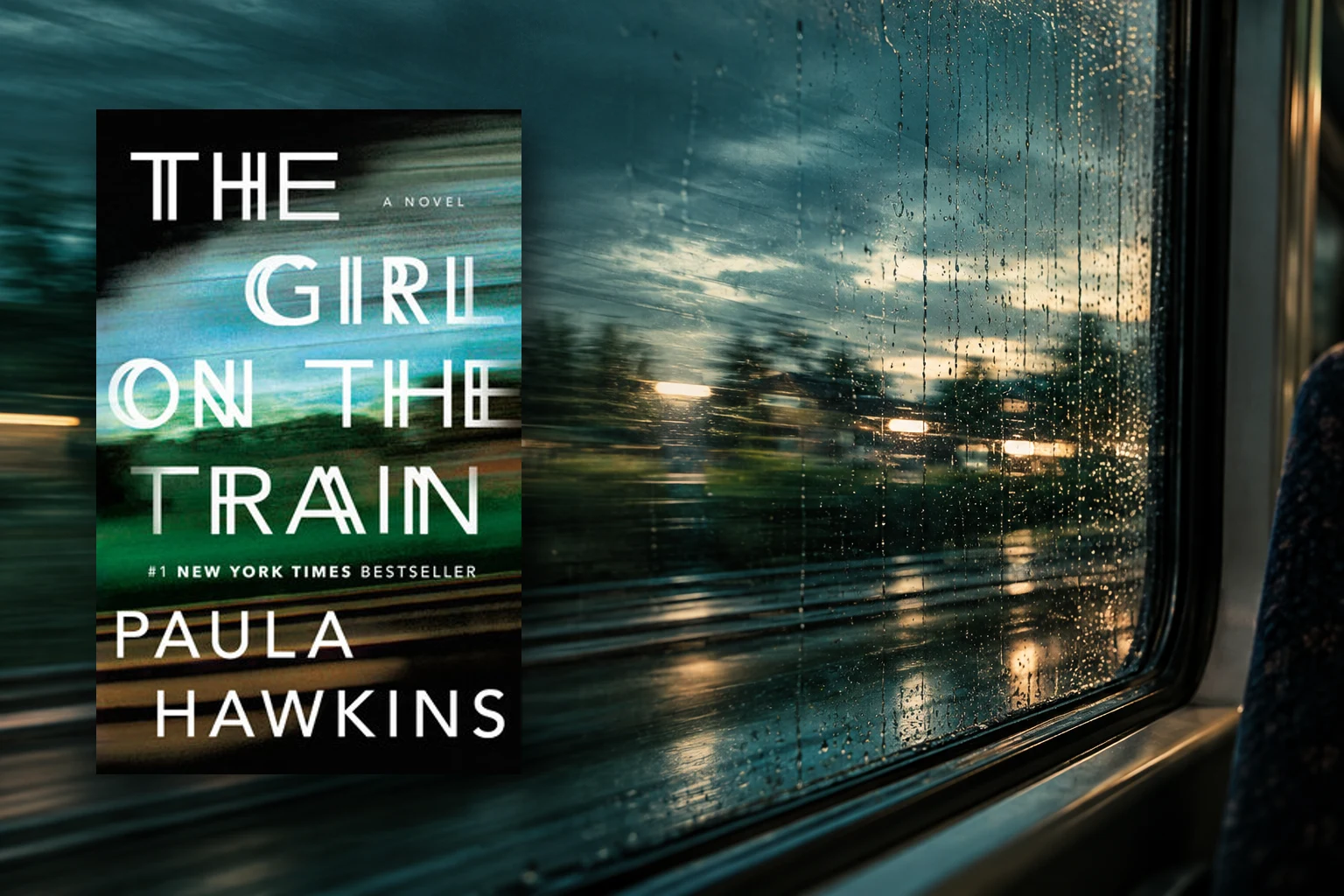
A train window offers a peculiar intimacy. It frames a home for a moment, then removes it before the observer can test what she thinks she saw. Paula Hawkins builds The Girl on the Train around that mismatch between visibility and knowledge. Rachel Watson watches a couple during her commute and imagines a happy life for them. When she later sees something that troubles her, the private story she invented becomes entangled with a real disappearance. The mystery begins in a passing glance, but it grows from the confidence with which a stranger can fill in everything a glance leaves out.
Rachel’s imagined couple is an important early measure of her own circumstances. The appeal of their apparent happiness is not only that it looks attractive. It can be made into a tidy narrative, free of the conflict and disappointment that make a lived relationship harder to understand. Hawkins does not ask us to mock this impulse. People constantly make stories from partial views of their neighbors and fellow travelers. The novel’s sharper move is to show what happens when such a story is mistaken for familiarity. Rachel has been watching, yet she knows far less than watching allows her to feel.
The train is therefore more than a clever location for a witness. Its motion sets a strict limit on evidence. A scene appears through glass, at a fixed distance, for only a short time. The observer cannot hear an explanation or ask a question. Movement provides both the novel’s rhythm and its epistemic problem: what happens in the interval after the view disappears? Rachel’s imagination supplies continuity. When events challenge that continuity, she must reconsider not only what she saw but the confidence with which she interpreted it.
Hawkins compounds this difficulty through Rachel’s uncertain memory. The publisher’s reading guide invites discussion of how much she can trust her recollections and how readily other people trust her. Her drinking is part of that problem, but the novel’s interest should not be reduced to a simple equation in which one person’s impairment makes all her observations worthless. Credibility is social as well as personal. Rachel can doubt herself while other people make judgments about her based on what they already believe a reliable witness ought to look like.
That tension gives the suspense an uncomfortable human scale. The reader wants Rachel to clarify the troubling sight and help establish what happened. At the same time, her attempts to do so are shaped by embarrassment, damaged confidence, and the knowledge that she may have misunderstood. Hawkins keeps uncertainty close to the person carrying it. The mystery is not a clean contest between a brilliant investigator and a hidden culprit. It is a struggle to speak with conviction when conviction itself has become suspect.
The different perspectives associated with Rachel, Anna, and Megan widen the book’s view beyond the train window. They remind us that no single participant possesses the whole domestic story. Each woman occupies a position from which others can be observed, misread, or dismissed. This arrangement could have become a mere technique for withholding clues. At its best, it instead reveals how much of a relationship is visible only from within, and how misleading that inner view can also be. Private knowledge is not automatically complete knowledge.
The novel is especially attentive to the stories society already has prepared for women. The publisher’s guide asks about expectations attached to marriage, motherhood, and Rachel’s response to her lost relationship. Those questions matter because a woman’s account can be heard through a ready-made role before its details receive attention. A wife, an ex-wife, and a woman viewed from a train are not neutral categories. Each carries assumptions about happiness, rivalry, and trustworthiness. Hawkins lets those assumptions affect the reading of testimony without turning the women into mere symbols.
There is also a moral complication in Rachel’s observation. Watching strangers from a public train is ordinary, but the pleasure of building a private fiction around them is less innocent once she becomes involved in their lives. The book does not need to treat curiosity as a crime to ask what it can conceal. Rachel’s imagined intimacy gives her motivation to care, yet it also makes it harder to separate a person from the role she has assigned. The reader shares that temptation. A compelling thriller uses our desire to know more while reminding us that desire is not a method of knowing.
Hawkins’s main strength is the fit between premise and form. The repeated journey and shifting accounts make uncertainty feel like a condition of daily perception rather than a trick introduced only to protect a final reveal. Scenes of looking, remembering, and explaining all test the same underlying question. That coherence gives the book more staying power than a puzzle whose value lies solely in its solution. It also creates a possible frustration: revisiting doubt can slow the forward movement of the investigation, especially for readers who want every new chapter to deliver a fresh, stable clue.
The novel’s darkness is grounded in ordinary forms of vulnerability. A relationship ends; a person loses confidence in her account of herself; another person’s seemingly perfect life becomes an object of envy. Hawkins draws suspense from the distance between those experiences and the polished surfaces visible to outsiders. The title promises a witness in motion, but its central problem is the difficulty of stopping long enough to understand anything fully. Looking closely is necessary; it is not sufficient.
The Girl on the Train works best when it makes us reconsider the authority we grant both sight and social reputation. Rachel may misread what she observes, but the people who judge her can also mistake their assumptions for evidence. The novel keeps those two kinds of error in view at once. Its mystery draws us forward; its more durable question concerns who is believed, on what grounds, and how quickly an attractive story can harden into a false certainty.
EDITOR’S VERDICT
Tale24’s assessment
An arresting train-window premise joins suspense to a thoughtful question about whose observations count.
Points to considerRepeated uncertainty can feel circular for readers who prefer a brisk, clue-led investigation.
Best for: Readers drawn to character-centered psychological suspense, imperfect memory, and competing perspectives.
Editorial method: This is an independent assessment informed by the work and its official supporting information. AI tools may assist the drafting process; Tale24 reviews and takes responsibility for everything it publishes.