Literature & Thought · TALE24 REVIEW
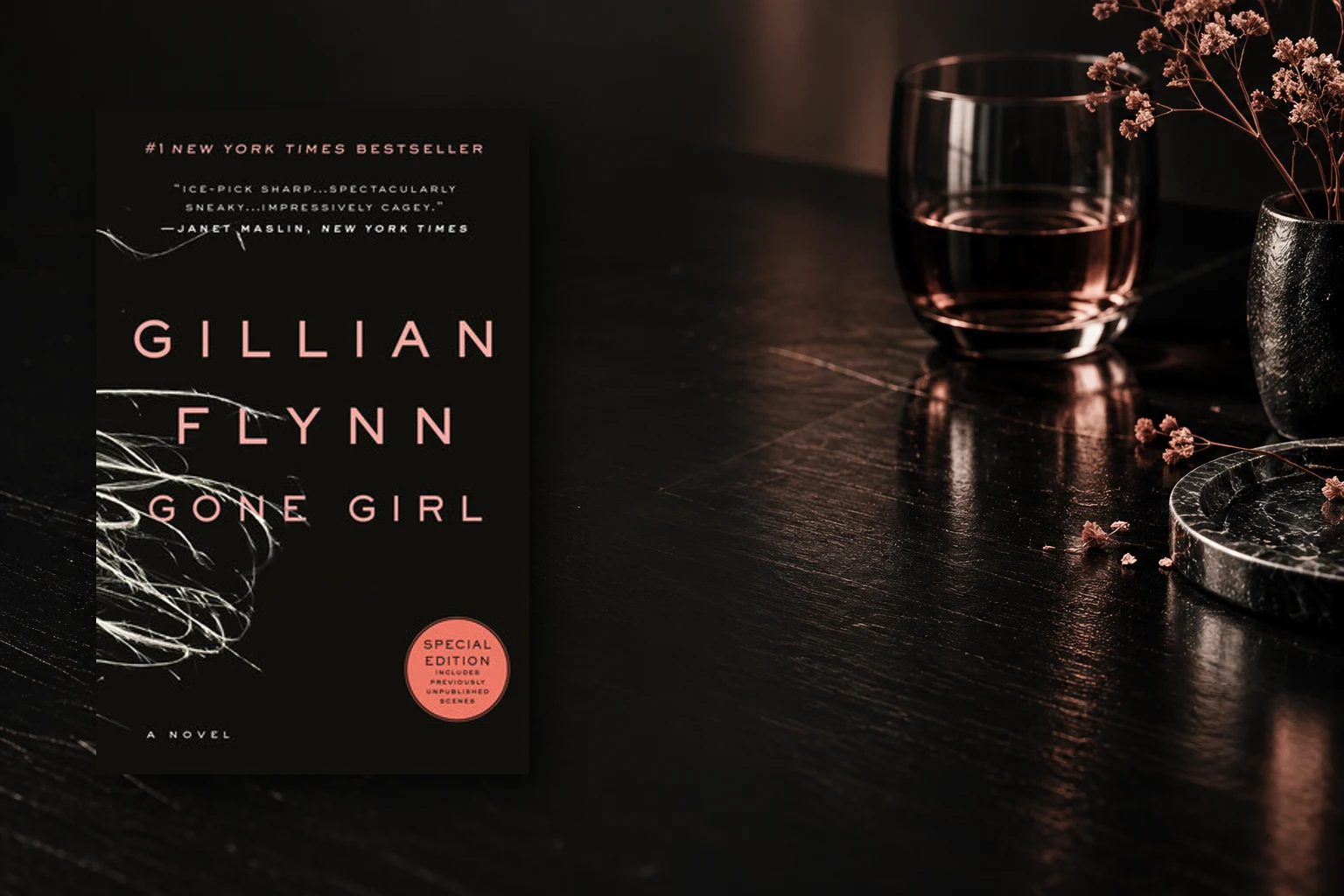
Gone Girl: When a Marriage Becomes Public Evidence
Gillian Flynn makes a missing-person investigation a contest over who gets to define a marriage. The novel’s sharpest suspense comes from the distance between evidence, performance, and public certainty.
A bold two-voice structure connects domestic secrecy to the appetite for a simple public story.
A missing person leaves an absence that other people rush to explain. In Gillian Flynn’s Gone Girl, Amy Dunne disappears on the morning of her fifth wedding anniversary, and the search for her immediately puts her husband, Nick, under scrutiny. The question of what happened matters, but the novel is equally interested in the speed with which a marriage can be turned into a public account. Police, television, acquaintances, and readers all need a version of the couple that makes sense. Flynn makes that need for a coherent story part of the mystery itself.
The familiar outline of a domestic thriller offers a useful starting point. A spouse is missing; the spouse who remains must answer questions; apparently ordinary details acquire a sinister charge. Flynn complicates the outline by showing that a detail does not speak for itself. A gesture can look affectionate in one telling and calculating in another. A hesitation can suggest grief, indifference, or the awkwardness of being watched. Nick’s difficulty is not simply that he must explain events. He must do so in a setting where his manner of explanation becomes evidence, too.
Amy’s diary gives the book another kind of apparent access. The form promises intimacy: private writing seems less rehearsed than a statement made to a camera or an investigator. Yet a diary is also a selected account, shaped by its writer’s memory and sense of audience. Flynn places these modes of telling beside Nick’s perspective without asking the reader to accept either as a transparent window. Their tension produces suspense while making a broader point about the way people present themselves inside a relationship. Even an intimate partner may know only a carefully maintained version of the other person.
The novel’s interest in performance extends beyond a simple claim that everyone lies. People adapt to roles that are offered to them, and marriage supplies especially persistent ones: devoted husband, ideal wife, wronged partner, dependable witness. The disappearance makes those roles visible because each is suddenly inspected for signs of failure. Flynn’s satire works when it catches the difference between the person someone is expected to be and the untidy motives that a polished role conceals. The result is disquieting because the gap feels ordinary before it becomes dangerous.
Public attention intensifies that gap. A case involving a missing wife invites the neat grammar of true-crime coverage, with recognizable innocence on one side and recognizable guilt on the other. The publisher’s reading guide explicitly asks how audiences expect crime stories to have a heroine and a villain. Gone Girl tests that expectation by making judgment feel urgent and unstable at once. Nick can be assessed through a facial expression or an ill-chosen phrase, although neither can carry the weight placed upon it. The novel understands how rapidly a person can become a character in somebody else’s explanation.
This is where Flynn’s use of two accounts does more than distribute clues. Each account changes the questions a reader asks of the other. What looked like context may become an attempt to control context; what sounded like a confession may be another performance. A thriller can use unreliability merely to conceal a solution. Here it also turns the reader’s confidence into a subject of inquiry. We may enjoy feeling sharper than a television audience inside the novel, yet we are making similar judgments from partial material.
The marital setting gives that inquiry an edge. Marriage is often described as a place of privileged knowledge, where two people see each other more clearly than outsiders can. Flynn asks whether proximity can instead produce its own blind spots. Shared routines allow assumptions to harden. Old disappointments can be retold until they seem like settled facts. One partner’s account of the relationship may be persuasive precisely because it borrows the language of long familiarity. The book’s most unsettling possibility is not that strangers misunderstand a couple, but that the couple’s members have competing archives of their life together.
Flynn also knows when to make the machinery of suspense conspicuous. The changing accounts, pressure of investigation, and calculated timing of information keep the reading experience alert. A sentence that seems to settle a point may reopen it a few pages later. That control is a considerable strength, although it has a cost. Some readers may feel that the precision of the reversals makes behavior seem engineered for the next revelation. The novel occasionally asks us to admire the design of a trap when we might prefer more room for its people to behave without serving the design.
Its satirical force remains stronger than a tally of surprises. The public consumes uncertainty by converting it into a moral verdict; the private relationship contains its own competing versions of responsibility. Those pressures are linked rather than simply placed side by side. A television narrative can magnify what a marriage already does on a smaller scale: choose flattering evidence, explain away contradictions, and assign a role to the other person. Flynn sharpens those habits until they become the terms of a crime story.
The novel is dark and sometimes deliberately unpleasant. Its appeal depends on a willingness to sit with people who are neither easy to trust nor easy to dismiss. Readers seeking a comforting puzzle, in which solving the case restores a clear moral order, may find its treatment of intimacy corrosive. Readers interested in the ethics of interpretation will find more to hold onto. Gone Girl asks what happens when the urge to know the truth becomes entangled with the pleasure of pronouncing judgment.
That question outlasts the immediate mystery. Amy’s absence opens a space for explanations, but the novel’s real subject is the appetite that fills it. Flynn makes the reader feel how compelling a polished account can be, how much work it takes to resist one, and how uncertain even a close relationship can become when every word is treated as evidence. The achievement is a thriller that examines the very habits of certainty that make thrillers so satisfying.
EDITOR’S VERDICT
Tale24’s assessment
A bold two-voice structure connects domestic secrecy to the appetite for a simple public story.
Points to considerIts engineered reversals can make character behavior feel subordinate to the design of the plot.
Best for: Readers who want a dark, satirical mystery about marriage, media judgment, and unreliable accounts.
Editorial method: This is an independent assessment informed by the work and its official supporting information. AI tools may assist the drafting process; Tale24 reviews and takes responsibility for everything it publishes.