Literature & Thought · TALE24 REVIEW
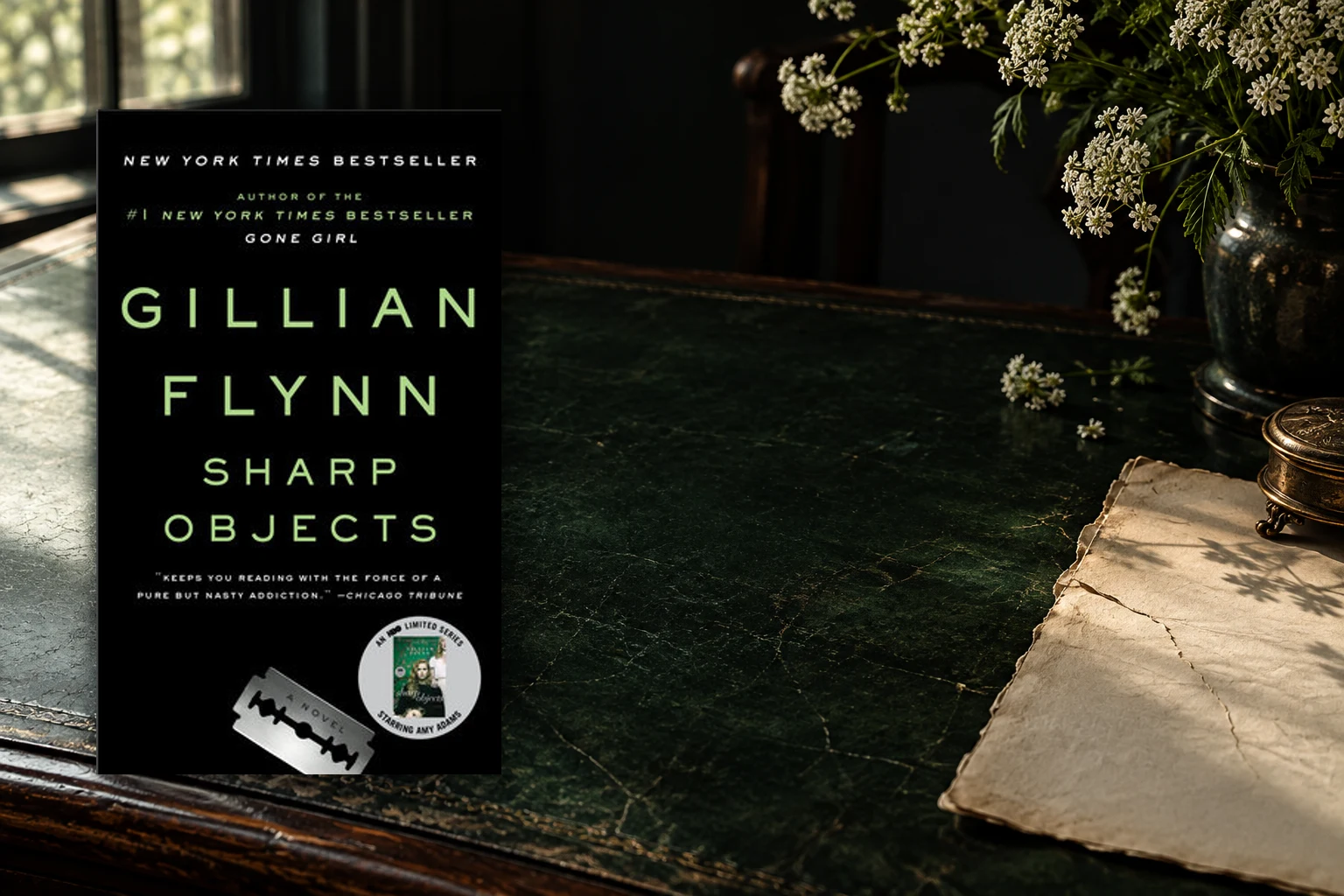
Sharp Objects: A Crime Story Written Close to Home
Gillian Flynn sends a reporter home to cover murdered girls and confront the family history she would rather keep at a distance. The investigation unsettles the boundary between telling another person’s story and surviving one’s own.
A strong convergence of crime reporting, family power, and a claustrophobic small-town atmosphere.
Reporting a crime requires a distance that can be difficult to keep. In Gillian Flynn’s Sharp Objects, Camille Preaker returns to her hometown to cover the murders of two preteen girls. She has recently been in psychiatric care, and the assignment places her back in the family home from which she has long been estranged. The premise promises an investigation, but it also asks what it means for a reporter to enter a story that reopens her own history. Camille is supposed to gather other people’s accounts while the town and her family keep producing accounts of her.
The return home changes the usual geometry of a crime novel. An outsider can ask questions, observe local customs, and leave when the work is done. Camille knows the place too well for that freedom. Familiar rooms and relationships have claims on her attention before she can decide what they mean for the case. Her knowledge may help her notice what a visiting journalist would miss, yet it can also make neutrality impossible. Flynn draws pressure from this double position. Camille belongs to the town’s past without feeling safely at home in its present.
Her professional role offers one possible defense. A reporter can put a question in a notebook, attribute an answer, and build a story from what can be checked. The deaths of two girls demand that kind of care. They must not become mere raw material for an adult’s private reckoning. At the same time, a news story is an arrangement of voices and details, and whoever makes that arrangement exercises power. Sharp Objects keeps the ethical problem visible: Camille’s proximity may deepen the story, but it may also pull attention away from the people whose lives have ended.
Flynn’s small-town setting makes that problem harder. A community is not simply a collection of witnesses waiting to be interviewed. It has habits of loyalty, rumor, and selective memory. People know which subjects to discuss in public and which are kept inside a family. The investigation moves through that social texture rather than across a neutral map of clues. The Gothic atmosphere arises less from decoration than from the feeling that ordinary domestic surfaces conceal old forms of control. A polite explanation can carry as much pressure as an open threat.
Camille’s relationship with her mother and her young half-sister gives the book its most intimate source of unease. The official publisher description presents those relationships as estranged and difficult; the novel’s suspense grows from the challenge of interpreting them while Camille is meant to report on a separate crime. A family can insist that its version of the past is the only acceptable one. It can also train its members to doubt what they feel or remember. Flynn uses those possibilities to connect the public mystery with the private struggle over who may define a girl or woman’s experience.
That connection demands care from the reader as well. The murdered children should not be reduced to symbols for Camille’s distress, just as Camille should not be reduced to a convenient instrument for solving their deaths. The book’s difficult subject matter includes psychological suffering and self-harm. These are not reliable shortcuts to character insight or evidence of danger in real life. The most responsible way to approach the novel is to see how it represents harm and control without treating pain as an aesthetic ornament or a diagnostic puzzle.
The journalism thread gives the thriller a question that survives the mechanics of revelation. How can one tell a truthful story when the surrounding community has an interest in managing appearances? A reporter can verify a statement yet still miss the reason it was offered. An interview can produce information while leaving the most important silence intact. Flynn’s premise places Camille between the demand for a publishable account and the recognition that neither a family nor a town can be understood through one neat explanation.
The book’s form keeps that tension close to Camille’s point of view. The reader encounters the town through someone whose knowledge is both deep and compromised by painful association. That is a more unsettling arrangement than simple ignorance. We cannot assume that a familiar detail is trustworthy merely because Camille remembers it, or dismiss it merely because she is affected by it. Flynn makes the work of interpretation feel personal without claiming that personal memory alone can settle a public case. The result is suspense built from the unstable relation between proximity and clarity.
The setting also resists the comforting idea that bringing hidden things into view automatically repairs them. Reporting can expose facts, but facts enter a community whose members may have practiced not seeing. Family history can become more legible without becoming easier to bear. This is one reason the novel’s atmosphere feels so oppressive. Its questions are not confined to who committed a crime. They extend to what a place is willing to recognize, what it prefers to explain away, and who pays for that preference.
Flynn’s intensity is a strength, though it sets a clear limit on the book’s appeal. The sustained closeness to family damage and violence can be exhausting. Readers looking for a procedural investigation with restorative distance may find little of that here. The book is more interested in emotional pressure than the orderly pleasure of collecting clues. That choice gives its atmosphere coherence, but it can make the experience feel punishing, especially for anyone sensitive to its subject matter.
Sharp Objects is most compelling when it treats the crime story and the family story as connected questions about narrative authority. Camille seeks answers about murdered girls while confronting the versions of herself that other people have kept in circulation. Flynn does not make either task simple. The novel’s achievement lies in making the reporter’s work ethically and emotionally difficult, and in showing how a town’s most familiar stories can obstruct the truth they claim to preserve.
EDITOR’S VERDICT
Tale24’s assessment
A strong convergence of crime reporting, family power, and a claustrophobic small-town atmosphere.
Points to considerIts sustained emotional harshness and painful subject matter may overwhelm readers seeking a procedural mystery.
Best for: Readers prepared for a dark, character-driven thriller about reporting, family control, and psychological harm.
Editorial method: This is an independent assessment informed by the work and its official supporting information. AI tools may assist the drafting process; Tale24 reviews and takes responsibility for everything it publishes.