Literature & Thought · TALE24 REVIEW
Silver Nitrate: Who Gets to Make the Horror Film?
A sound editor’s practical knowledge of film meets a lost-movie curse, binding production craft, analog cinema, friendship, and occult belief.
The excerpt makes sound editing and insecure work tangible; Elizabeth Hand’s review recognizes the analog film texture and friendship while offering a fair pacing reservation.
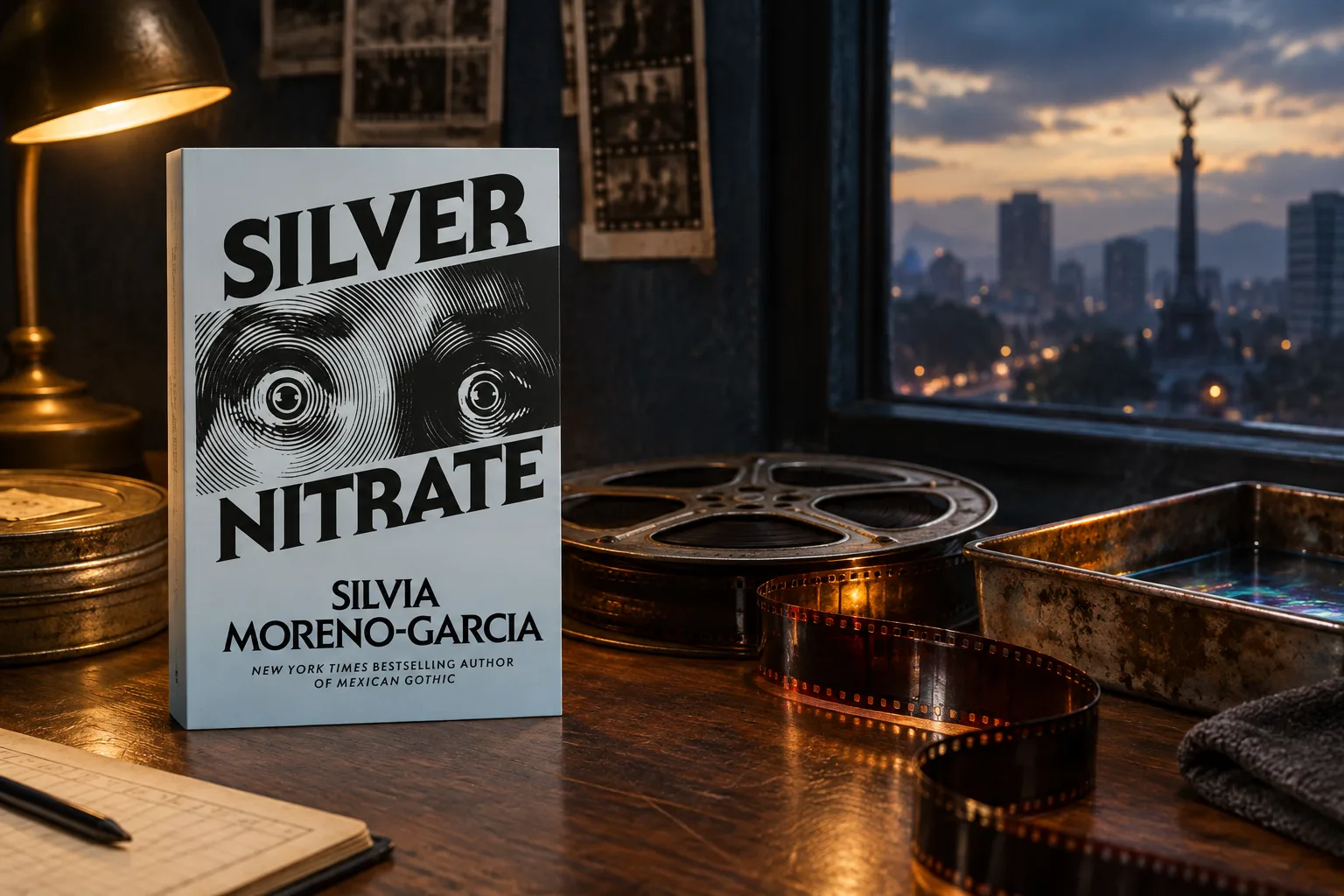
Silver Nitrate makes horror cinema both subject and method. Silvia Moreno-Garcia sets the novel in 1993 Mexico City, where sound editor Montserrat and her childhood friend Tristán become involved with a lost film said to carry an occult curse. The publisher’s sample opens inside a horror sequence, then reveals Montserrat at work on the sound levels. That cut supplies a telling entry point: fear is not only an atmosphere but something people build through image, timing, and sound. Elizabeth Hand’s Washington Post review adds a second lens, praising the analog-film references and the friendship at the story’s center while finding some explanations of movie magic overextended. Together, these materials frame a book about cinematic enchantment and how much explanation it can bear.
The excerpt’s opening shifts from a woman running through a horror-film scene to Montserrat watching the audio levels and stopping the image. The transition turns screen danger into work under review. Montserrat listens, identifies what is wrong with the sound, and considers the effort required to fix it. The person who makes fear legible to an audience is initially outside the frame. She is not a spectator fooled by the image; she is a technician who understands its construction. That position changes how the supernatural premise lands. When colleagues invoke ghosts or curses, the novel has already shown a character trained to separate the effect from the mechanism. Craft becomes a form of knowledge that can challenge belief, even if it cannot settle every mystery.
The same sample gives Montserrat’s expertise a material cost. She faces deadlines, inadequate staffing, and an insecure freelance position while other men receive more stable assignments. The passage makes her work specific: she listens to levels, estimates a repair, and weighs whether the job will keep her in the editing room for long hours. Her sister’s illness adds a personal reason she wants to earn more, but it does not turn professional precarity into an abstract symbol. The source describes a fictional workplace, so these conditions should not be presented as a verified history of every Mexican film crew. Within the story, however, they create a useful tension: Montserrat can hear and fix problems others leave behind, yet her skill does not guarantee security or recognition. The excerpt makes technical competence visible alongside the unequal terms under which it is used.
The publisher’s synopsis introduces the occult engine through director Abel Urueta, an unfinished film, Nazi occultism, and volatile silver nitrate stock. That combination sets film’s material properties beside supernatural claims about images. The title itself points toward old photographic technology, while the story’s cursed reels turn preservation into a source of danger. The synopsis does not warrant treating the fictional curse as historical fact, nor does it independently establish every technical detail about nitrate stock. It is enough to notice how the premise binds medium and myth: the film is not a neutral container for a story but an object whose making, storage, and projection matter to the plot. That premise extends the opening scene’s interest in craft. Sound editing reveals how an effect is assembled; the lost film asks what other kinds of power might be embedded in an artifact.
Hand’s Washington Post review provides a valuable reservation rather than a line of blanket praise. She enjoys the film references and analog technology, and she singles out Montserrat and Tristán’s long friendship, with its shared history and adult tensions. She also argues that the explanations of how the movie magic works go on too long. For a story whose premise depends on occult mechanics, that complaint identifies a genuine balancing act: detail can make the invented system feel tactile, but explanation can interrupt the dread it is meant to support. The review’s mixed assessment helps readers anticipate both the pleasure and the possible drag. A reader who enjoys tracing film lore may welcome the density; someone who wants mystery to stay partly unexplained may prefer the novel to move more quickly through its rules. The limitation is not that the book has too much background in the abstract, but that background can compete with momentum.
The friendship between Montserrat and Tristán complicates the craft-centered angle. The Washington Post review describes a long-standing bond shaped by shared movie watching, affection, and adult resentments; the publisher synopsis positions them together in the investigation. Their differing visibility contrasts Montserrat’s hidden labor with Tristán’s acting career, altered after an accident. That contrast can support a reading about who receives attention in a film culture, though it should not be turned into the claim that Montserrat alone authors the horror. The excerpt’s strength is smaller and more concrete: she has expertise, makes judgments, and knows what production demands. The larger story then places that practical knowledge beside an occult mystery that neither can be reduced to technical error nor assumed to be true just because an old director says so.
The author’s discussion guide adds context for the novel’s preoccupation with sound and analog media. Moreno-Garcia writes that her mother worked in radio, handled editing equipment, and was one of few women in a male-dominated technical world; she says this influenced her decision to make the audio editor a woman. She also describes wanting to exhume analog media for a book and traces the title to a childhood mishearing of a movie title. This is useful author-supplied context, but it should not replace analysis of the fiction or be treated as proof that every scene represents her mother. It does help explain why the behind-the-scenes craft feels central rather than decorative. Sound is not just an accessory to the film’s magic; it is part of the author’s chosen imaginative material and the protagonist’s professional identity.
Silver Nitrate is likely to appeal to readers who enjoy occult mysteries built around old movies, analog formats, and the work that happens behind the screen. The public materials place technical knowledge beside belief: Montserrat can diagnose sound, yet the synopsis gives her a mystery that may exceed ordinary explanation. Hand’s reservation about extended explanations is worth bearing in mind, especially for readers who prefer a leaner pace. This discussion uses the publisher’s excerpt and synopsis, the author’s discussion guide, and one professional review; it does not claim firsthand reading of the entire novel. Those sources point to a story whose pleasures are tied to its particulars—film stock, editing rooms, references, and a long friendship—so it will suit readers who want their horror surrounded by cultural texture as much as immediate scares.
EDITOR’S VERDICT
Tale24’s assessment
The excerpt makes sound editing and insecure work tangible; Elizabeth Hand’s review recognizes the analog film texture and friendship while offering a fair pacing reservation.
Points to considerExplanations of the invented movie magic may feel extended, and the public sample alone cannot establish the full novel’s execution.
Best for: Readers drawn to occult mysteries, analog cinema, film production craft, and character-centered friendships.
Editorial method: This is an independent assessment informed by the work and its official supporting information. AI tools may assist the drafting process; Tale24 reviews and takes responsibility for everything it publishes.