Literature & Thought · TALE24 REVIEW
The Haunting of Hill House: When a House Becomes an Argument
A measured description of a house becomes unsettling when domestic order, scholarly ambition, and Eleanor’s uncertain point of view begin to blur.
The opening pairs precise architectural language with unease; criticism by Hilarie Ashton and Mara Terese Gawarecki adds useful readings of point of view and domestic space.
Shirley Jackson’s The Haunting of Hill House begins with an apparent contradiction: a house can be soundly built, orderly, and silent, yet somehow not sane. The opening puts the reader between two kinds of certainty. Masonry and rooms can be inventoried; the quality of the place cannot. The effect is more interesting than a simple question of whether ghosts exist. Jackson makes observation itself feel vulnerable, because a precise description does not produce a stable explanation. That tension carries into the people who arrive to investigate. A scholar wants evidence, but the evidence he gathers is compromised by his own ambitions; a house seems legible in physical terms and wrong in moral ones. The novel’s Gothic pressure thus begins in the gap between what can be measured and what can be trusted.
The first description lingers over walls, bricks, floors, doors, wood, and stone. Its measured attention resembles an architectural survey, the kind of language that might promise safety through exactness. Then the narration sets that controlled surface against an uncanny judgment about the house’s sanity. Nothing in the inventory needs to move for the mood to shift. Instead, the familiar domestic materials become difficult to read: solidity no longer guarantees shelter, and silence does not reassure. This is a formal choice, not proof that the building possesses a mind outside the story. The prose makes the reader experience a mismatch between physical description and emotional response. By starting with that mismatch, Jackson turns the house into a problem of interpretation before the investigation has had a chance to produce any convincing evidence.
Dr. Montague brings another kind of order to the opening. He has a doctorate in anthropology and wants to publish a definitive account of psychic disturbances, but the passage also makes plain his appetite for a sensation. He searches the records of psychic societies, newspapers, and parapsychological reports; he then excludes candidates he regards as theatrical, unintelligent, or attention-seeking. The procedure looks systematic on paper, yet its categories are personal judgments, and the source material is hardly neutral. Montague’s credentials do not make the inquiry fraudulent, nor does the excerpt support a claim that Jackson rejects science wholesale. It does show how a researcher’s hopes can shape what counts as evidence. His careful attention to his title, meant to lend authority to the project, sits uneasily beside the unstable method he uses to assemble it.
Literary scholar Hilarie Ashton offers a useful way to understand why the novel’s uncertainty is more than a puzzle about ghosts. In a 2018 article in Style, she argues that shifts in tense, punctuation, formatting, and quotation sometimes allow Eleanor Vance’s perceptions to enter the narration without an explicit frame. Ashton is especially interested in moments that are not conventionally Gothic or frightening. That observation matters because ambiguity can arise in ordinary language, not only during a supernatural episode. If a thought feels like part of the narration, the reader may hesitate over where a character’s consciousness ends and the story’s description begins. Ashton calls attention to craft rather than offering a single answer about what is real. Her reading makes the novel’s formal instability part of its suspense: perception is not a window outside the haunting but one of the places where uncertainty takes shape.
A different critical lens comes from Mara Terese Gawarecki’s University of St. Thomas master’s thesis, which reads Hill House’s architecture as a constrictive domestic and maternal space. The argument complicates the familiar idea of home as uncomplicated refuge. A domestic interior may shelter, but it can also set the terms of dependence and confinement. Gawarecki stresses that Eleanor’s relation to the house is ambivalent, a qualification that keeps this reading from turning architecture into a simple symbol with one meaning. The house can be threatening and still exert an attraction; the domestic can promise belonging and still constrain the person who seeks it. This lens sits naturally beside Jackson’s opening contrast between material order and unease. It also widens the question from “What is in the house?” to “What kinds of safety and freedom does a house offer, and to whom?”
These readings show that the novel’s haunted-house effect depends on more than atmosphere. The building’s orderly surfaces, Montague’s uncertain research, and the narration’s proximity to Eleanor all unsettle the tools a reader might use to sort fact from interpretation. A University of Maryland student essay also discusses limited point of view and free indirect discourse as sources of uncertainty. These approaches are useful as possibilities, not keys that unlock the book once and for all. They also reveal a limitation for some readers: the same formal openness that sustains dread can feel withholding if one wants firm supernatural rules. Jackson’s method asks for attention to shifts in voice and setting, then declines to reward that attention with a tidy explanatory system.
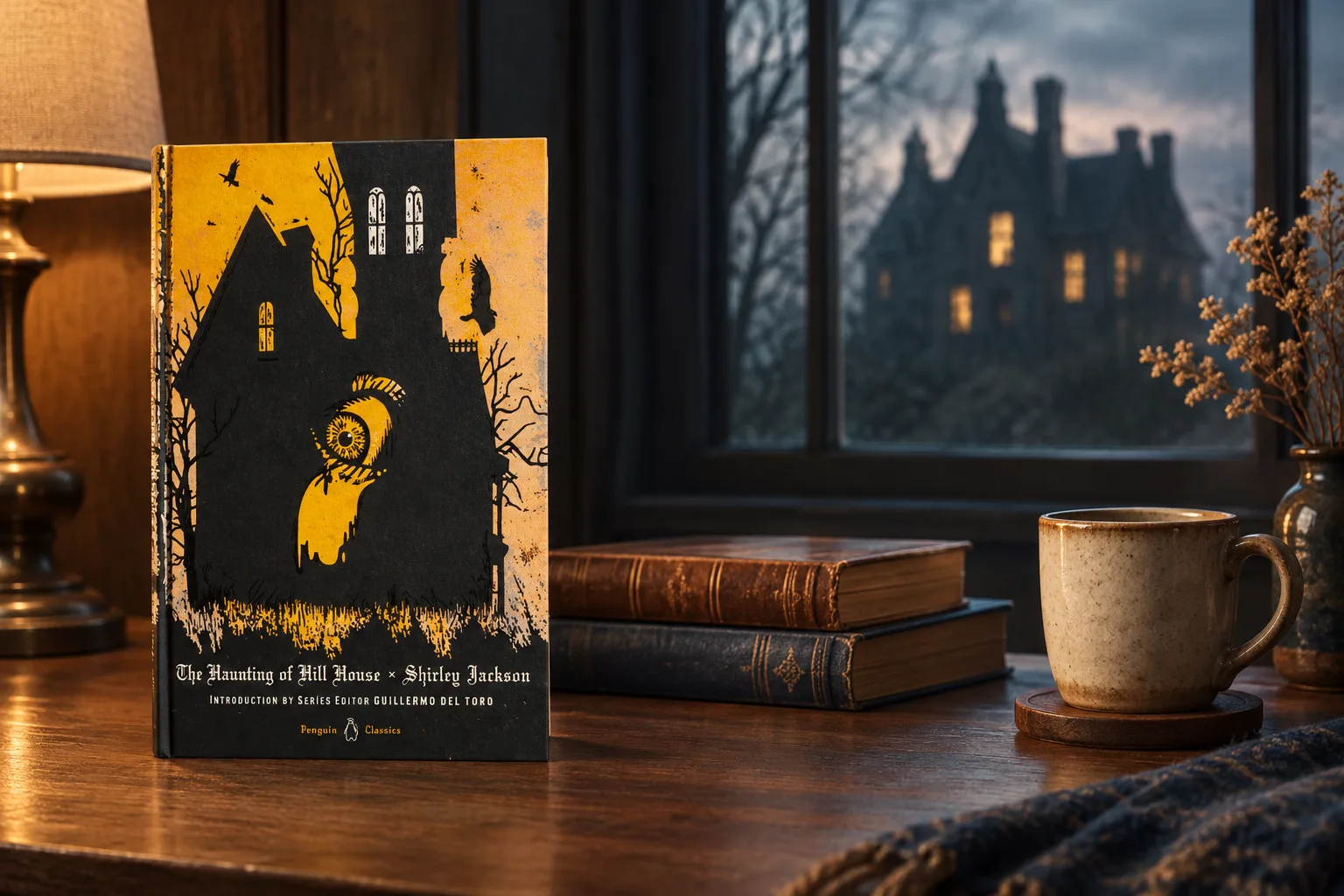
The Penguin edition places the novel in Gothic and horror fiction, with an introduction by Laura Miller and series curation by Guillermo del Toro. Such context helps identify the book’s literary lineage, but neither the edition nor its reputation should substitute for reading the prose on its own terms. The available opening and publisher synopsis establish a gathering of investigators, a hostile house, and an inquiry whose evidence is fragile from the start. Scholarship adds arguments about perception and domestic space, but these are interpretations of the novel, not neutral facts about authorial intention. Taken together, they point toward a particularly rewarding audience: readers who enjoy close attention to point of view, the uncanny inside ordinary rooms, and endings to questions that remain unsettled. Readers seeking a stable rulebook may find the ambiguity frustrating; for others, uncertainty is the source of the fear.
A note on scope belongs here because the distinctions matter. This discussion draws on the publisher’s public description and excerpt, bibliographic information, and named literary criticism; it does not present itself as a firsthand rereading of the complete novel. Ashton’s account of narrative technique and Gawarecki’s study of domestic architecture offer grounded ways into the text, while the opening passage provides a direct basis for discussing its measured physical description and Montague’s screening process. That combination is enough to make a focused case about how the Gothic atmosphere is built, but it does not settle every question about Eleanor or the house. The most useful recommendation is therefore also the most specific: approach Hill House for the unstable relation between rooms, minds, and evidence, rather than expecting the suspense to resolve into a straightforward test of whether a haunting is objectively real.
EDITOR’S VERDICT
Tale24’s assessment
The opening pairs precise architectural language with unease; criticism by Hilarie Ashton and Mara Terese Gawarecki adds useful readings of point of view and domestic space.
Points to considerThe novel withholds stable answers about perception and haunting, which may frustrate readers looking for fixed supernatural rules.
Best for: Readers of Gothic fiction interested in narrative point of view, domestic space, and psychological ambiguity.
Editorial method: This is an independent assessment informed by the work and its official supporting information. AI tools may assist the drafting process; Tale24 reviews and takes responsibility for everything it publishes.