Literature & Thought · TALE24 REVIEW
Mexican Gothic: The House That Turns Privilege Uneasy
Noemí’s social confidence meets the authority of an isolated family estate, while critical debate asks how far the novel’s anticolonial Gothic vision extends.
The opening gives Noemí agency and makes credibility a social question; contrasting scholarship creates a thoughtful discussion of gender, race, and Gothic conventions.
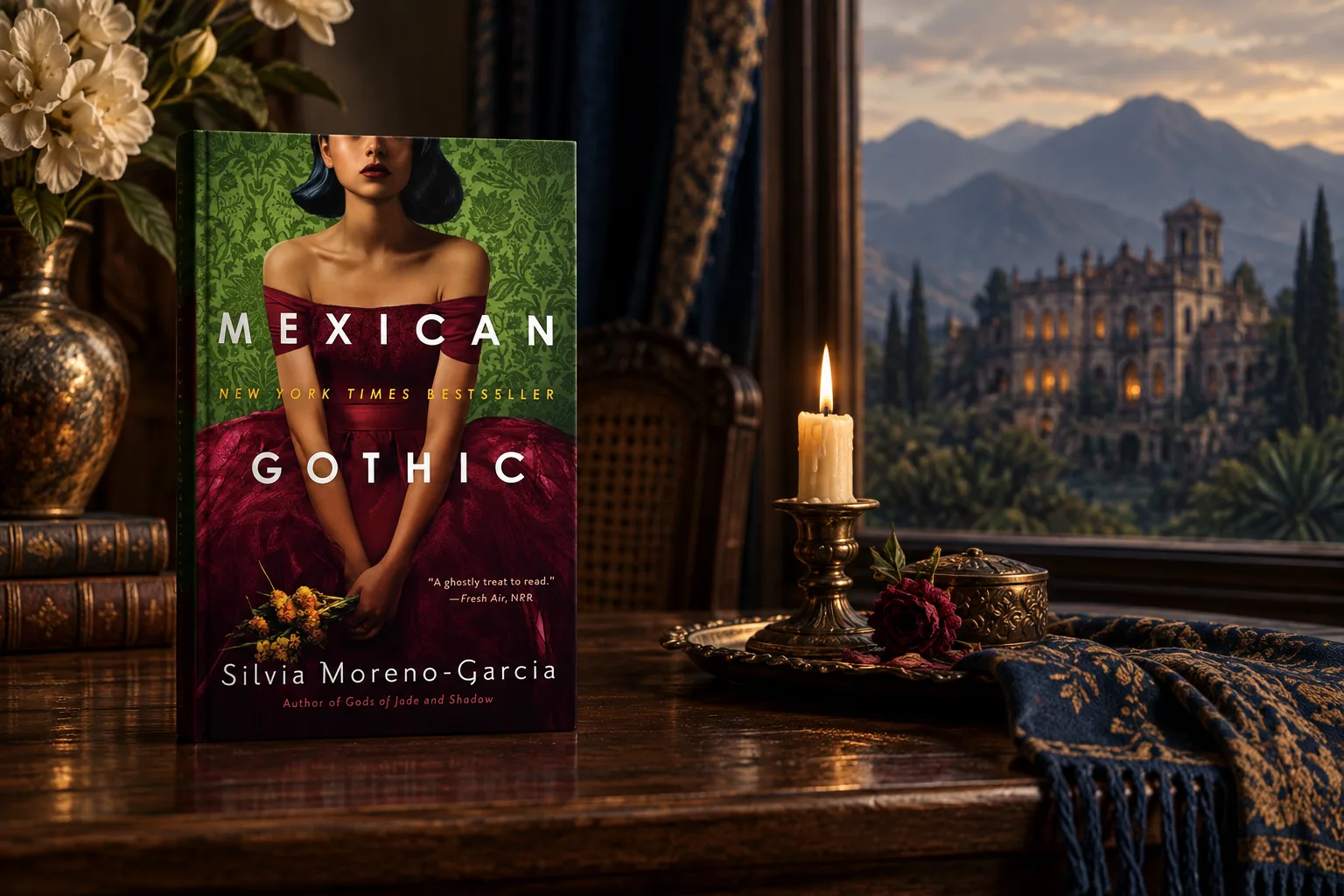
Silvia Moreno-Garcia’s Mexican Gothic places the country-house story in 1950s Mexico and makes social authority part of its machinery of dread. The official premise sends Noemí Taboada from a Mexico City party to remote High Place after her cousin Catalina writes for help. The contrast is more than city against countryside. The opening lets Noemí move through high society with ease, while the family’s response to Catalina raises a sharper question: whose account of distress will be taken seriously? Critics disagree about how fully the novel’s Gothic framework answers its colonial and racial questions. That disagreement makes the book more interesting to discuss than an uncomplicated claim that it simply overturns the genre. Its heroine can have agency while the novel’s representation remains open to scrutiny.
The public excerpt first shows Noemí at a costume party, making a casual choice about her costume and speaking with her date, Hugo. The scene introduces her through social ease and flirtation rather than a solemn announcement of bravery. The narrative then moves to her father’s office, where a family conversation about Catalina’s letter turns on whether the cousin is melodramatic or in real trouble. Noemí resists the convenient dismissal and brings Catalina’s losses into view. This is a modest act, but it gives the rescue premise a social dimension before the isolated house appears. The issue is not yet whether a ghost exists; it is whether a woman’s distress can be recognized inside a family that has already begun explaining it away. The opening therefore makes credibility part of the Gothic setup.
Penguin Random House’s synopsis adds the destination: High Place, an isolated mansion associated with an old wealthy family and a faded mining empire. The house belongs to a history of property and inherited standing, not merely to a mood of creaking corridors. A country house concentrates power because its residents can regulate access, information, and daily life within a bounded space. In this case, the family’s wealth and distance from the city give those questions a material setting. That reading should remain measured: the synopsis supports attention to isolation and inheritance, but it cannot establish how every later scene develops them. Even so, the pairing of a modern socialite with an old estate creates a productive friction. Noemí arrives with social confidence; the house belongs to a family whose authority is older and more entrenched than hers.
Hana Vega’s 2023 master’s thesis at California State University, San Bernardino reads Mexican Gothic through the female Gothic and anticolonial feminism. Vega emphasizes Noemí as a decisive woman of color whose agency challenges Western-centered genre conventions. This framework helps explain why the novel’s heroine is not introduced as a passive captive waiting for events to happen to her. The excerpt’s party and office scenes support that point in a limited way: Noemí makes decisions, notices how Catalina is being characterized, and pushes back. Vega’s study interprets the broader novel, while those details come directly from the published sample. Keeping the two levels separate matters. The opening can establish a character’s social presence without proving how the complete narrative handles every question of colonial power. Vega’s reading is a strong lens, but it is not the only one available.
In an article for Atlantis: Critical Studies in Gender, Culture & Social Justice, Luisa Fernanda Grijalva-Maza and Claude Denis complicate a purely celebratory anticolonial reading. They argue that the novel may reproduce Mexico’s mestizaje system and a whitening of racial identity, framing conflict as evil Europeans against valiant mestiza Mexicans while marginalizing Indigenous women and darker-skinned classes. This is a specific scholarly critique, not a consensus verdict or a reason to dismiss the book outright. It asks readers to look beyond the presence of a capable heroine and examine whose experiences the story centers or leaves at the edge. That distinction is valuable in Gothic fiction, where the struggle against an oppressive household can appear politically clear while its broader social world remains selective. The critique invites a harder question than whether Noemí is empowered: whose empowerment becomes visible in the narrative?
A separate ecogothic article in Studies in American Fiction approaches the novel through extraction, eugenics, and ecological imperialism. Read alongside the Atlantis article and Vega’s thesis, it shows that the book has prompted several frameworks that do not line up neatly. One sees an anticolonial intervention; another asks whether racial hierarchy is reproduced inside that intervention; a third foregrounds land and extraction. These approaches should not be collapsed into one tidy message, and none of the article abstracts proves an author’s intention. Their disagreement does, however, sharpen the review’s central point: Gothic space can expose the violence attached to wealth and inheritance while still leaving questions about representation unsettled. A useful review can acknowledge both the genre’s political reach and its limits without treating the latter as a reason to ignore the former.
The book’s accessible opening also makes a pacing choice visible. Before Noemí reaches High Place, the party, flirtation, and conversation with her father establish her social position and the family’s account of Catalina. Readers who want immediate supernatural activity may find that setup gradual. Readers interested in how a Gothic heroine is shaped by class and by the credibility granted to women may find that groundwork worthwhile. This is a judgment about the available opening, not a claim about the entire novel’s pacing. The publisher describes the later house as isolated and its patriarch as a source of fascination and menace; the synopsis connects the family to old wealth and mining. Those details prepare a conventional Gothic architecture, but the review’s stronger interest is the question of who may speak within it.
Mexican Gothic suits readers drawn to haunted estates, social history, and debates about what contemporary Gothic fiction can do with inherited European forms. The available materials support a nuanced recommendation rather than a verdict that the novel either solves or fails its politics. Noemí’s early agency is clear in the excerpt; scholarly discussion shows that agency alone does not end debate about the racial frame. That tension makes the book a good choice for readers who enjoy carrying a question past the final page: what does a story challenge, and what assumptions might it preserve while doing so? This discussion draws on the publisher’s synopsis and excerpt alongside named academic studies, not a claim to have personally read the full novel. For readers who value both atmospheric premises and critical conversation, that unresolved tension is a reason to pick up the book rather than a footnote to its appeal.
EDITOR’S VERDICT
Tale24’s assessment
The opening gives Noemí agency and makes credibility a social question; contrasting scholarship creates a thoughtful discussion of gender, race, and Gothic conventions.
Points to considerThe political reading remains contested, and readers seeking immediate supernatural action may find the social setup gradual.
Best for: Readers interested in Gothic houses, social power, feminist criticism, and debates about representation.
Editorial method: This is an independent assessment informed by the work and its official supporting information. AI tools may assist the drafting process; Tale24 reviews and takes responsibility for everything it publishes.