Science & Nature · CRITICAL ESSAY
The Immortal Life of Henrietta Lacks: Science, Race, and Consent
Rebecca Skloot's landmark medical history unites the discovery of HeLa cells with Deborah Lacks's search for truth, exposing ethical fault lines that reverberated all the way to a 2023 legal settlement.
Gripping dual-timeline reporting that turns cellular biology, Jim Crow medical inequality, and Deborah Lacks's grief into unforgettable nonfiction.
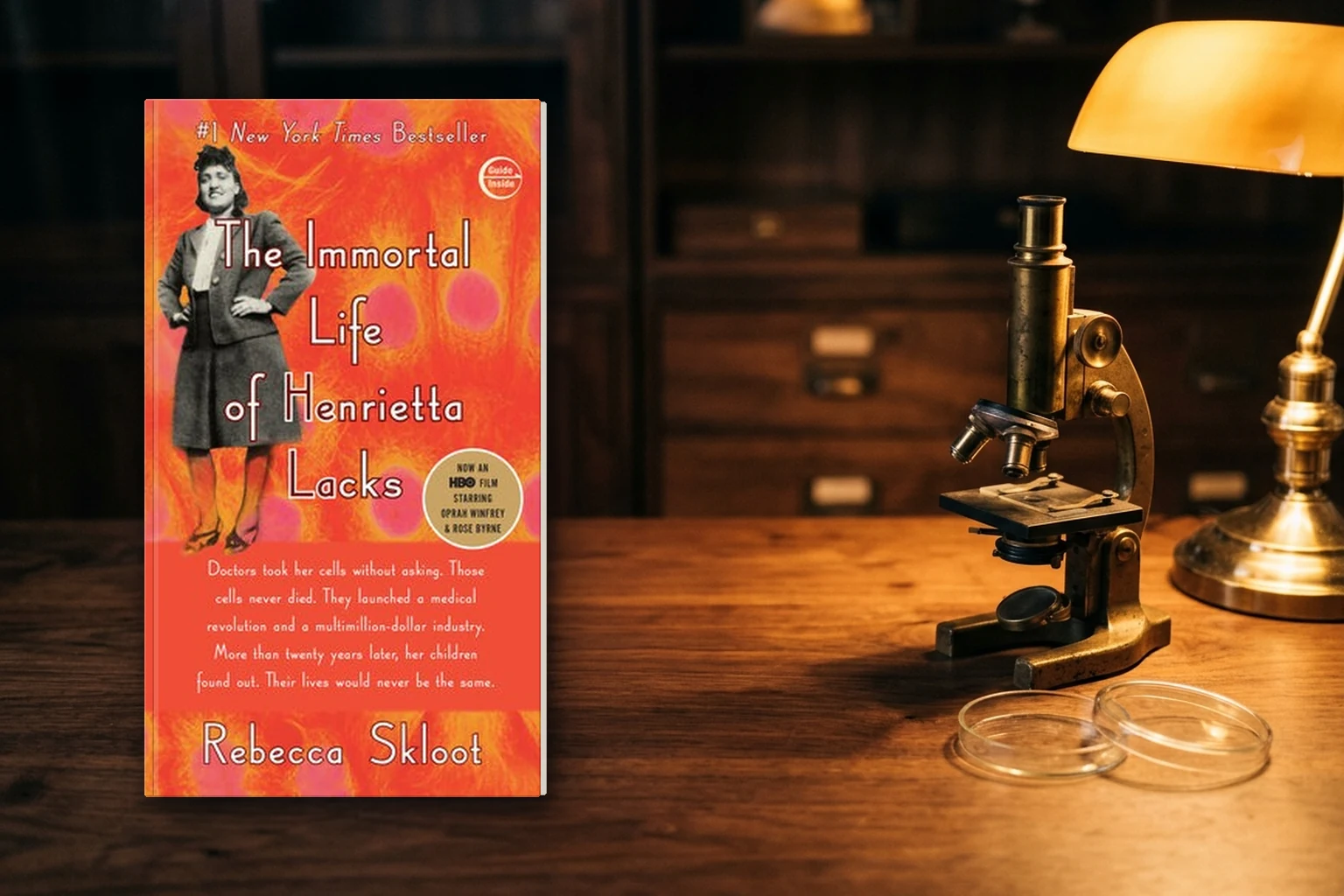
In February 2010, science journalist Rebecca Skloot published a book that transformed an obscure laboratory acronym into one of the most consequential moral reckonings in modern American medicine. Issued in Crown's verified 400-page paperback edition, The Immortal Life of Henrietta Lacks spent years on The New York Times bestseller list, won both the 2011 National Academies Communication Award and the Chicago Tribune Heartland Prize, and reshaped public literacy around informed consent, tissue ownership, and racial inequity in biomedical research.
Looked at through both its narrative craft and the real-world legal milestones that followed publication, Skloot's achievement lies in refusing to let scientific triumph erase human history. By weaving laboratory breakthroughs directly into the lives of the family left behind, the book turns an abstract bioethical principle into an unshakable portrait of unequal recognition.
Braiding Two Timelines Across Life, Death, and Immortality
Skloot structures her chronicle across three overarching acts—"Life," "Death," and "Immortality"—while braiding two distinct chronological threads. The historical strand reconstructs the brief life of Henrietta Lacks, born August 18, 1920, raised in a Clover, Virginia log cabin that had once served as slave quarters after her mother died in childbirth, and later married to her cousin David Lacks before moving to Maryland. On October 4, 1951, at age thirty-one, Henrietta died of aggressive cervical cancer in the segregated "colored ward" of Johns Hopkins Hospital in Baltimore.
During her care, tissue biopsied from her tumor without her knowledge or consent reached Johns Hopkins researcher Dr. George Otto Gey. Whereas previous human cell cultures perished rapidly in glass flasks, Lacks's cells—abbreviated "HeLa"—multiplied at extraordinary speed, becoming the world's first immortal human cell line. Those cells went on to underwrite Jonas Salk's polio vaccine, chemotherapy testing, in vitro fertilization, gene mapping, and modern viral vaccine research.
Running beside that scientific trajectory is Skloot's decade-long reporting partnership with Henrietta's deeply guarded daughter, Deborah Lacks, tracing how the family learned of HeLa twenty-five years after Henrietta's death—prompted in part by a 1976 Rolling Stone article by Michael Rogers—and navigated cloning rumors, Jim Crow fears of "night doctors," and painful poverty without health insurance while commercial laboratories built a multi-billion-dollar biomedical industry. By pairing Deborah's lived bewilderment with archival medical records, Skloot anchors every scientific milestone inside real familial memory rather than treating cell biology as a disembodied triumph.
Narrative Empathy and Critical Reception
Literary and medical reviewers immediately recognized how deftly Skloot kept microscopic biology and family bereavement in equal focus. Publishers Weekly awarded the book a starred review, praising how Skloot allowed witnesses and archival records to speak directly in a "rich, resonant tale of modern science." Writing in The New York Times, critic Dwight Garner confessed to putting the book down repeatedly to chase family and guests around his house and tell them he was reading "one of the most graceful and moving nonfiction books I've read in a very long time," saluting its rare fusion of "brains and pacing and nerve and heart."
In The Guardian, novelist Hilary Mantel praised Skloot's "tenacious detective work" across the tangled terrain of race, class, medical history, and folklore. Crucial to that success is Skloot's restraint with technical jargon: she translates cell culture contamination, chromosomal biology, and early clinical paternalism cleanly enough for general readers without flattening scientific accuracy. Even readers encountering genetics or laboratory cell culture for the first time follow exactly why HeLa transformed twentieth-century medicine and why its human origins mattered so profoundly.
Reporting Ethics, Tissue Property Law, and Institutional Reckoning
Yet Hilary Mantel also put her finger on the uncomfortable moral tension embedded inside the book's own making, noting in The Guardian that the narrative "both irritates and fascinates." Readers inevitably confront the friction of an outside white journalist embedding herself closely inside a vulnerable Black family's grief, sometimes becoming a visible actor inside arguments and disclosures that expose raw intergenerational trauma.
Scholarly medical-history assessments, such as a review from Baylor University Medical Center Proceedings archived on NIH PubMed Central, add essential historical nuance: taking patient tissue without explicit consent was legally customary under 1951 medical paternalism rather than an isolated rogue act. What sharpened the injustice was the collision of Jim Crow segregation, unequal public-ward treatment, and US legal doctrine under which donors forfeit property ownership once tissue exits the body—leaving glaring ethical gaps around privacy and commercialization. Skloot sought to address equity directly by founding the nonprofit Henrietta Lacks Foundation from book proceeds to assist descendants with medical and educational expenses, yet extended-family disagreements over representation and compensation continued long after publication.
From Page to Policy: NIH Oversight and the 2023 Settlement
Few works of modern narrative nonfiction have catalyzed such tangible institutional responses years after leaving press. In 2013, following public outcry over the unconsented publication of the full HeLa genome, the National Institutes of Health brokered a controlled-access agreement granting two Lacks family representatives seats on the committee reviewing researcher requests for HeLa genomic data. That milestone recognized that genomic disclosures implicate living relatives decades after an unconsented hospital biopsy.
A decade later, in August 2023—on what would have been Henrietta Lacks's 103rd birthday—The Guardian reported a historic confidential settlement between Henrietta Lacks's estate, represented by civil rights attorney Ben Crump, and biotechnology giant Thermo Fisher Scientific over unjust enrichment from commercial sales of HeLa cells. Those developments confirm that Skloot's book did not close a settled historical chapter; it gave citizens, lawyers, and scientists shared factual ground to demand overdue accountability.
Verdict for Contemporary Readers
The Immortal Life of Henrietta Lacks occasionally divides readers through Skloot's prominent first-person presence and the messy emotional friction of Deborah Lacks's extended family dynamics. Yet those imperfections underscore why the story refuses easy closure: real biomedical justice involves complicated living people, not sanitized textbook heroes, and journalism written across racial and economic divides rarely unfolds without moral friction.
For general nonfiction readers, students of bioethics, medical humanities, and public health, and working scientists alike, the Crown edition remains essential reading. It stands as a clear, enduring warning that scientific brilliance must never be divorced from informed consent, transparent institutional governance, and respect for the human lives inside every medical breakthrough. Paired with subsequent NIH oversight and the 2023 Thermo Fisher settlement, Skloot's chronicle proves how deeply rigorous science reporting can reshape public accountability long after publication.
CRITICAL PERSPECTIVE
Tale24’s assessment
Gripping dual-timeline reporting that turns cellular biology, Jim Crow medical inequality, and Deborah Lacks's grief into unforgettable nonfiction.
Points to considerRaises delicate ethical friction around a journalist embedding inside a traumatized family and leaves unresolved legal questions over tissue ownership.
Best for: Readers of medical history, bioethics, narrative nonfiction, public health students, and working biomedical researchers.
Editorial method: This is Tale24’s original analysis of the published material and attributed criticism. AI tools may assist the drafting process; Tale24 reviews and takes responsibility for everything it publishes.
READING AND RESEARCH
Sources and edition scope
Bibliographic details and textual claims in this review were checked against the edition and reference records below (The Immortal Life of Henrietta Lacks by Rebecca Skloot). Commercial retailer links are kept separate from editorial verification.
- penguinrandomhouse.com — the immortal life of henrietta lacks by rebecca skloot / 9781400052189 Publisher's edition record
- theguardian.com — 22 / life henrietta lacks rebecca skloot Editorial reference
- pmc.ncbi.nlm.nih.gov — articles / PMC3516052 Library & bibliographic record
- theguardian.com — 02 / henrietta lacks family lawsuit settlement thermo fisher scientific hela tissue immortal cells harvested Editorial reference
Sources checked November 23, 2026.
KEEP READING