Literature & Thought · TALE24 REVIEW
In Cold Blood and the Dangerous Appeal of Understanding a Killer
Truman Capote’s landmark true-crime narrative asks readers to understand a murder without allowing understanding to become an excuse. Its literary power also makes the boundary between reported fact and shaped scene unusually important.
A formally ambitious account that exposes how motive, sympathy, and narrative structure shape a reader’s judgment.
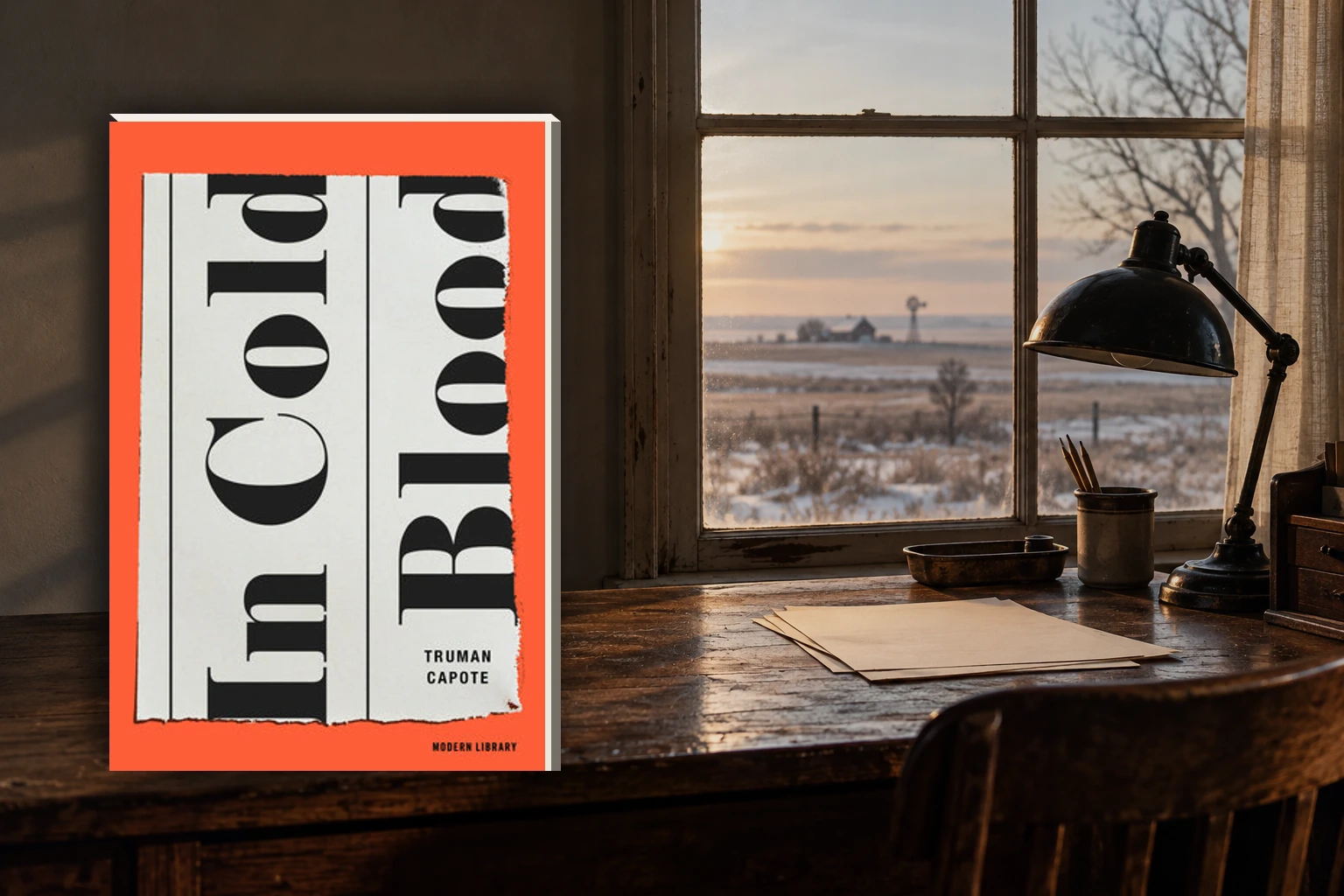
The promise of a psychological crime story is that a terrible act can be made intelligible. Truman Capote’s In Cold Blood, centered on the murder of the Clutter family in Kansas, gives that promise exceptional literary force. Its subject is a specific crime and its aftermath, yet its larger achievement is to make the reader feel the pull of explanation itself. The killers can be followed, described, and placed inside a coherent narrative. Whether that coherence brings us closer to the truth is the question that makes the book more unsettling than a conventional account of detection.
Capote’s method brings journalism and the techniques of a novel into the same space. Reported events acquire pacing, atmosphere, and a sense of dramatic relation. That formal decision matters to a study of criminal behavior. A case file may assemble facts without making a person feel present; a literary narrative can make motives seem legible before they have been established. The reader gains continuity and emotional involvement, but also has to ask where observation ends and interpretation begins. The book’s confidence of form is part of its fascination and part of the reason it deserves critical care.
The Clutter family must remain more than the opening condition of somebody else’s psychological portrait. True crime often gives a perpetrator a complicated past, an arresting voice, and an apparent inner life while victims appear primarily as the proof of his violence. Capote’s account invites a reader to notice how attention is distributed. The family’s ordinary life gives the crime its human scale; the killers’ trajectories give the narrative its forward movement. Those functions are unequal, and the inequality can quietly turn a work about loss into a search for the most compelling explanation of the people who caused it.
One reason the book endures is that it resists a single comfortable category for the killers. To ask about background, disposition, choice, and circumstance is necessary if we want more than a word such as evil. Yet a collection of possible influences is not a formula that predicts murder. Psychological description can illuminate a person’s habits while leaving the crucial act morally and causally unresolved. The desire for a decisive origin story may tell us as much about the reader’s wish for safety as it tells us about a particular offender. If violence has one identifiable source, we can imagine that source being recognized in advance.
Capote’s literary approach intensifies that desire. Narrative invites us to connect earlier details with later outcomes. A gesture can feel like a sign; a remembered disappointment can appear to foreshadow an act. In life, such details are usually ambiguous and often common. In a book, selection gives them weight. The distinction does not invalidate the account. It explains why a thoughtful reader should treat a persuasive psychological pattern as an interpretation built from material, rather than a diagnosis or an experimentally established cause.
This is also where the book’s emotional intelligence becomes complicated. Intimacy with an offender need not be sympathy for the offense, and sympathy for a damaged life need not minimize the dead. Capote’s account asks readers to hold those propositions together. The temptation is to move too quickly from understanding a person’s suffering to treating the crime as its inevitable result. Such inevitability would reduce both moral agency and the many people with difficult histories who never harm anyone. The stronger reading preserves the uncomfortable gap between explanation and responsibility.
The form of nonfiction places another obligation on the reader. A scene may feel fully inhabited because the prose arranges space, time, and response with unusual skill. That feeling is not independent verification of every detail. Memories conflict, interviews are partial, and even direct participants may narrate themselves strategically. The literary reconstruction asks for trust while the subject matter calls for scrutiny. We can admire the book’s craft and still keep its apparent access to private thoughts at a measured distance. The tension is more productive than either an uncritical embrace or a blanket dismissal of literary true crime.
There is a moral problem in suspense as well. A crime narrative often creates momentum by delaying what the reader most wants to know. Here that machinery can make the path toward violence feel like an aesthetic experience. Capote’s control of sequence gives the account power, but it risks giving readers the satisfactions of pattern and closure where the actual event supplied neither. A serious encounter with the book includes noticing one’s own appetite for the next revelation. That appetite does not make reading unethical; it makes the ethics of attention impossible to ignore.
The case also exposes the limits of retrospect. Once the outcome is known, almost any earlier detail can be made to look predictive. Criminal psychology is most useful when it distinguishes evidence from a story assembled after the fact. In Cold Blood is valuable precisely because its persuasive narrative makes that distinction hard to maintain. Its emotional and formal success becomes a test of the reader’s discipline: can we remain open to complexity without treating the written sequence as a transparent map of causation?
For readers expecting a procedural guide to offender profiling, the book will offer something more demanding. Its center of gravity is storytelling: who receives a history, whose voice carries authority, and what happens when a writer turns a catastrophe into a durable work of art. The book can deepen concern for the human lives involved, but it cannot end the question of whether any account has given those lives proportionate space. That unresolved question is a strength when it keeps readers attentive, and a limitation when a beautifully finished passage seems to settle what the evidence cannot.
In Cold Blood remains important because it makes the search for motive inseparable from the way a story is told. The crime is real; the narrative is constructed. Holding both facts in view allows a richer reading than simply treating the book as a window into a killer’s mind. Capote shows how urgently we want violence to make sense. The most responsible response is to value the insight his form can provide while resisting the ease with which insight can harden into certainty.
EDITOR’S VERDICT
Tale24’s assessment
A formally ambitious account that exposes how motive, sympathy, and narrative structure shape a reader’s judgment.
Points to considerIts novelistic intimacy can make reconstructed interior lives seem more certain than the evidence permits.
Best for: Readers interested in the ethics of true crime, the psychology of violence, and literary nonfiction.
Editorial method: This is an independent assessment informed by the work and its official supporting information. AI tools may assist the drafting process; Tale24 reviews and takes responsibility for everything it publishes.