Literature & Thought · TALE24 REVIEW
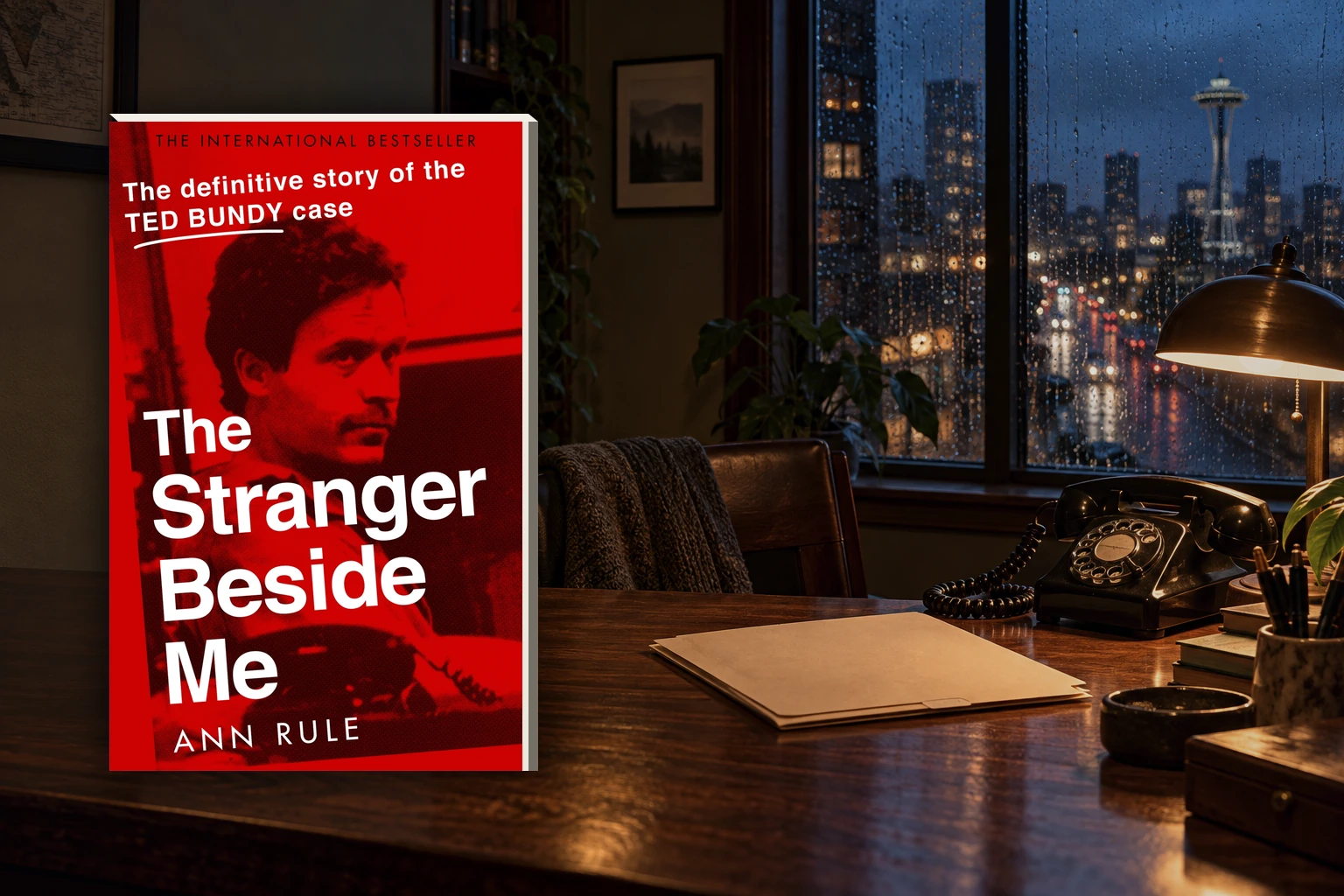
The Stranger Beside Me: How Familiarity Can Conceal Violence
Ann Rule’s account of knowing Ted Bundy turns true crime into an inquiry about the limits of personal judgment. Its most disturbing insight is how little ordinary familiarity can prove about another person.
The author’s personal connection creates an unusually exacting perspective on trust, hindsight, and divided loyalty.
A stranger can be feared because little is known about him. Ann Rule’s The Stranger Beside Me reverses that assumption. Rule knew Ted Bundy as a friend while she was also following a series of killings. The book’s enduring disturbance lies in the gap between those positions: the person encountered in daily life and the person identified through a criminal investigation. The psychological question is not simply how Bundy could deceive other people. It is why familiarity so readily feels like knowledge, even when it reveals only one part of a person’s life.
The title names a proximity that is emotionally and intellectually unstable. Someone can be beside us and remain a stranger in crucial ways. Rule’s connection to Bundy makes that possibility more than a general warning about appearances. It places the writer inside the uncertainty she is trying to describe. She cannot narrate from the clean distance of a later investigator who knows the outcome. Her memory of a friend and the accumulating public evidence must coexist, and the resulting tension gives the book a form that a detached case history could not easily reproduce.
This structure invites a dangerous shortcut. It would be easy to read every remembered mannerism as a clue and every friendly act as a calculated disguise. Hindsight makes earlier life appear organized toward a later revelation. But the fact that an ordinary gesture becomes frightening in retrospect does not mean it was legible as evidence at the time. Rule’s premise is powerful because it exposes the limits of confident judgment, not because it supplies a reliable list of traits by which to identify a murderer. To turn her experience into a checklist would repeat the certainty the experience unsettles.
Charm is an especially tempting explanation. Popular accounts often present Bundy’s social ease as if charm itself were a criminal instrument. Social skill can help someone gain trust, but it is neither rare nor diagnostic. What matters is the mismatch between the version of a person available in one relationship and conduct hidden elsewhere. Rule’s personal vantage shows how easily a limited, sincerely held impression can be mistaken for the whole. The lesson is less sensational than the idea of a monster in disguise: people make judgments from partial encounters, and sometimes those judgments prove tragically insufficient.
Rule also faced a problem distinctive to first-person true crime. Her relationship offered access and narrative force, yet it could place her feelings near the center of a story whose gravest losses belonged to others. A writer can honestly recount shock and divided loyalty without making personal betrayal the principal harm. The book asks readers to notice that distribution of attention. Bundy’s ability to command interest has long shaped the public telling of his crimes. A responsible reading keeps the people he harmed visible, rather than allowing the puzzle of his personality to become the only subject.
The book’s emotional drama is sharpened by a conflict between private and public ways of knowing. Friendship rests on repeated, situated experiences; an investigation depends on records, testimony, and claims that can be tested against one another. Neither mode is automatically complete. Personal knowledge may capture a habit that a file cannot, while documentary evidence can expose conduct no friend had reason or opportunity to see. Rule’s position makes the collision between the two methods vivid. It shows why loyalty can persist after suspicion becomes rational, and why suspicion can feel morally disorienting before it becomes settled fact.
That conflict should not be simplified into a failure of intuition. People are often told that they would have known, that a dangerous person must have shown unmistakable signs. Such claims impose a comforting logic on an event after it has occurred. They can also unfairly burden those who were close to an offender. Rule’s account is more useful when it is read as a study in bounded evidence. She had experiences with Bundy, not a complete view of his actions. The absence of a visible warning in one setting cannot confirm innocence, just as retrospective discomfort cannot alone establish guilt.
The true-crime genre is attracted to a figure who appears to move between ordinary life and extreme violence. That contrast generates suspense, but it can also flatter the reader with the thought that the concealed self was always waiting to be discovered by someone sufficiently perceptive. The Stranger Beside Me complicates that fantasy. Its authority comes from the author’s proximity, yet proximity did not grant omniscience. The reader learns more by attending to that limitation than by searching each recalled interaction for a secret code.
There is also an ethical limit to psychological speculation. Bundy’s crimes are historical facts, but claims about a single inner cause for them demand a different standard of evidence. A personality label may sound explanatory while doing little to clarify decisions, opportunities, and consequences. Rule’s story gives readers a powerful account of what it felt like to revise an understanding of a person. That is not the same as a clinical evaluation, and the book is strongest when it makes the instability of social knowledge its central insight.
The personal form can make the account unusually compelling. A reader is drawn into the experience of having one history of a person challenged by another. Still, the form carries a cost: the serial killer’s image can become more memorable than the lives interrupted by his acts. That is a risk in nearly every book about a famous offender, and this one cannot escape it entirely. Recognizing the risk makes room for a better reading, one that refuses to confuse notoriety with explanatory importance.
The Stranger Beside Me remains a significant study of crime because it unsettles an everyday psychological confidence. We usually infer character from repeated contact and coherent behavior. Rule’s experience shows how limited those inferences can be without suggesting that everyone should become suspicious of everyone else. Its strongest warning is precise: knowing a person in one context does not mean knowing every context. The book’s lasting value lies in turning that unsettling fact into a disciplined question about trust, evidence, and the stories we tell once the truth has changed.
EDITOR’S VERDICT
Tale24’s assessment
The author’s personal connection creates an unusually exacting perspective on trust, hindsight, and divided loyalty.
Points to considerBundy’s notoriety can dominate the frame, requiring readers to keep victims and evidentiary limits in view.
Best for: Readers interested in the psychology of deception and the ethical tensions of first-person true crime.
Editorial method: This is an independent assessment informed by the work and its official supporting information. AI tools may assist the drafting process; Tale24 reviews and takes responsibility for everything it publishes.