Literature & Thought · TALE24 REVIEW
The Odds of Reunion: Fate, War, and Romance in In the Likely Event
Rebecca Yarros makes coincidence the engine of a decade-long romance, then places its promise of reunion against the pressure of military duty and Afghanistan in 2021. The premise invites a question about how much narrative weight real conflict can carry for a love story.
The premise gives chance encounters and a decade of separation structural force, while the dual timeline and military assignments place private choices alongside larger obligations.
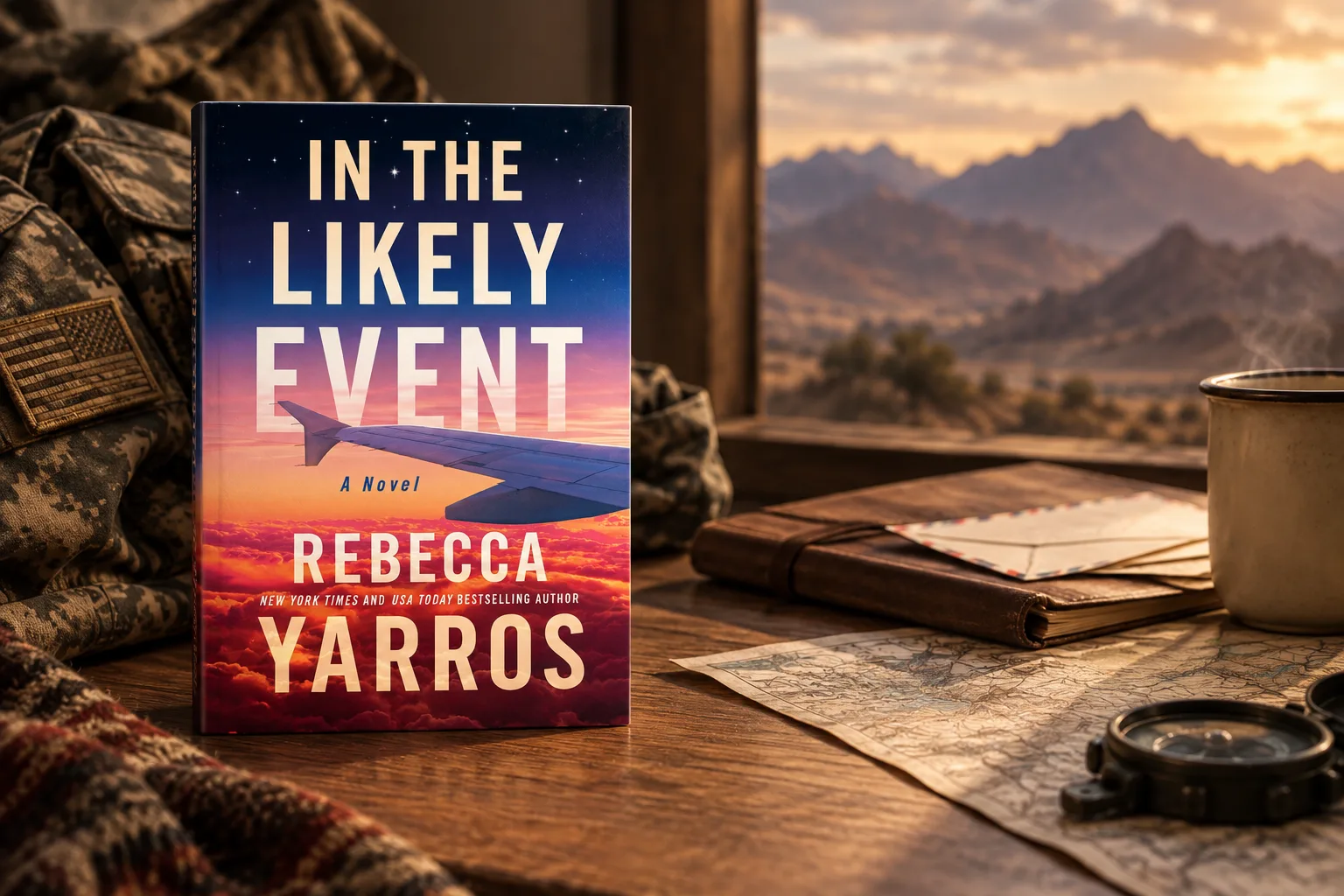
Rebecca Yarros builds In the Likely Event around a collision that sounds almost too large to be chance: ninety seconds after takeoff, the plane carrying Izzy Astor and Nate Phelan goes down in the Missouri River. They survive, their lives take sharply different routes, and years later they meet again in Afghanistan. The book’s title makes the organizing question plain. When two people repeatedly cross paths, does coincidence begin to feel like destiny—or does the story have to show what they choose to do with the time they get?
That question gives the premise more to work with than a simple “meant to be” romance. The official synopsis places the first meeting in 2011 and the reunion a decade later, after Nate enters military service and Izzy moves into politics. Publishers Weekly’s 2023 review describes an alternating structure that moves between the two narrators and timelines. Such a design can make each encounter carry two kinds of suspense: what is happening now, and what earlier separation has left unresolved. It also makes timing part of the relationship’s substance. A missed chance is not merely a delay before the expected couple gets together; it is a period in which each person builds a life beyond the other.
The structure’s promise is also its main test. A sequence of reunions can make love feel inevitable, but inevitability is not the same as intimacy. The ten-year span asks whether the characters change in ways that matter, or whether the plot mainly keeps resetting their attraction until circumstance finally permits a lasting union. Alternating perspectives offer Yarros a way to show how the same interval feels different to each person. In the account available from Publishers Weekly, both are strong yet vulnerable, and their push and pull supplies the emotional center. That is a useful description of the design, though a full judgment of how convincingly each voice develops would require reading the whole novel.
The plane crash is more than an extravagant meet-cute. It gives the relationship a shared origin in danger, so memory can bind the characters before they have accumulated ordinary shared experience. But a spectacular beginning can set a demanding scale for everything that follows. Later scenes must make time apart emotionally legible, rather than relying on the initial emergency to guarantee a bond. The synopsis’s chain of chance encounters makes this the book’s central craft problem: how to turn an improbable pattern into a believable relationship without asking readers to accept fate as a substitute for character.
The reunion changes the genre’s temperature. Nate is assigned to protect Izzy in Afghanistan, where she has arrived as an aide to a senator. Military duty and political work place the romance inside an active public crisis. Publishers Weekly says the novel addresses the horrors of war and the aftermath of trauma, and highlights a supporting cast that includes Izzy’s sister Serena, a photojournalist, and Nate’s friend Julian. These details suggest a wider web of obligations around the couple. Protection is not just a romantic gesture; it is a job performed in a place where other people’s safety and political decisions are also at stake.
That setting creates the sharpest ethical question for a reader. A real conflict can give a romance urgency, but it can also become scenery that lends gravity to a private love story. The book is marketed as romance and women’s fiction, not as a history of Afghanistan or an account of the 2021 withdrawal. That distinction helps set expectations, but it does not remove the question of whose experiences the plot makes visible. The synopsis centers an American military protector and a political aide. Whether Afghan characters have substantial agency, or whether the surrounding crisis primarily intensifies the couple’s danger, cannot be settled from a synopsis or a short professional review. Any confident claim either way would exceed the available evidence.
The contrast between the characters’ roles nevertheless offers a promising source of tension. Nate’s assignment gives him immediate power to act in a crisis; Izzy’s political work puts her inside institutions whose decisions affect people at a larger scale. A romance built around protection has to keep the protected character’s choices meaningful. Izzy’s career and her sister’s presence hint at motives and loyalties beyond the relationship. The key question is whether the story lets those motives shape the action, rather than treating them as reasons to put her in danger so Nate can rescue her. Publishers Weekly’s account calls the leads equally strong and vulnerable, a balance that would support a more mutual romance if the full narrative sustains it.
This is also where the book’s popular appeal and its potential limits meet. Readers drawn to contemporary military romance often want high stakes and emotional intensity to occupy the same frame. A decade of near-misses, a sudden reunion, and a protective assignment offer an efficient way to produce both. Yet the more extraordinary the plot becomes, the more carefully it must distinguish emotional consequence from escalation. A plane crash, years of separation, military service, trauma, and a crisis in Afghanistan are not interchangeable sources of suspense. Each carries a different human scale. The novel’s form can braid them together, but the braid must leave enough room for each strand to register on its own.
The available evidence supports a focused, rather than totalizing, assessment. Publishers Weekly responds positively to the emotional romance, the two-timeline approach, and the supporting cast. The official page presents the novel as a standalone and places it in romance and women’s fiction. The public synopsis frames chance encounters as the couple’s recurring pattern. Those signals make the book a clear fit for readers who enjoy long-running second-chance tension, dual timelines, military romance, and a plot that ties private feeling to public danger. Readers seeking a deeply contextualized account of Afghanistan, or who prefer romance that keeps its stakes within everyday life, may want to consult a sample and independent reviews before deciding.
In the Likely Event asks readers to believe that repeated coincidence can become a kind of promise. Its most interesting tension is whether that promise leaves room for agency: whether Izzy and Nate make a life through choices, or are simply carried by events until the timing changes. The premise gives the question force, and the professional reception points to emotional momentum. The same premise also carries a responsibility to treat its real-world setting as more than a device. On the sources available here, that is the right question to take into the book—and the limit of what this review can responsibly conclude.
EDITOR’S VERDICT
Tale24’s assessment
The premise gives chance encounters and a decade of separation structural force, while the dual timeline and military assignments place private choices alongside larger obligations.
Points to considerThe real Afghanistan setting raises a demanding question about whose experience the romance makes visible; the available sources cannot establish how the full novel answers it.
Best for: Readers of second-chance contemporary and military romance who enjoy dual timelines and high-stakes reunion plots. Readers seeking detailed Afghan context may want to sample the book and consult additional criticism.
Editorial method: This is an independent assessment informed by the work and its official supporting information. AI tools may assist the drafting process; Tale24 reviews and takes responsibility for everything it publishes.