Literature & Thought · TALE24 REVIEW
The Pied Piper’s Debt Becomes a Captive Romance
Raven Kennedy turns the Piper’s public bargain into a captive romance. The premise raises a sharper question: what becomes of a folktale’s collective debt when its consequences are made intimate?
A vivid fae-and-Plague premise, a stigmatized heroine, and a morally uncertain Piper create strong material for character-led romantasy.
The Pied Piper story begins with a bargain: a community asks a stranger to solve a crisis, then discovers that help has a price. Raven Kennedy’s The Sweetest Fiend keeps that transaction at its center, but redirects its pressure toward a captive romance. The interesting question is not whether this is a faithful retelling. It is what happens to a folktale about public responsibility when its debt becomes intimate.
This Tale24 assessment draws on the publisher’s description and sample front matter, a professional review, and published reader responses. It evaluates the book’s premise and reception rather than claiming a full-text reading. That distinction matters here: the available commentary is sharply divided on whether the romance deepens the legend or displaces it.
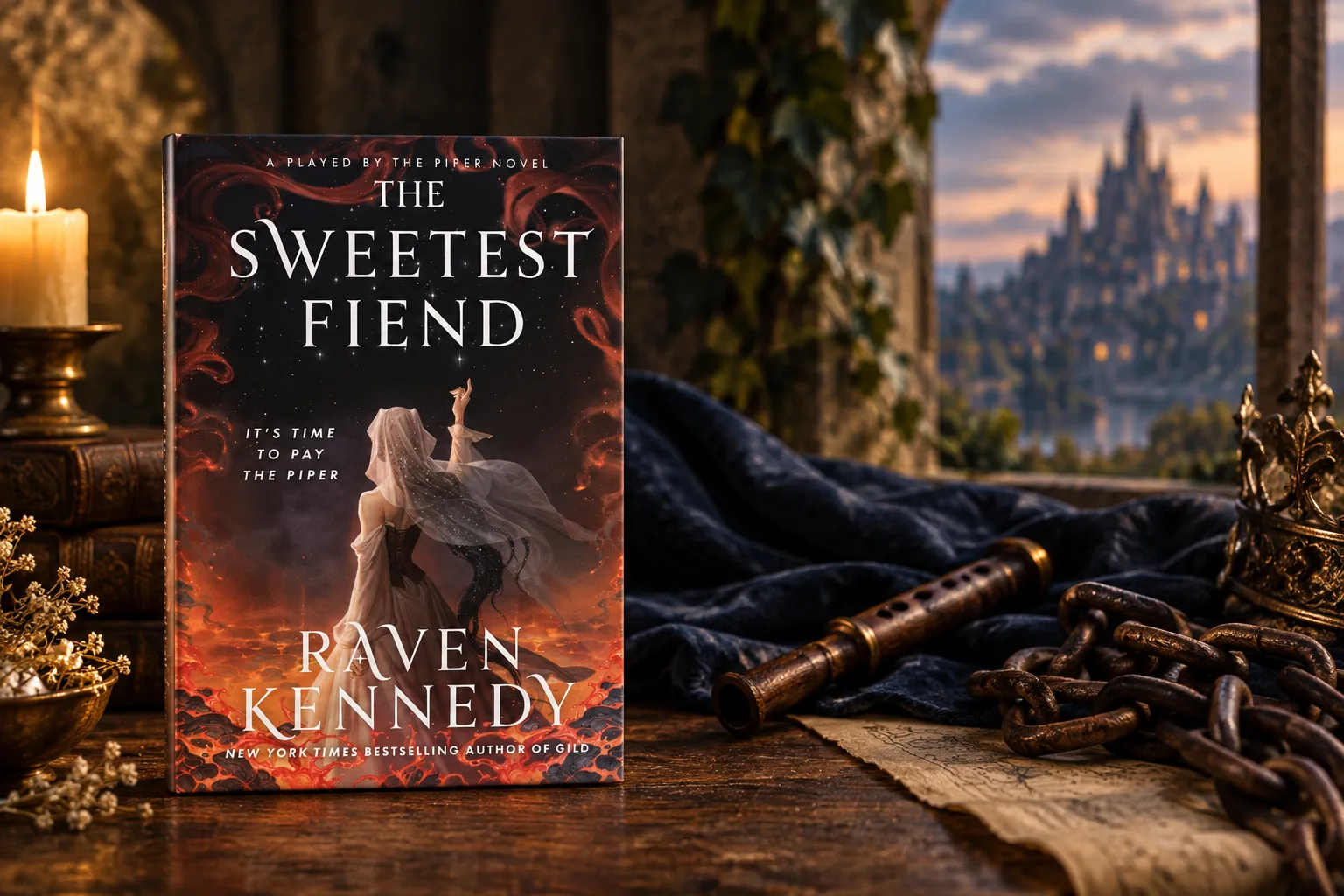
In Kennedy’s version, the familiar village is Hamelyn, threatened by Plagues in a fae world. Esti is a fiend, half Bane and half fae, and is treated as suspect because of what she is. When the Pied Piper removes a plague, the town’s refusal to pay brings a terrible consequence: 130 people are taken, Esti among them. The author’s official description frames her immediate goal as escape and return to a family that depends on her. The old story’s arithmetic remains recognizable—aid, refusal, payment—but the captured girl now occupies the center of the plot.
That shift opens a promising tension. In the traditional outline, the Piper’s power is frightening partly because it is impersonal: an outsider enforces a bargain against an entire town, and the children pay for adults’ breach. Here, the Piper is also a romantic lead, while Esti’s danger is tied to prejudice against fiends and to her personal bond with her family. A civic wrong is narrowed into a relationship between two people. That can make the moral problem more immediate, but it also changes who must carry it. The town’s decision risks becoming a setup for attraction rather than the story’s enduring ethical question.
The worldbuilding gives that personal conflict a useful social dimension. The publisher describes a history of Banes, fae power, and Plagues; Kirkus identifies Esti’s ability to read the truth about people as part of the magic system. Her status as a fiend places her at the intersection of fear, inherited stigma, and survival. This premise can make the romance more than a clash of temperaments: attraction has to contend with a world that has already assigned Esti a category and a presumed guilt. Reader responses often single out her outsider position and the plague-stricken setting as the elements that keep the fantasy vivid.
But the Piper’s role makes the romantic turn ethically delicate. He rescues Hamelyn from one danger and then abducts its residents as payment. The book is marketed with captive-romance and forced-proximity elements, so the imbalance is not an incidental obstacle; it is the engine that brings Esti and Varrik together. That can sustain suspense if the narrative keeps the cost of coercion visible as power shifts. It can feel much less convincing if magic or immediate chemistry does the work that trust and choice would need to do. Reviews disagree on exactly this point. Some readers praise the banter, yearning, and morally uncertain Piper; others, along with Kirkus, find the enemies-to-lovers progression abrupt or insufficiently earned.
The disagreement over pacing follows a similar divide. The opening catastrophe—plagues, danger, and the Piper’s arrival—promises urgent forward motion. The Page Walker found that opening effective, then described a slower middle that leaves room for a large cast and relationship-building. Kirkus, by contrast, sees the first third as sluggish and the plot as repetitive, with Esti’s escape attempts failing to generate enough momentum. Those are not simply opposite reactions to the same speed. They point to a question of narrative emphasis: once the immediate crisis has delivered the characters into captivity, does the novel keep transforming the conflict, or does it repeatedly circle the same attraction and escape pattern?
For romantasy readers, the answer may depend on what they want the retelling to prioritize. The publisher’s language promises dark magic, secrets, mature romance, and sweeping stakes; reader reviews frequently praise the world, character chemistry, and cliffhanger. Readers looking for the legend’s social bargain to remain in the foreground may find the relationship focus a meaningful departure—or a frustration. The Page Walker makes that distinction explicit, valuing the character work while wishing for a deeper return to the folklore’s questions about promises and consequences.
That critical split is also the book’s clearest point of interest. Retellings are not obligated to preserve a source tale’s moral structure. They can alter its center of gravity. Yet a recognizable symbol such as the Piper’s payment carries expectations with it. When the story converts collective debt into a captor-and-captive romance, it invites readers to ask whether the original harm is being interrogated, softened, or simply used to make proximity unavoidable. The answer depends on how fully the narrative lets Esti’s agency and the town’s responsibility remain consequential after the romance takes hold.
The Sweetest Fiend therefore seems best approached as a dark romantasy that borrows the Piper’s bargain to launch a character-led duology, not as a close exploration of the folktale’s moral aftermath. Its premise offers strong ingredients: a stigmatized heroine, a dangerous rescuer, a community in crisis, and a payment that cannot be made cleanly. The available reviews suggest real appeal in the atmosphere, banter, and romantic tension, alongside a credible concern that pacing and emotional development may not satisfy every reader. The book’s promise lies in that unresolved friction. Whether its sequel turns the Piper’s debt back toward the wider community remains an open question.
EDITOR’S VERDICT
Tale24’s assessment
A vivid fae-and-Plague premise, a stigmatized heroine, and a morally uncertain Piper create strong material for character-led romantasy.
Points to considerProfessional and reader reviews diverge on the slow middle, repeated escape beats, and whether the romantic progression earns its emotional turns.
Best for: For adult romantasy readers who enjoy dark fae worlds, captive-romance tension, and a Pied Piper reimagining; readers seeking folklore-centered moral analysis may want to check a sample first.
Editorial method: This is an independent assessment informed by the work and its official supporting information. AI tools may assist the drafting process; Tale24 reviews and takes responsibility for everything it publishes.