Psychology & Skills · CRITICAL ESSAY
Quiet: Reclaiming Contemplation Without Mythologizing Temperament
Susan Cain's cultural touchstone challenged America's loud 'Extrovert Ideal' and reshaped office design, even as critics questioned its earnest slogans and tendency to idealize introversion.
Engaging synthesis of cultural history, temperament biology, and practical concepts like 'restorative niches' that modernized school and office norms.
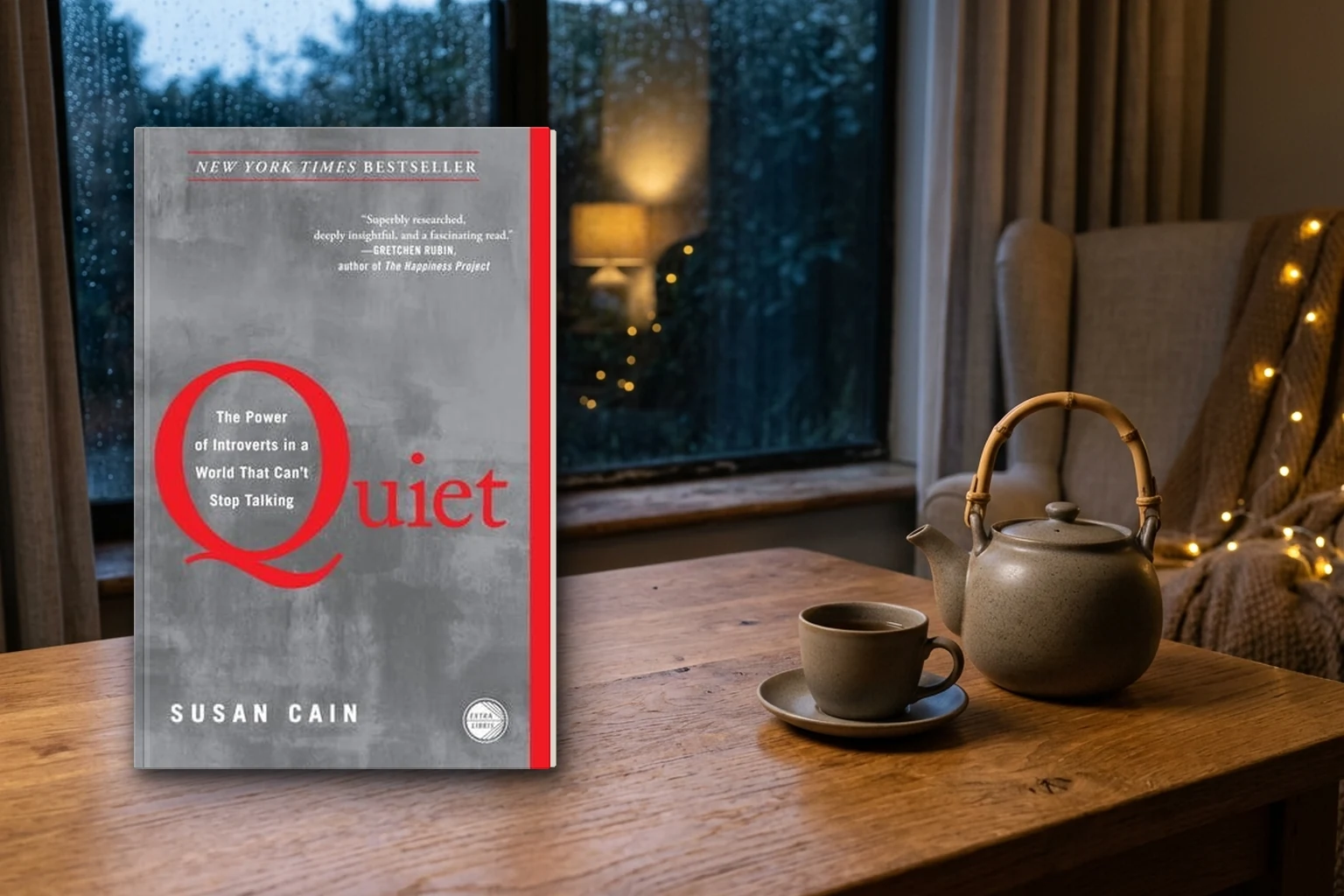
When former corporate negotiations attorney Susan Cain published Quiet: The Power of Introverts in a World That Can't Stop Talking in 2012—available in Crown's verified 368-page paperback edition—the book struck an immediate cultural nerve. Winner of the 2012 Goodreads Choice Award for Best Nonfiction and a long-running number-one New York Times bestseller, Quiet helped spark a broader "Quiet Revolution" alongside Cain's widely viewed TED talk, pushing American elementary schools and Fortune 500 offices to question why constant vocal performance had become the default proxy for competence.
Examined carefully today, Quiet succeeds far better as cultural history and organizational advocacy than as strict personality science. Cain makes an unforgettable case against institutions built exclusively around rapid talkers, even while her advocacy sometimes tips into sweeping generalizations and overly flattering portraits of the quiet temperament she set out to defend.
From the Culture of Character to the Extrovert Ideal
Cain frames her central argument around a historical shift rather than a mere personality quirk. Opening with an introduction titled "The North and South of Temperament" that contrasts Rosa Parks's quiet moral resolve against modern expectations of public charisma, she estimates that roughly one-third to one-half of Americans are introverts—people who prefer lower-stimulation environments and recharge in solitude—yet live inside institutions governed by what she calls the "Extrovert Ideal." That contrast immediately reframes quietness not as timidity, but as an alternative form of moral and intellectual presence.
Structured across four main parts containing eleven chapters plus a concluding section titled "Wonderland," Quiet builds its cultural argument methodically. Part One traces how early twentieth-century urbanization, mass advertising, and sales culture replaced a nineteenth-century "Culture of Character," which prized inner moral discipline, citizenship, and reserve, with a "Culture of Personality" built on magnetic self-promotion and rapid social poise. Cain sharpens this history through vivid institutional reporting: visits to Harvard Business School, where constant networking and rapid speaking feel like "an extreme sport," and sharp critiques of open-plan offices and "The New Groupthink," where mandatory group brainstorming often suppresses independent creative insight in favor of social conformity and vocal confidence. By tracing how corporate architecture and seminar rooms reward quick speech over careful thought, she explains why quiet workers so often feel out of place despite producing strong work.
Temperament Biology, Free Traits, and Restorative Niches
In Part Two ("Your Biology, Your Self?"), Cain anchors cultural observation in developmental and personality psychology. She walks readers through Harvard psychologist Jerome Kagan's longitudinal studies comparing high-reactive and low-reactive infants, linking cautious sensory sensitivity to the "orchid hypothesis"—the finding that sensitive children may wilt under harsh overstimulation yet flourish remarkably in attentive, supportive surroundings.
Rather than trapping readers inside biological determinism, Cain draws on psychologist Brian Little's "free trait theory": the encouraging observation that introverts can temporarily adopt extroverted behaviors on behalf of deeply meaningful core projects, provided they grant themselves regular "restorative niches" afterward to recover energy. She pairs that framework with neurochemical reward-sensitivity findings contrasting reckless Wall Street crash-era risk appetite against Warren Buffett's patient, solitary reflection.
Part Three ("Soft Power") then broadens the analysis into cross-cultural communication, exploring how traditional East Asian values honoring humility and attentive listening clash with Western expectations of rapid verbal assertion. Part Four ("How to Love, How to Work") concludes by translating temperament research into practical strategies for mixed-temperament couples, Pixar-inspired hybrid offices featuring quiet sanctuaries alongside collaborative rooms, and parenting introverted children without trying to "fix" their natural pace of engagement.
Cultural Impact and Critical Acclaim
Trade critics immediately recognized Quiet's capacity to reframe unspoken workplace anxieties. Kirkus Reviews praised the book as "an intriguing and potentially life-altering examination of the human psyche that is sure to benefit both introverts and extroverts alike," highlighting Cain's timely warning against corporate boardrooms dominated by alpha-style reward sensitivity. Publishers Weekly commended Cain's "diligence, research, and passion" across biographical portraits spanning Eleanor Roosevelt and Rosa Parks to Steve Wozniak and West Coast leadership retreats.
Its practical influence proved remarkably concrete. Giving managers and educators clear vocabulary—distinguishing quiet processing from disengagement, defending asynchronous writing alongside live meetings, and pairing collaborative hubs with silent focus rooms—helped normalize healthier hybrid norms long before remote work accelerated those conversations across US workplaces and classrooms. By linking historical sociology with accessible behavioral anecdotes, Cain shifted a private feeling of exhaustion into a shared institutional conversation. Rather than treating classroom silence or deliberate preparation as social deficits, schools and offices gained grounded reasons to design multiple channels for thoughtful participation.
Rhetoric, Binary Framing, and Critical Pushback
Yet major reviewers flagged real stylistic and conceptual flaws beneath Cain's persuasive synthesis. In The New York Times, Judith Warner welcomed the topic's urgency while criticizing Quiet as "a long and ploddingly earnest book" marred by "go-go language" and "gratuitous sloganeering" that "offset Cain's serious research rather badly," noting a tendency to smooth complex corporate shifts into neat cultural dichotomies. Even sympathetic readers occasionally feel the prose straining to turn nuanced psychological evidence into uplifting rally cries.
Writing in The Guardian, journalist Jon Ronson praised Cain's empathetic, convincing critique of exhausting open-plan offices, yet caught an ironic rhetorical imbalance: by casting introverts repeatedly as "especially empathic," "modest," and morally thoughtful "orchids," Cain slips into "the kind of narcissistic rhetoric she eschews in extroverts." Personality psychologists similarly observe that although Cain carefully defines shyness (fear of social judgment) as distinct from introversion (preference for lower stimulation), later chapters occasionally blur the two—and flatten a continuous spectrum where many people function as adaptable ambiverts into two tidy, opposing camps.
Verdict for Contemporary Readers
Read with healthy skepticism toward its occasional self-help cheerleading, Quiet remains an influential, compassionate corrective to noisy institutional defaults. Its weakness lies not in its research sources, which are thoughtfully selected and honestly attributed, but in a rhetorical drift that sometimes romanticizes solitude while treating a fluid human spectrum as two fixed tribes. Real organizations thrive not by inverting dominance from loud speakers to silent thinkers, but by designing schedules and spaces where both deliberation and lively exchange coexist without penalty.
For introverted professionals, people managers, HR and workspace designers, educators rethinking participation grades, and parents of sensitive children, Cain's Crown paperback retains high practical value. Its best gifts—free trait theory, restorative niches, and thoughtful spaces that protect deep concentration—improve workplaces and classrooms for extroverts and introverts alike. Taken not as a rigid badge of identity but as an argument for quieter institutional breathing room and thoughtful organizational design, Quiet earns its lasting place in contemporary social psychology.
CRITICAL PERSPECTIVE
Tale24’s assessment
Engaging synthesis of cultural history, temperament biology, and practical concepts like 'restorative niches' that modernized school and office norms.
Points to considerOccasionally lapses into earnest sloganeering, blurs shyness with introversion, and risks idealizing introverts as uniquely empathetic 'orchids.'
Best for: Introverted professionals, managers, workplace designers, educators, and parents navigating mixed-temperament teams and classrooms.
Editorial method: This is Tale24’s original analysis of the published material and attributed criticism. AI tools may assist the drafting process; Tale24 reviews and takes responsibility for everything it publishes.
READING AND RESEARCH
Sources and edition scope
Bibliographic details and textual claims in this review were checked against the edition and reference records below (Quiet: The Power of Introverts in a World That Can't Stop Talking by Susan Cain). Commercial retailer links are kept separate from editorial verification.
- penguinrandomhouse.com — quiet by susan cain / 9780307352156 Publisher's edition record
- kirkusreviews.com — susan cain / quiet power introverts Independent review
- theguardian.com — 22 / quiet power introverts susan cain review Editorial reference
Sources checked November 23, 2026.
KEEP READING