Science & Nature · CRITICAL ESSAY
Cosmos: Carl Sagan's Humanist Monument to Scientific Wonder
Four decades after accompanying Sagan's landmark PBS series, Cosmos remains an unmatched fusion of planetary science and cultural history, even where subsequent astronomy has outpaced its 1980 science.
Lyrical, historically rich synthesis of astronomy and human curiosity, anchored by timeless metaphors like the Cosmic Calendar.
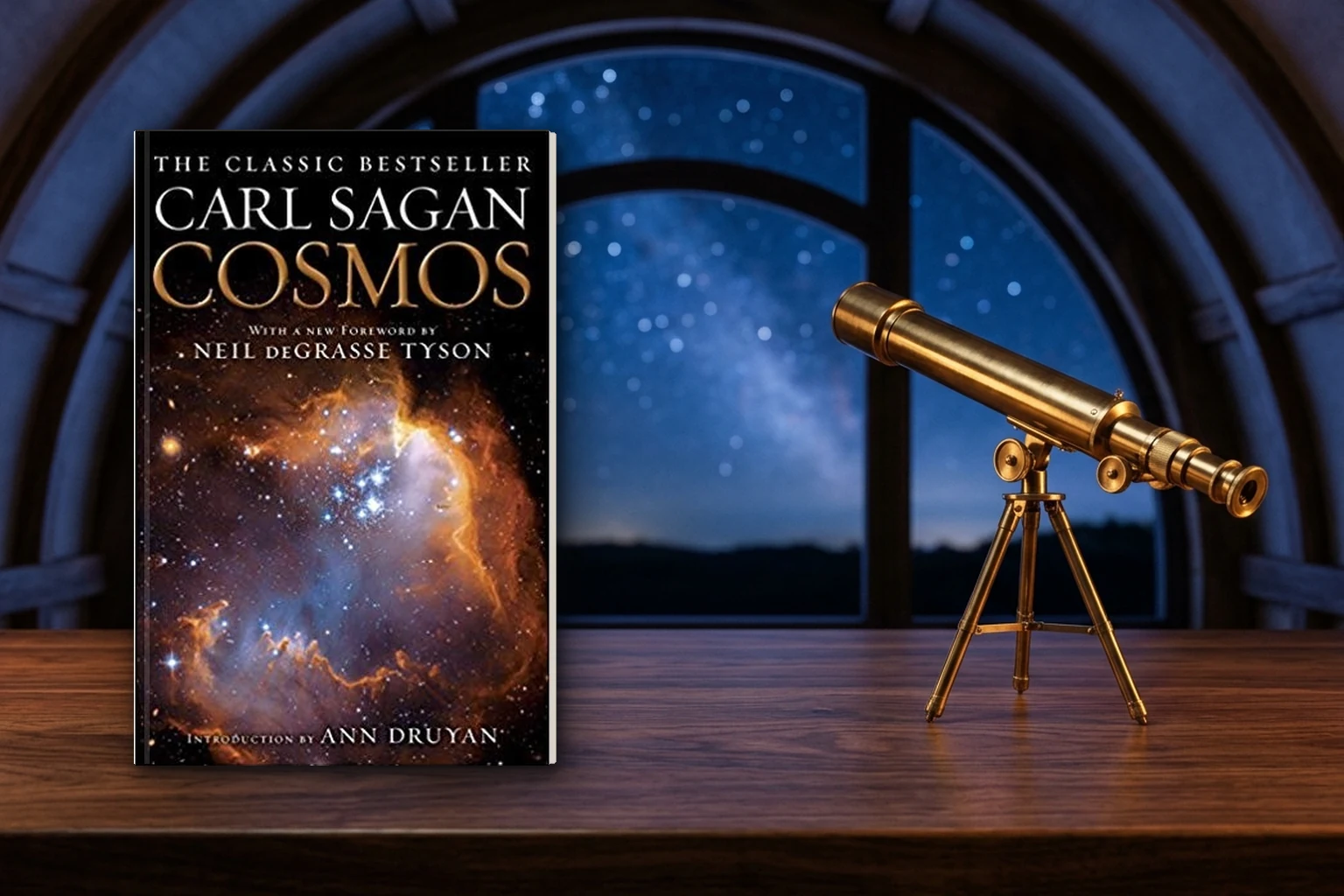
When Cornell astronomer and Pulitzer Prize-winning writer Carl Sagan published Cosmos in 1980 alongside his thirteen-part PBS series Cosmos: A Personal Voyage, he accomplished something extraordinarily rare in modern publishing: turning technical astrophysics and deep evolutionary time into an intimate shared experience for millions of ordinary households. Reissued by Ballantine Books in a verified 432-page paperback ahead of the 2014 television sequel—framed with an Introduction by longtime collaborator Ann Druyan and a Foreword by Neil deGrasse Tyson—the volume endures as an icon of American science communication.
Evaluating Cosmos today requires holding two truths together. As a work of humanistic prose and scientific pedagogy, few books have ever rivaled its capacity to ignite wonder; as an empirical reference written in 1980, however, forty-plus years of planetary probes and cosmology have necessarily reshaped many details beneath Sagan's overarching vision.
Thirteen Voyages Linking Starlight and Civilization
Organized into thirteen illustrated chapters matching each broadcast episode—opening with "The Shores of the Cosmic Ocean," spanning "One Voice in the Cosmic Fugue," "The Harmony of Worlds," "Heaven and Hell," "Blues for a Red Planet," "Travelers' Tales," "The Backbone of Night," "Travels in Space and Time," "The Lives of the Stars," "The Edge of Forever," "The Persistence of Memory," and "Encyclopaedia Galactica," and concluding with "Who Speaks for Earth?"—Cosmos deliberately refuses to treat science as a sterile catalog of equations detached from human affairs. Instead, Sagan pairs cosmic evolution with intellectual history, philosophy, and political survival, crystallizing his thesis in the enduring formulation that "we are a way for the cosmos to know itself."
That dual perspective turns abstract scale into human drama. In Chapter 1, Sagan introduces the famous Cosmic Calendar, compressing the entire sweep of cosmic history into a single calendar year in which every recorded milestone of human civilization crowds inside the final seconds of December 31. In the very same opening movement, he recounts how ancient Alexandrian scholar Eratosthenes measured Earth's circumference accurately using simple noon shadows and geometric reasoning—showing readers that scientific discovery begins with observant curiosity rather than expensive hardware alone. Framing human ingenuity at both cosmic and earthly scales sets a compassionate intellectual tone that carries smoothly across the remainder of the voyage.
Metaphor, Historical Storytelling, and Ecological Warning
Throughout the middle chapters, Sagan moves fluidly between rigorous physics and sympathetic biography. Readers trace Johannes Kepler's agonizing search for elliptical planetary laws against entrenched orthodoxy, examine Venus's runaway greenhouse inferno in "Heaven and Hell" as an urgent comparative mirror for Earth's fragile biosphere, follow Mars exploration alongside Voyager encounters across the outer solar system, and discover how heavy atoms forged inside dying stars literally assemble human bone and blood. By rooting astrophysics in concrete human biographies and planetary comparisons, Sagan invites non-specialists to grasp why distant cosmic processes bear directly on life on Earth.
Just as memorable are Sagan's civic warnings. Mourning the destruction of the ancient Library of Alexandria as a cautionary parable against anti-intellectual intolerance, reflecting in "The Persistence of Memory" on how genes and books preserve human experience across generations, and closing Chapter 13 with an urgent warning against Cold War nuclear catastrophe, Sagan treats scientific literacy not as a hobby for specialists, but as an indispensable safeguard for planetary survival.
Literary Triumph and the "Sagan Effect"
Upon debut, Cosmos shattered sales benchmarks for popular science in the United States, spending seventy weeks on The New York Times Best Seller list and fifty weeks on Publishers Weekly's chart, while winning the 1981 Hugo Award for Best Related Non-Fiction Book at Denvention Two. In The New York Times Book Review, novelist James Michener hailed it as "a cleverly written, imaginatively illustrated summary of [Sagan's] ruminations about our universe," admiring prose that felt "iridescent, with lights flashing upon unexpected juxtapositions of thought." Kirkus Reviews summed it up crisply as "Sagan at his best."
Nearly three decades later, retrospective commentary in The Guardian still praised Cosmos as "a complete guide to life, the universe and everything" that "still educates, entertains and inspires awe." Yet Sagan paid an ironic institutional price for that public warmth: within mid-century academic circles, his immense television fame provoked lingering professional pushback later dubbed the "Sagan effect," a dismissive assumption among some peers that popular clarity implied shallower scholarship.
Forty Years of Scientific Progress and Historiographic Limits
Reading Cosmos faithfully in the twenty-first century means acknowledging precisely where science has marched past 1980. Written fifteen years before the 1995 confirmation of exoplanets orbiting sun-like stars and eighteen years before the 1998 discovery of cosmic acceleration and dark energy, Sagan's discussions in Chapter 10 ("The Edge of Forever") around cosmic density and the universe's ultimate fate inevitably reflect pre-dark-energy debates. Likewise, updated planetary-formation models and torrents of telemetry from Cassini, New Horizons, Mars rovers, Hubble, and the James Webb Space Telescope have transformed data that Sagan could only frame through early spacecraft glimpses.
Historians and more technically minded readers have also noted two stylistic trade-offs. Sagan's sweeping poetic humanism sometimes prioritizes emotional resonance over deep technical rigor, and historical set pieces—including contested scholarly traditions surrounding Hypatia and the precise demise of the Library of Alexandria—lean toward simplified dramatic parable rather than strict historiographical qualification. Approaching the book with those caveats clear lets modern readers admire Sagan's synthesis without confusing a 1980 landmark for a current astrophysics survey or a peer-reviewed classical history monograph.
Verdict for Contemporary Readers
Anyone seeking an up-to-date textbook on dark energy, exoplanet atmospheres, or modern Mars geology must pair Cosmos with contemporary astronomy writing. Yet obsolescence in specific measurements does nothing to dull Sagan's deeper achievement: demonstrating how empirical skepticism and poetic reverence belong together in civic life. Few works of nonfiction bridge ancient geometry, planetary science, and modern ecological urgency with such effortless moral clarity.
For curious general readers, high school and college students stepping into STEM fields, science educators, and lovers of natural philosophy, the Ballantine paperback—enriched by Ann Druyan's and Neil deGrasse Tyson's framing—remains an essential monument. It endures not because every 1980 figure stayed fixed, but because nobody ever explained why looking up at night matters with greater clarity, courage, and grace. Read alongside newer observational breakthroughs, Sagan's voice in "Who Speaks for Earth?" still reminds readers that scientific curiosity and planetary stewardship belong together as a collective human inheritance rather than a narrow academic specialty reserved for astronomers alone.
CRITICAL PERSPECTIVE
Tale24’s assessment
Lyrical, historically rich synthesis of astronomy and human curiosity, anchored by timeless metaphors like the Cosmic Calendar.
Points to considerOriginally written in 1980 before exoplanet confirmations, dark energy, and modern space telescopes, leaving several astrophysical sections dated.
Best for: Curious general readers, STEM students, science educators, and admirers of humanistic natural philosophy.
Editorial method: This is Tale24’s original analysis of the published material and attributed criticism. AI tools may assist the drafting process; Tale24 reviews and takes responsibility for everything it publishes.
READING AND RESEARCH
Sources and edition scope
Bibliographic details and textual claims in this review were checked against the edition and reference records below (Cosmos by Carl Sagan). Commercial retailer links are kept separate from editorial verification.
- penguinrandomhouse.com — cosmos by carl sagan / 9780345539434 Publisher's edition record
- thehugoawards.org — hugo history / 1981 hugo awards Editorial reference
- theguardian.com — 12 / carl sagan cosmos personal voyage Editorial reference
Sources checked November 23, 2026.
KEEP READING