Literature & Thought · CRITICAL ESSAY
Slaughterhouse-Five: Fractured Time as the Grammar of Trauma
Kurt Vonnegut spent twenty-three years searching for a way to write about the firebombing of Dresden; his solution turned nonlinear time and dark science fiction into an enduring antiwar testimony.
Inventive nonlinear metafiction that turns sci-fi dislocation and dark humor into an honest formal vessel for wartime PTSD.
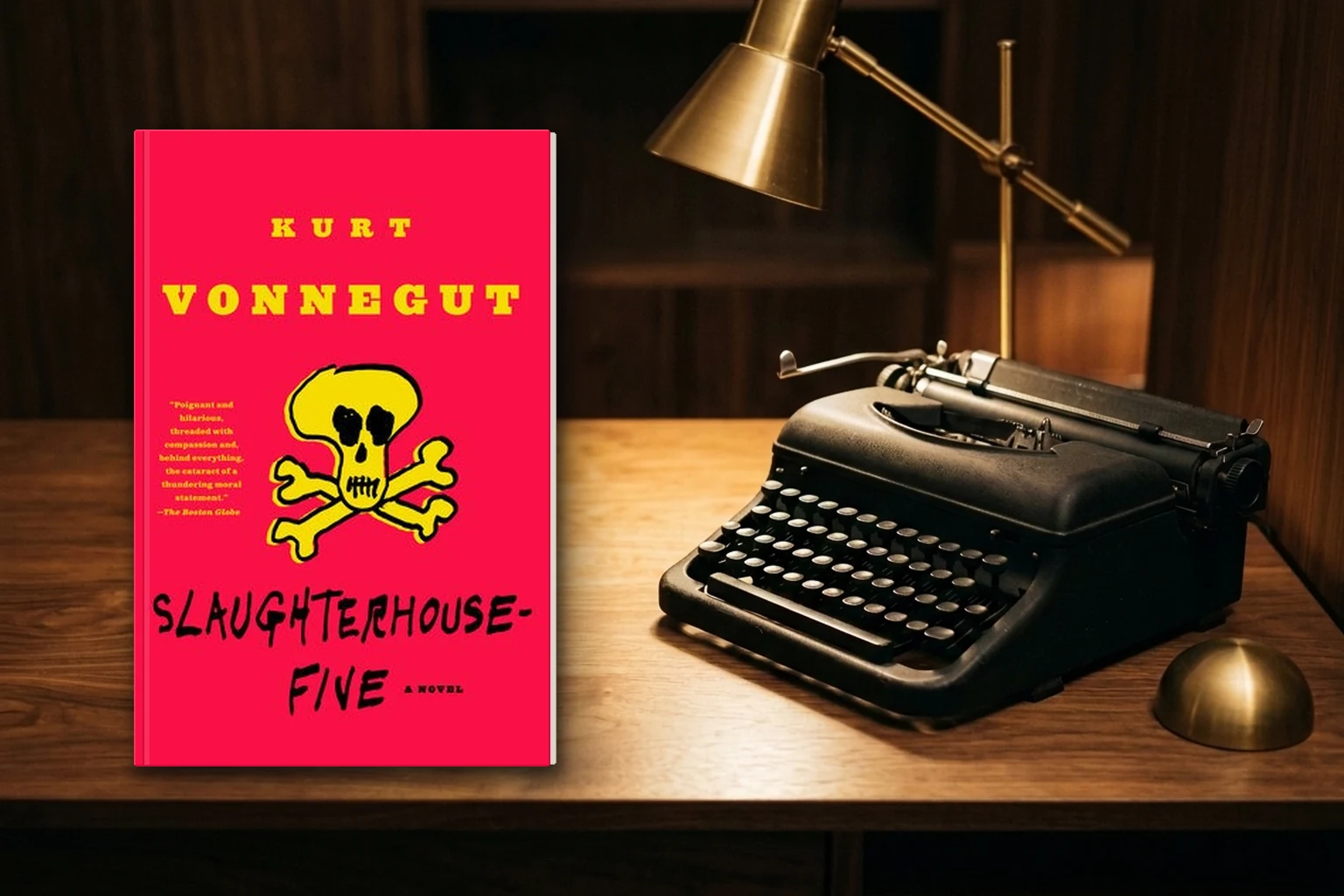
Few American war novels announce their own failure of nerve so disarmingly as Kurt Vonnegut's Slaughterhouse-Five; or, The Children's Crusade: A Duty-Dance with Death. Published by Delacorte Press on March 31, 1969, and available in Dial Press Trade Paperbacks' verified 288-page edition, the novel emerged from what Vonnegut described as a twenty-three-year struggle to confront the Allied firebombing of Dresden, Germany, which he survived in February 1945 as an American prisoner of war. Rather than forcing an incomprehensible mass catastrophe into conventional heroic chronology, Vonnegut shattered linear storytelling altogether.
Examined through its formal design and half-century critical record, Slaughterhouse-Five succeeds precisely because it treats narrative breakage as moral honesty. Where traditional war fiction often turns carnage into suspenseful spectacle, Vonnegut strips away plot surprises in Chapter 1, steps onto the page in his own voice, and uses science-fiction dislocation to dramatize how a damaged mind survives events too vast for ordinary sequence. By placing authorial memory and pulp imagination side by side, the book invites readers to examine not just what happened in wartime Europe, but why neat storytelling cannot contain collective devastation.
Framing the Antiwar Premise in Plain Sight
Vonnegut opens the novel not on a battlefield, but in his own autobiographical voice visiting old war comrade Bernard V. O'Hare to jog memories of Dresden. That opening frame achieves its ethical clarity through Bernard's wife, Mary O'Hare, whose anger that war books glorify killers rather than depict frightened young boys prompts Vonnegut to adopt the subtitle "The Children's Crusade." By telling readers right away how the story starts, where it leads, and how it finishes, Vonnegut eliminates cheap suspense and signals that this book refuses to flatter military drama.
At the center of the fictional narrative stands Billy Pilgrim, an unassuming barber's son from Ilium, New York, who becomes a prosperous optometrist after World War II. During the war, Billy serves as an unarmed chaplain's assistant captured in the Battle of the Bulge and transported to Dresden, where he shelters underground in a meat locker designated Slaughterhouse Five ("Schlachthof Fünf") while firestorms incinerate the city above. Simultaneously, Billy has become "unstuck in time," snapping uncontrollably across childhood, German captivity, postwar suburban family life, a plane crash, his eventual assassination, and alleged captivity on the planet Tralfamadore in a domed zoo beside Hollywood actress Montana Wildhack. That sharp juxtaposition between mundane American suburbia and subterranean wartime shelter keeps Dresden from feeling safely sealed inside history.
Tralfamadore, PTSD, and the Logic of "So It Goes"
On a literal level, the Tralfamadorian sequences look like playful mid-century pulp fantasy. Yet literary scholars and psychiatric readers have long recognized how closely Billy's involuntary time shifts mirror the phenomenology of severe Post-Traumatic Stress Disorder. Intrusive flashbacks, emotional numbing, and sudden dissociation detach a traumatized veteran from chronological safety, collapsing decades so that a peacetime optometry office or wedding anniversary abruptly gives way to freezing boxcars and charred ruins.
The four-dimensional Tralfamadorians instruct Billy that all moments—past, present, and future—always exist and cannot be changed, advising him simply to turn his attention toward pleasant instants and ignore terrible ones. Every time human, animal, or trivial death enters the text, Vonnegut follows it with the flat refrain "So it goes." Far from endorsing callous indifference, that deadpan repetition exposes the psychic cost of emotional anesthesia: leveling a mass civilian firebombing alongside spoiled champagne shows what happens when a survivor trains himself not to feel differential grief while normal domestic life carries on uninterrupted around him.
Black Humor, Critical Praise, and Postmodern Breakthrough
Released during the escalation of the Vietnam War, Slaughterhouse-Five vaulted Vonnegut from cult paperbacks into the front rank of American letters, spending sixteen weeks on The New York Times Best Seller list and peaking at number four. It earned nominations for both the Hugo Award and the Nebula Award and won a place on the Modern Library 100 Best Novels list, proving that speculative devices and high literary seriousness did not belong in mutually exclusive boxes.
In The New York Times Book Review of April 6, 1969, critic Robert Scholes hailed the novel as "an extraordinary success… a book we need to read, and to reread… funny, compassionate, and wise," observing that Vonnegut's humor does not evade horror but fortifies readers to look straight at it. In March 1969, Kirkus Reviews similarly applauded the Dresden chapters as "a precise jumble and jangle, disconcerting and ultimately devastating." Five decades later, retrospective commentary in The Guardian continues to emphasize how Vonnegut's "supremely human" moral voice keeps metafictional invention anchored in tangible tenderness toward ordinary soldiers and civilians.
Fatalism Debates, Genre Tension, and Censorship Battles
That very blend of satire, science fiction, and documentary memory has also drawn durable critical pushback. Even favorable 1969 New York Times notices cautioned that readers might "either love it, or push it back in the science-fiction corner," reflecting literary resistance to mixing alien zoos with wartime atrocity. Philosophical critics have pressed deeper on Billy Pilgrim's extreme passivity and the Tralfamadorian fatalism implied by "So it goes," questioning whether portraying all human history as fixed in amber risks discouraging active moral resistance against war.
Defenders rightly answer that Vonnegut's own grieving authorial presence in the opening and closing chapters subtly undercuts Tralfamadorian apathy: Billy accepts determinism to numb himself, whereas Vonnegut refuses to forget. Outside literary journals, meanwhile, the book faced fierce political and religious suppression. The American Library Association Office for Intellectual Freedom records decades of US school bans, court challenges, and the notorious 1973 burning of copies in Drake, North Dakota, triggered by objections to profanity, sexual passages, alleged "un-Godliness," and unflinching antiwar views. Those recurring battles underscore how unsettling an unheroic witness to wartime destruction remained to communities invested in conventional patriotism.
Verdict for Contemporary Readers
Slaughterhouse-Five endures because it refuses the dishonest comforts of tidy war storytelling without surrendering to bleakness for its own sake. Readers seeking linear battlefield realism, escalating tactical drama, or psychologically rounded secondary characters will find Vonnegut deliberately sparse, flat, and stylized. Yet that deliberate austerity is how the novel registers shock: after Dresden, ordinary prose conventions simply look inadequate.
For readers of twentieth-century American fiction, postmodern satire, war literature, and intellectual-freedom history, the Dial Press paperback remains indispensable. In less than three hundred pages, Vonnegut forged a humane vocabulary for trauma and civilian loss that remains acutely relevant whenever modern societies debate what can—and must—be remembered in the aftermath of war.
CRITICAL PERSPECTIVE
Tale24’s assessment
Inventive nonlinear metafiction that turns sci-fi dislocation and dark humor into an honest formal vessel for wartime PTSD.
Points to considerBilly Pilgrim's passivity and the refrain 'So it goes' continue to spark debate over cosmic fatalism, while unorthodox structure divides traditional war-fiction readers.
Best for: Readers of modern American literature, postmodern satire, war narratives, and students studying trauma and banned books.
Editorial method: This is Tale24’s original analysis of the published material and attributed criticism. AI tools may assist the drafting process; Tale24 reviews and takes responsibility for everything it publishes.
READING AND RESEARCH
Sources and edition scope
Bibliographic details and textual claims in this review were checked against the edition and reference records below (Slaughterhouse-Five by Kurt Vonnegut). Commercial retailer links are kept separate from editorial verification.
- penguinrandomhouse.com — slaughterhouse five by kurt vonnegut / 9780385333849 Publisher's edition record
- kirkusreviews.com — kurt vonnegut / slaughterhouse five Independent review
- theguardian.com — 05 / reading group slaughterhouse five by kurt vonnegut is our book for march Editorial reference
- oif.ala.org — history repeated the trials of vonneguts slaughterhouse five Editorial reference
Sources checked November 23, 2026.
KEEP READING